How to Get Guidewire Certification
Guidewire Certification is an official credential issued by Guidewire Education confirming that a professional is prepared to work on a Guidewire Cloud implementation. To get Guidewire Certification, you complete the required role-based curriculum, then pass a remotely proctored exam enrolled through your organisation’s Training Coordinator. Guidewire currently offers two levels — Certified Associate and Certified Ace — and certifications must be kept current with each release.

- Sanjay
- September 2, 2026
- 6:12 am
Table of Contents
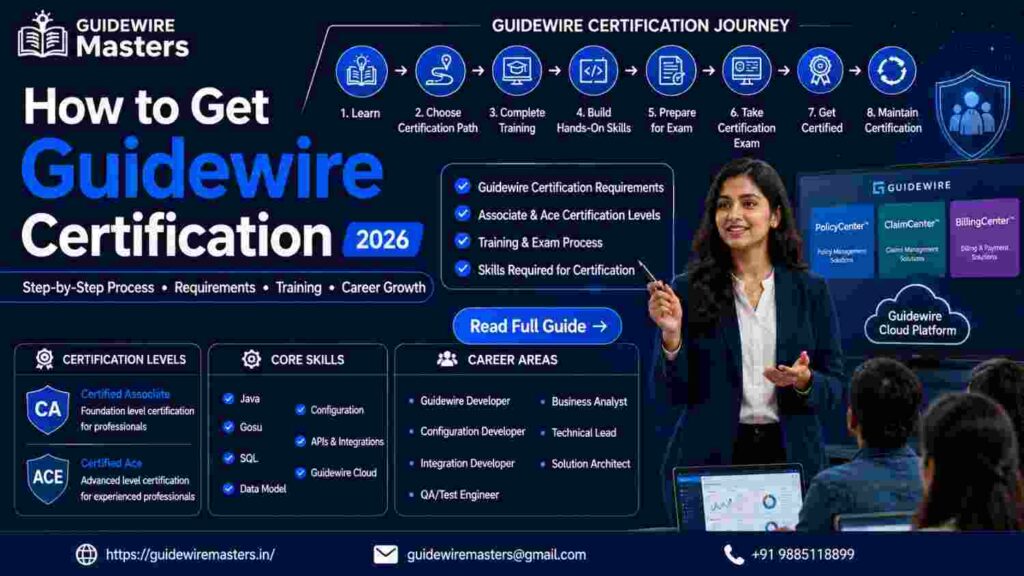
If you work anywhere near property and casualty (P&C) insurance technology, you have heard the same advice repeated: get Guidewire certified. What is rarely explained clearly is how the process actually works, who is eligible, and what happens after you pass.
Guidewire Software is the core platform that a large share of the world’s P&C insurers use to sell policies, process claims, and manage billing. More than 570 insurers in 43 countries rely on Guidewire products, supported by 1,700+ successful implementation projects. Those implementations are delivered by carriers, system integrators, and consulting partners — which is where most Guidewire jobs sit.
A Guidewire Certification is not a training completion certificate from a coaching institute. According to Guidewire’s official certification page for developers, it is official recognition from Guidewire Education that an individual is well prepared to support a cloud implementation, and each certification is tied to a specific role, product track, and release. That distinction matters enormously, and it is the single most misunderstood point in this topic.
Understanding how to get Guidewire Certification before you start studying will save you months. It tells you which product track to choose, which skills to build first, and — importantly — why the certification exam itself is usually the last step in a longer career sequence, not the first.
This guide covers the current certification structure, the realistic path for freshers and experienced developers, the skills that actually get tested, what the credential is worth in the Indian market, and the mistakes that waste people’s time.
What is Guidewire Certification?
Guidewire Certification is a formal credential awarded by Guidewire Education after a candidate completes a defined curriculum and passes a proctored exam for a specific role and product track.
Its purpose is practical rather than academic. Certification is required for all professionals working on Guidewire Cloud implementations, including but not limited to developers — a requirement set out in Guidewire’s Cloud Standard GW-CMP-1178. In other words, the credential exists primarily so that implementation teams meet a competency bar before touching a live insurer’s core system.
Learning Guidewire and being Guidewire certified are two different things:
Learning Guidewire | Guidewire Certification | |
Who issues it | Any training provider | Guidewire Education only |
What it proves | You studied the concepts | You passed an official proctored exam for a role, product, and release |
Access | Open to anyone | Enrolled through an organisation’s Training Coordinator |
Expiry | None | Must be maintained per release |
Both matter. Training builds the skill; certification validates it in a form employers and Guidewire itself recognise.
How to Get Guidewire Certification The Step-by-Step Process
Guidewire’s own summary of the process is short: build the skills, then validate them. The official path has three stages — training, testing, and maintenance. Here is the full journey, including the career steps that sit around those three stages.
Step 1 — Understand the Guidewire ecosystem. Learn what InsuranceSuite is, how PolicyCenter, ClaimCenter, and BillingCenter relate to each other — a structured Guidewire tutorial for beginners is the fastest way to build this map — and how Guidewire Cloud Platform changed the delivery model. Without this map, product choices are guesswork.
Step 2 — Choose your specialisation. Certification is role-based, not generic. Decide whether you are heading toward core configuration, cloud integration, digital (Jutro), testing, or analysis.
Step 3 — Learn insurance domain fundamentals. Policy lifecycle, underwriting, endorsements, renewals, FNOL, reserves, settlements, premium billing, and delinquency. Candidates who skip this struggle badly later, because Guidewire’s data model is a direct expression of insurance concepts.
Step 4 — Learn the product and its technical stack. Gosu, the data and product model, PCF screens, business rules, batch processes, and the relevant integration patterns.
Step 5 — Build practical skills. Configuration exercises, API calls, debugging, and reading real logs. Hands-on repetition is what separates people who pass from people who memorise, and it is the core of any realistic plan for how to become a Guidewire professional.
Step 6 — Complete the required curriculum. Guidewire Education offers instructor-led training and self-paced learning through a free LearningPass subscription, organised by role and aligned to each certification pathway.
Step 7 — Study the official certification objectives. Guidewire publishes exam guides for preparation best practices — read the guide for your specific track rather than a generic syllabus.
Step 8 — Practise with realistic scenarios. Work through problems the way a project would present them: a change request, a defect, an integration failure.
Step 9 — Get enrolled and take the exam. Once you have completed the recommended training, you contact your designated Training Coordinator to be enrolled in an exam. Associate and Ace exams are delivered online through the Guidewire Education portal as remotely proctored exams, with results typically available within a few business days.
Step 10 — Maintain the certification. Guidewire enforces an N-3 policy — you stay within three releases by completing “New Features” eLearning courses and knowledge checks. Fall behind N-3 and you must retake the proctored exams.
Step 11 — Keep extending. Cloud Credentials and release badges let you demonstrate depth in specific Guidewire Cloud capabilities beyond the core certification.
An important eligibility reality check
The step most guides omit: you enroll through a Training Coordinator, which normally means through an employer. Guidewire certification is built around implementation teams at carriers, Partner Connect partners, and Guidewire itself. Independent learners generally cannot walk in and buy a proctored exam seat the way you can with a cloud vendor certification.
For most people in India, the honest sequence is therefore: learn the skills → get hired onto a Guidewire project → certify with employer sponsorship. Guidewire’s own certification FAQ addresses affiliation, prerequisites, and cost directly — check it at Guidewire Education before assuming otherwise, since program terms change.
This is also why Guidewire certification training and the certification itself are not the same purchase. Structured Guidewire Training in Hyderabad exists to make you employable on a Guidewire project; the employer then sponsors the exam. Anyone promising to sell you the certification directly is describing something Guidewire does not offer.
Guidewire Certification Path Which Track Should You Choose?
Certifications are organised into role-based pathways, and Guidewire’s guidance is to choose a primary path based on where you spend most of your project time. The current developer-side pathways are:
Pathway | Who it fits | Certification levels |
InsuranceSuite Configuration / Core Developer | Full-stack developers on core configuration and product model changes, and test automation specialists in PolicyCenter, BillingCenter, or ClaimCenter | Certified Associate – InsuranceSuite Developer; Certified Ace – InsuranceSuite Developer (per product track) |
InsuranceSuite Cloud Integration Developer | Developers handling external system integrations on Guidewire Cloud — REST/API, Integration Gateway flows, event-driven integrations | Certified Associate – InsuranceSuite Developer, then Certified Ace – Cloud Integration |
Jutro Digital Experience Developer | Developers building digital experiences on the Jutro Digital Platform and integrating them with InsuranceSuite via the Digital SDK | Certified Associate – Jutro Developer; Ace level coming soon |
Data & Analytics / BI / ETL | Reporting and data engineers | No Data and Analytics certification is offered currently — courses remain available |
Guidewire has also offered Certified Associate and Certified Ace designations for business analysts and quality analysts, which partners need in order to achieve Guidewire Cloud specialisations.
How beginners should decide compare the day-to-day work in each track through our breakdown of Guidewire job roles and responsibilities before committing. If you enjoy building screens, rules, and product models, go core configuration. If you like APIs, messaging, and systems talking to each other, go cloud integration. If you come from React/TypeScript, Jutro is the shortest bridge. If you are strong on process and requirements rather than code, the analyst track fits better.
Guidewire PolicyCenter Certification
PolicyCenter is the policy administration application in InsuranceSuite — it handles submissions, quoting, underwriting, issuance, endorsements, cancellations, reinstatements, and renewals.
Professionals building PolicyCenter expertise typically work across:
- Product model — lines of business, coverages, coverage terms, and how rating hooks in
- Data model — entities, extensions, typelists, and relationships
- Configuration — PCF screens, validation and underwriting rules, jobs and workflows
- Gosu — the language used for rules, enhancements, and business logic
- Integrations — rating engines, document generation, third-party data services
- Testing — automation around policy transactions
- Cloud — configuration within Guidewire Cloud guardrails
Working through a Guidewire PolicyCenter step-by-step tutorial is the practical way to internalise these areas. PolicyCenter suits people who like modelling business logic. It is the most commonly implemented starting point on many programmes, and product-model knowledge transfers well into architecture roles later.
Guidewire Policy Center
PolicyCenter is the system of record for what an insurer has agreed to cover, for whom, at what price, over what period. It handles the full set of policy transactions — submission, quote, issuance, endorsement, cancellation, reinstatement, renewal and rewrite — each a distinct transaction type with its own rules, validation and financial consequences.
PolicyCenter is also where the product model lives: the structured definition of lines of business, coverages, terms and their relationships. Understanding it is the difference between a configurator and someone who genuinely understands PolicyCenter. Our PolicyCenter implementation guide covers this in depth.
Guidewire ClaimCenter Certification
Guidewire ClaimCenter manages the claims management process end to end: First Notice of Loss, claim registration and assignment, coverage verification, exposures, reserves, payments, recovery, litigation tracking, and closure.
Core knowledge areas include the claim data model, assignment and segmentation rules, financial transactions (reserves, checks, recoveries), workflow and activity patterns, Gosu rules, integrations with payment and document systems, testing, and cloud operating practices.
ClaimCenter expertise is valuable because claims is where insurers feel operational pain most directly — cycle time, leakage, and fraud. Claims projects also tend to be long-running, which means sustained demand for support, enhancement, and migration work rather than one-off builds.
Guidewire BillingCenter Certification
BillingCenter handles the money side: accounts and policy periods, payment plans and instalments, invoicing, payment allocation, disbursements, commissions, delinquency and write-offs, and the general ledger interface.
Because BillingCenter is financially sensitive, the work rewards precision. Key areas are the billing data model, financial transaction handling, plan configuration, Gosu logic, and integrations with payment gateways, banks, and finance systems.
BillingCenter suits professionals with an accounting or finance-systems instinct, and specialists are comparatively scarce — which is often an advantage when staffing decisions are made.
Guidewire Cloud Certification
Guidewire Cloud is now the center of gravity for the entire ecosystem, and certification is explicitly framed around cloud readiness. Relevant knowledge includes:
- Guidewire Cloud Platform and cloud-delivered Insurance Suite
- SaaS operating model and configuration guardrails
- Cloud migration from legacy on-premise deployments
- API-first development and event-driven Guidewire integration patterns
- DevOps and CI/CD pipelines
- Cloud operations, monitoring, and observability
Why it matters: Guidewire’s CEO described insurers as focused on modernising core systems, migrating critical business functions to cloud platform solutions, and adopting AI across applications — and cloud migration is precisely where a large share of current project demand sits. On-premise-only skills are depreciating assets; cloud skills are the appreciating ones.
Guidewire Certification Requirements
Guidewire keeps formal academic prerequisites light, but the practical requirements are real. Before pursuing certification, you should generally have:
- Guidewire product knowledge in your chosen track
- Insurance domain fundamentals for P&C
- Programming fundamentals — object-oriented thinking
- Gosu — the Insurance Suite language (Java-like, statically typed)
- Java fundamentals — the closest transferable base
- SQL — for data model work and defect investigation
- APIs and integration concepts — REST, SOAP, JSON, XML, messaging
- Development or project exposure — increasingly important at Ace level
At Associate level, the requirement is to complete the required base and platform curriculum and pass the proctored Associate exam. At Ace level, you must hold the relevant Associate certification, complete advanced product-specific courses, complete any required proficiency exercises, and pass the Ace proctored exam.
Official eligibility varies by certification, role, and release. Confirm the current requirements through Guidewire Education or your organisation Training Coordinator rather than relying on any third-party article — including this one.
Who Should Get Guidewire Certification?
Guidewire states that certification applies if your work touches Guidewire requirements, code, configuration, integration, testing, or cloud infrastructure — including developers and configuration specialists, integration and migration engineers, digital teams working with Jutro, and technical architects responsible for platform decisions.
In practice, these profiles benefit most:
Background | Transition difficulty | Why |
Java developer | Easiest | Gosu is Java-adjacent; OOP and API skills transfer directly |
.NET / other OOP developer | Easy | Same reasoning; syntax is a short adjustment |
QA / automation engineer | Moderate | Test automation is an explicit Guidewire track |
Business analyst (insurance) | Moderate | Domain knowledge already present; needs product depth |
Fresher (CS/IT graduate) | Harder | Must build both programming and domain foundations, and needs an employer route to the exam |
Non-IT insurance professional | Harder | Strong domain, but technical fundamentals take time |
If you are weighing which of these routes fits you, our guide to the Guidewire developer career path sets out what each role actually demands.
Skills Required for Guidewire Certification
The full picture is covered in our guide to the Guidewire skills that matter most at each career stage. In summary:
Essential for beginners: Insurance domain basics, Java fundamentals, Gosu, Guidewire Studio, data and entity model, type lists, PCF configuration basics, SQL.
Essential at intermediate level: Business rules, workflows and jobs, batch processes, REST and SOAP APIs, JSON and XML, the integration framework and messaging, debugging and logging.
Valuable at advanced level: Guidewire Cloud Platform, CI/CD and DevOps fundamentals, performance tuning, data migration, event-driven patterns, and solution design across PolicyCenter, ClaimCenter, and BillingCenter.
A useful rule from real projects: the people who progress fastest are not the strongest coders — they are the ones who can explain why the business needs a change before they build it.
Guidewire Certification Exam Preparation
Step 1 — Understand the certification objectives. Start from the official exam guide for your track. Studying without it means optimising for the wrong content.
Step 2 — Learn the fundamentals properly. Insurance concepts, Guidewire architecture, product fundamentals, configuration, data model, and integrations, in that order.
Step 3 — Practise hands-on wherever access is legitimately available — through your employer’s environment, official Guidewire Education labs, or hands-on Guidewire training with licensed lab access.
Step 4 — Review weak areas deliberately. Write down every concept you could not explain out loud, and close those gaps before moving on.
Step 5 — Use reliable resources only: official Guidewire documentation (docs.guidewire.com), Guidewire Education courses and exam guides, structured training programmes, and real project experience.
A firm warning: do not use exam dumps, leaked question banks, or “guaranteed pass” material. Proctored exams are monitored, the material violates Guidewire’s terms, and it produces professionals who cannot function on a real project — which is a far more expensive problem than a failed exam.
How Long Does It Take to Get Guidewire Certification?
Timelines depend on prior IT experience, Java knowledge, insurance domain familiarity, existing Guidewire exposure, product track, daily study hours, and access to hands-on practice.
Guidewire’s own planning guidance is to define your training plan at least 60 days before project kickoff, and it notes that new developers can become a Certified Associate in 2–3 weeks of course preparation. That figure assumes a developer already working in a project context with structured training — not a fresher starting from zero.
Starting point | Realistic learning timeline to Associate-level readiness |
Fresher (no IT experience) | 5–8 months of consistent study, including Java and insurance fundamentals |
Developer with Java experience | 2–4 months |
Professional already working on Guidewire projects | 2–3 weeks of focused course preparation, per Guidewire’s guidance |
These are learning estimates, not guaranteed certification timelines. Exam scheduling depends on your organisation’s Training Coordinator and internal training plan.
Guidewire Certification Cost
his is where most online articles invent numbers. Here is what can actually be verified:
- Self-paced learning is available through a free LearningPass subscription.
- In October 2025, Guidewire removed the fees for all of its e-learning education courses for PartnerConnect partners, to help partners grow their pool of certified analysts and developers.
- Guidewire’s certification FAQ includes a direct question on whether earning a certification or credential costs money — read the current answer at source.
Costs you should still plan for: instructor-led training where your organisation uses it, third-party preparatory training if you are self-funding your skills, retake fees where applicable, and your own time. Many employers sponsor certification because partner specialisations depend on certified headcount.
Do not trust any site quoting exact Guidewire exam prices without an official source — pricing structures differ by organisation, region, and program terms, and they change.
Guidewire Certification Benefits
Guidewire positions certification as a portable, stackable career asset that provides verifiable skills, positions you for lead roles, and makes it easier to be staffed on Guidewire projects. Guidewire also publishes vendor-reported outcome figures for certified teams: an 85% increase in project acceleration, a 130% improvement in implementation quality, and a 75% reduction in avoidable support cases. (These are Guidewire’s own figures for organisations, not independent research, and not individual outcomes.)
Realistic individual benefits:
- Validates product knowledge against an official standard
- Strengthens technical credibility with employers and clients
- Signals a clear specialisation rather than generic experience
- Improves internal visibility when projects are staffed
- Supports international opportunity, since the credential is recognised across the global Guidewire network
- Forces structured learning and closes silent knowledge gaps
Certification does not guarantee a job, an interview, or a salary increase. It removes a barrier; it does not replace capability.
Guidewire Certification in India
India is one of the largest delivery bases for Guidewire work. Global insurers and system integrators run large Guidewire practices from Hyderabad, Bengaluru, Pune, Chennai, and Mumbai, covering greenfield implementations, support and maintenance, and cloud migrations.
Two market signals are worth knowing:
- Guidewire has hosted its annual Developer Summit in Bangalore, which the company described as activating the industry’s largest developer ecosystem — a direct indication of where the platform’s engineering talent base sits.
- India’s non-life insurance market continues to expand and digitise, as tracked in India’s insurance sector data published by IBEF. Gross direct premium underwritten by non-life insurers grew 6.20% year-on-year in FY25 to ₹3.08 trillion, and non-life premiums rose 8.85% year-on-year to ₹79,306 crore in Q1 FY26.
Our overview of the Guidewire software career landscape in India covers where these roles concentrate. For candidates in India, the practical implication is that certification is most achievable after you join a carrier or partner. Structured training in Hyderabad or elsewhere gets you employable; the employer route gets you certified.
Guidewire Certification Career Opportunities
Role | Core responsibility | Skill progression |
Guidewire Developer | Build and modify application functionality | Gosu, data model, PCF, rules |
Configuration Developer | Product model, screens, business rules | Deep product knowledge per centre |
Integration Developer | REST/SOAP APIs, messaging, event flows | Integration Gateway, cloud APIs |
QA / Test Engineer | Functional and automated testing | Test automation frameworks, domain scenarios |
Business Analyst | Requirements, process design, UAT | Insurance domain plus product fluency |
Technical Lead | Design reviews, code quality, mentoring | Cross-module design, delivery ownership |
Technical Architect | System design, performance, standards | Data modelling, integration architecture |
Solution Architect | End-to-end solution across products | Business process plus platform strategy |
Cloud Engineer | CI/CD, environments, observability | DevOps plus Guidewire Cloud operations |
Guidewire Consultant | Advisory and implementation delivery | Domain, product, and stakeholder skills |
For a role-specific deep dive, see our Guidewire PolicyCenter jobs career guide.
Guidewire Certification Salary in India
The table below gives indicative ranges based on publicly reported market data, and is consistent with our detailed breakdown of Guidewire salaries in India. Guidewire roles are a narrow, specialised market with wide variance and small reported sample sizes, so treat these as reference points rather than benchmarks.
Experience Level | Typical Role | Indicative Salary Range |
0–2 years | Junior Guidewire Professional | ₹4–7 LPA |
3–5 years | Guidewire Developer | ₹8–15 LPA |
6–10 years | Senior Guidewire Professional | ₹15–25 LPA |
10+ years | Architect / Technical Lead | ₹25–45+ LPA |
For context, Glassdoor reported an average Guidewire Developer salary in India of about ₹7.96 lakh per year as of July 2026, with a typical range between roughly ₹4.43 lakh (25th percentile) and ₹14.98 lakh (75th percentile), based on 53 anonymously submitted salaries. Self-reported salary datasets skew by who chooses to report, so cross-check against live job postings for your city.
Actual compensation depends on experience, product specialisation, cloud exposure, certification status, employer tier, location, project complexity, and interview performance. No article can promise a package.
Guidewire Certification vs Guidewire Training
Factor | Guidewire Training | Guidewire Certification |
Purpose | Build skills and understanding | Validate skills against an official standard |
Learning focus | Concepts, configuration, hands-on practice | Defined exam objectives per role and release |
Practical skills | Where they are actually developed | Assumed as a prerequisite |
Validation | Provider-issued, not officially recognised | Issued by Guidewire Education, recognised across the ecosystem |
Career value | Gets you employable and interview-ready | Gets you staffed and credible on projects |
Best for | Beginners, career changers, upskillers | Professionals on or joining Guidewire Cloud projects |
They are complementary. Training without certification limits recognition; certification without genuine hands-on capability collapses in the first sprint.
Guidewire Certification vs Guidewire Experience
Employers evaluate both, and they weight them differently by role.
Experience demonstrates things an exam cannot: configuring against ambiguous requirements, integration failures at 2 a.m., production support under pressure, debugging a rule nobody documented, performance tuning a batch process, testing edge cases in real insurance workflows, and surviving a cloud migration.
Certification demonstrates that your knowledge is current, standardised, and complete rather than shaped only by the one project you happened to work on. It also carries commercial weight: certified headcount is what partners need for specialisations and staffing.
The strongest profile is both — and if you have to pick an order, build the experience that makes certification meaningful.
Guidewire Certification Career Path
Level | Focus | Skills |
Beginner | Fundamentals | Insurance basics + Guidewire architecture + Java/Gosu basics |
Intermediate | Product expertise | PolicyCenter / ClaimCenter / BillingCenter configuration |
Advanced | Technical expertise | Gosu depth, data model, integrations, testing, debugging |
Expert | Architecture | Cloud platform, integration architecture, design leadership |
Progression is usually product depth first, then breadth across centres, then architecture. The jump from developer to architect is rarely about writing more code — it is about being able to defend a design decision to both an underwriter and a CTO.
Top Companies Hiring Guidewire Professionals
Guidewire work in India flows largely through consulting and IT services firms, including Accenture, Cognizant, Capgemini, Infosys, Wipro, TCS, Deloitte, EY, PwC, and LTIMindtree, alongside insurers and specialist boutiques.
Why these firms hire heavily: they are the implementation partners. Guidewire PartnerConnect consulting practices worldwide include more than 18,900 consultants trained or experienced in Guidewire products, and Guidewire’s cloud certifications are required for partners to achieve Guidewire Cloud specialisations. Certified headcount is directly tied to a partner’s ability to win and staff work.
Typical demand areas are implementation, configuration, integration, testing, cloud migration, production support, and technical leadership.
Company hiring needs change constantly — verify current openings on the companies’ own career sites rather than assuming any specific role is open.
Guidewire Certification and Cloud Migration
Cloud migration is the reason the certification program tightened. Moving from a heavily customised on-premise deployment to Guidewire Cloud changes how teams work, as our note on Guidewire implementation strategies sets out: configuration must respect cloud guardrails, integrations shift to APIs and events, releases run through CI/CD, and operations depend on monitoring and observability rather than server access.
That is exactly why certification is required for all professionals working on Guidewire Cloud implementations and why the N-3 maintenance policy exists — a credential earned three releases ago no longer describes the platform your team is running on.
The takeaway for your career: treat certification as a subscription to staying current, not a trophy.
Common Mistakes to Avoid When Preparing for Guidewire Certification
Mistake | Fix |
Studying only theory | Pair every concept with a hands-on exercise |
Ignoring insurance fundamentals | Learn the policy and claims lifecycle before the product |
Memorising instead of understanding | Explain each concept aloud without notes |
Skipping hands-on practice | Use legitimate lab access; build small end-to-end scenarios |
Ignoring the data model | Trace entities and typelists for every feature you build |
Ignoring integrations | Practise REST/SOAP calls and message handling explicitly |
Learning only one module | Add working familiarity with a second centre |
Using outdated resources | Check the release your material targets |
Relying on exam dumps | Use official exam guides and documentation only |
Not reading certification objectives | Start from the official guide for your track |
Ignoring cloud concepts | Learn CI/CD, APIs, and cloud operations basics |
No project knowledge | Build a realistic end-to-end scenario you can narrate in an interview |
How to Prepare for Guidewire Certification as a Fresher
- Learn Java fundamentals — OOP, collections, exceptions, basic design.
- Learn P&C insurance basics — policy, premium, underwriting, claim, reserve, billing.
- Learn Guidewire fundamentals — InsuranceSuite architecture and terminology.
- Choose one product to go deep on.
- Learn Gosu.
- Learn the data and entity model, including typelists.
- Learn configuration — PCF screens, rules, workflows.
- Study integration basics — REST, SOAP, JSON, XML, messaging.
- Practise, repeatedly, on realistic scenarios.
- Build a project narrative you can defend in an interview — rehearse it against real Guidewire interview questions.
- Target a Guidewire role at a carrier or partner.
- Follow official Guidewire certification guidance and certify with employer sponsorship.
The order matters: for a fresher, employment usually comes before certification, not after.
How to Prepare for Guidewire Certification as an Experienced Developer
Java, .NET, and other OOP developers transition well because the transferable skills are substantial: object-oriented design, SQL, API integration, debugging discipline, version control, and delivery habits.
The gap to close is domain and product, in this sequence: insurance fundamentals → Gosu and Guidewire Studio → data model → configuration → integration framework → cloud platform and DevOps. Testers should focus on the test automation track; frontend developers with React and TypeScript should look hard at Jutro.
Experienced professionals also have the shortest realistic route to certification, because once you are staffed on a project, the Associate level is reachable in a matter of weeks of course preparation.
Future Scope of Guidewire Certification
The direction of travel is clear from Guidewire’s own results and commentary. Third-quarter fiscal 2026 revenue reached $372.5 million, up 27% year-on-year, with subscription and support revenue up 35%. Annual recurring revenue stood at $1,147 million as of April 30, 2026, and the company attributed momentum to insurers modernising core systems, migrating to cloud platform solutions, and adopting AI across applications.
Trends worth tracking as a professional: cloud-native core platforms, API-first and event-driven architecture, AI and analytics embedded in claims and underwriting, automation of routine processing, data-driven pricing, and digital customer experiences.
Future-proofing means adding cloud and integration depth, keeping certifications inside the N-3 window, and understanding insurance well enough that AI tooling amplifies your judgement rather than replacing your task.
Statistics and Market Trends
Verified statistics (with sources):
- More than 570 insurers in 43 countries use Guidewire products, with 1,700+ successful implementation projects. (Guidewire, May 2026)
- Q3 FY2026 total revenue: $372.5 million, up 27% year-on-year, per Guidewire’s Q3 FY2026 results. (Guidewire, June 2026)
- ARR of $1,147 million as of April 30, 2026. (Guidewire, June 2026)
- Guidewire surpassed $1 billion in ARR in fiscal 2025, closing the year with 19 cloud deals in Q4. (Guidewire, September 2025)
- Guidewire PartnerConnect consulting practices include 18,900+ consultants trained or experienced in Guidewire products. (Guidewire PartnerConnect)
- Guidewire eliminated e-learning course fees for PartnerConnect partners in October 2025. (Guidewire, October 2025)
- India’s non-life insurers underwrote ₹3.08 trillion in gross direct premium in FY25, up 6.20% year-on-year.
- Non-life premiums grew 8.85% year-on-year to ₹79,306 crore in Q1 FY26.
Vendor-reported outcome claims (Guidewire’s own figures, not independent research): 85% increase in project acceleration, 130% improvement in implementation quality, and 75% reduction in avoidable support cases for certified teams.
Reasonable interpretation (clearly labelled as such): sustained double-digit growth in Guidewire’s cloud subscription revenue implies continued demand for cloud-certified implementation talent, and India’s position as a major delivery hub means a meaningful share of that work is staffed from Indian technology centres. This is an inference from the data above, not a published employment statistic.
Conclusion
How to get Guidewire Certification comes down to a sequence that most people attempt in the wrong order: understand the ecosystem, choose a role-based pathway, build genuine insurance and technical skills, complete the official curriculum, take the proctored exam through your organisation’s Training Coordinator, and then keep the credential current with every release.
The credential itself validates what you can already do. The value sits in the underlying capability — PolicyCenter product models, ClaimCenter financial transactions, BillingCenter payment logic, Gosu, the data model, integration patterns, and Guidewire Cloud practices. That combination is what makes someone useful on an implementation, and it is what opens doors to developer, integration, architecture, and consulting roles across India’s insurance technology sector and internationally.
If you are starting out, focus on becoming employable on a Guidewire project first, because that is normally the route to the exam. Build the fundamentals, get hands-on with a real product track, and treat certification as the checkpoint that confirms you are current — not as a shortcut past the learning. Explore structured Guidewire training in Hyderabad, verify the latest requirements at Guidewire Education, and start building the depth that a long career in insurance technology rewards.
Frequently Asked Questions
- What is Guidewire Certification?
Guidewire Certification is an official credential from Guidewire Education confirming that a professional is prepared to support a Guidewire Cloud implementation. Each certification is tied to a specific role, product track, and release. - How to get Guidewire Certification?
Complete the required role-based training curriculum, then contact your organisation’s designated Training Coordinator to enrol in the remotely proctored exam through the Guidewire Education portal. Afterwards, maintain the certification with each release. - What are the requirements for Guidewire Certification?
For Associate level, you complete the required base and platform curriculum and pass the proctored exam. For Ace level, you hold the relevant Associate certification, complete advanced product-specific coursework and proficiency exercises, and pass the Ace exam. - How much does Guidewire Certification cost?
Self-paced learning is available through a free LearningPass subscription, and Guidewire removed e-learning fees for PartnerConnect partners in October 2025. Exam and training costs vary by organisation and program terms — confirm current pricing with Guidewire Education. - How long does it take to get Guidewire Certification?
Guidewire notes that new developers can reach Certified Associate in 2–3 weeks of course preparation. Freshers starting from zero typically need several months to build the underlying Java, insurance, and product skills first. - Is Guidewire Certification worth it?
Yes, for professionals working on or joining Guidewire projects — certification is required for Guidewire Cloud implementation teams and is used by partners for staffing and specialisations. It is far less useful as a standalone credential without hands-on skills. - Can a fresher get Guidewire Certification?
Exams are enrolled through an organisation’s Training Coordinator, so freshers usually certify after joining a Guidewire customer or partner. The practical route is to build skills and domain knowledge first, get hired, then certify. - Which Guidewire certification should I choose?
Choose the pathway matching where you will spend project time: InsuranceSuite Configuration/Core Developer for configuration and product model work, Cloud Integration Developer for API and event-driven integration, or Jutro Developer for digital front-end work. - What skills are required for Guidewire Certification?
Insurance domain fundamentals, Gosu, Java basics, SQL, the Guidewire data and product model, PCF configuration, business rules, REST and SOAP APIs, XML and JSON, and Guidewire Cloud concepts. - Does Guidewire Certification help with getting a job?
It strengthens your profile and makes staffing easier, since partners need certified professionals for cloud projects and specialisations. It does not guarantee employment — hands-on capability and interview performance still decide outcomes.

Mrs.Jyosna
GuidewireMasters | 25+ articles published
Guidewire experts passionate about helping learners build successful careers in the insurance IT industry. Through in-depth guides, real-time training, certification support, and industry-focused resources, Guidewire Masters simplifies Guidewire technologies and provides practical knowledge to help students and professionals grow their careers confidently.
Share