Guidewire Skills
Guidewire Skills are the technical, functional, and business capabilities needed to configure, integrate, and deploy Guidewire InsuranceSuite (PolicyCenter, ClaimCenter, BillingCenter) for property and casualty insurers. They matter because Guidewire powers most global P&C carriers, so skilled professionals are scarce and well paid. Learning Guidewire Skills opens high-salary, cloud-focused, globally in-demand careers with strong long-term stability.

- Sanjay
- July 8, 2026
- 5:47 am
Table of Contents
Introduction
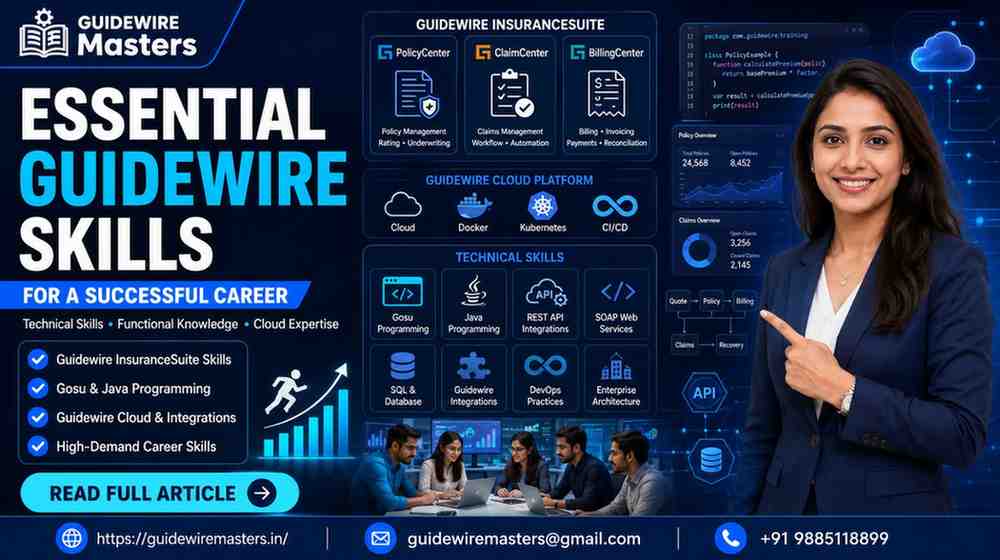
The property and casualty (P&C) insurance industry runs on a small handful of core platforms, and Guidewire sits at the very top of that list. From claims processing to policy underwriting to billing, thousands of insurers worldwide depend on the same software suite every single day. That dependence creates a simple reality: the people who can build, configure, and integrate this software are in constant demand, and Guidewire Skills have become one of the most valuable specializations in enterprise technology.
If you are a Java developer, a fresh graduate, or an insurance professional wondering where the next decade of opportunity lies, this guide walks through exactly what Guidewire Skills are, why companies are hiring so aggressively for them, and how you can build a roadmap from beginner to architect. Before we go deep, it helps to be clear on what is Guidewire as a platform and why it dominates modern insurance technology.
What Are Guidewire Skills?
Guidewire Skills are the complete set of technical, functional, and business capabilities that let a professional design, build, configure, integrate, test, and deploy applications on the Guidewire platform. They are not a single skill but a stack, ranging from the Gosu programming language and the data model at the technical layer, to insurance domain knowledge at the functional layer, to communication and delivery skills at the business layer.
Core Technical Skills :
At the foundation sit programming and platform capabilities Gosu (Guidewire’s native language), Java, SQL, XML, JSON, and the ability to work with the Guidewire data model, PCF configuration, typelists, and business rules. These are the day-to-day tools of a Guidewire developer.
Functional Skills :
Technical ability alone is not enough. Strong Guidewire professionals understand how insurance actually works: policy lifecycles, claims handling, underwriting, rating, billing cycles, and regulatory requirements set by insurance regulators. This domain fluency lets them translate business requirements into correct configuration.
Business Skills :
Finally, delivery-oriented skills, requirement gathering, documentation, client communication, and Agile teamwork, separate a good developer from a trusted consultant. These “soft” Guidewire Skills often determine who gets promoted into lead and architect roles.
Why Guidewire Skills Are in High Demand
Several forces are converging to keep demand for Guidewire Skills high, and all of them are structural rather than temporary:
- Digital transformation: Insurers are replacing legacy systems to compete with insurtech startups, and Guidewire is the platform of choice for that overhaul.
- Insurance modernization: Regulatory change, new products, and customer expectations require constant reconfiguration, which needs skilled hands.
- Guidewire Cloud adoption: The shift from on-premise to Guidewire Cloud Platform has created a whole new category of cloud and DevOps skills demand.
- Growing demand in India: India is now a primary global delivery centre for Guidewire, driving thousands of local openings.
- Global career opportunities: Guidewire Skills travel well, opening onsite and remote roles across the US, UK, Europe, and Australia.
Because the platform is specialized and cannot be self-taught quickly, the talent pool stays smaller than demand, which keeps salaries and job security strong. If you want to understand the long-term shape of this field, our overview of the Guidewire developer career path.
Essential Technical Guidewire Skills
The technical layer is where most learners begin, and it is where employers screen hardest. Here is what a well-rounded technical skill set looks like, and each of these areas is covered in depth in Guidewire course curriculum.
- Gosu Programming: Guidewire’s statically typed, object-oriented language built on the JVM, used for enhancements, rules, and business logic. You can explore the language reference on the Gosu documentation, and our dedicated guide to Gosu programming breaks it down for beginners.
- Java: The underlying platform is Java-based, so understanding Java fundamentals, collections, and OOP concepts is essential.
- SQL: Reading, writing, and tuning queries against the Guidewire database for reporting and troubleshooting.
- XML & JSON: The data formats used throughout configuration, metadata, and integrations.
- REST APIs & SOAP Web Services: The two integration styles Guidewire exposes and consumes.
- Guidewire Data Model: The entity model, relationships, and metadata that define how data is stored.
- PCF Configuration: Page Configuration Format files that control the user interface.
- Typelists & Entity Relationships: Guidewire’s approach to enumerations and data relationships.
- Batch Processes, Work Queues & Messaging: The mechanisms for background processing and asynchronous integration.
- Integration Framework: The plugins, message queues, and gateways that connect Guidewire to external systems.
Guidewire InsuranceSuite Skills
InsuranceSuite is made up of three core applications plus a shared contact system. Mastering the skills specific to each is what makes you employable on real projects.
Guidewire PolicyCenter Skills
PolicyCenter manages the entire policy lifecycle. Key PolicyCenter skills include product configuration, policy transactions (new business, renewal, endorsement, cancellation), rating engine setup, underwriting rules, and the PolicyCenter data model.
Guidewire ClaimCenter Skills
ClaimCenter handles claims from first notice of loss (FNOL) to settlement. Important ClaimCenter skills cover the claims lifecycle, exposure management, reserve handling, recovery and subrogation, and financial transactions. Understanding the end-to-end claims management process makes this configuration far easier to reason about.
Guidewire BillingCenter Skills
BillingCenter manages the money side: billing, invoicing, payment plans, delinquency handling, and agency billing (both direct bill and agency bill models). Strong BillingCenter skills are prized because billing errors directly affect revenue and customer trust.
ContactManager Skills
ContactManager is the shared system for contact management, customer profiles, address management, and integration across the suite. It keeps a single, consistent view of people and organizations across PolicyCenter, ClaimCenter, and BillingCenter.
Guidewire Cloud Skills
The biggest shift in the ecosystem is the move to the Guidewire Cloud Platform (GWCP). Cloud-era projects need a broader skill set than traditional on-premise work, and Guidewire Cloud services guide expands on this in detail. Core Guidewire Cloud Skills include:
- Kubernetes: Container orchestration for scaling and managing Guidewire deployments, documented at kubernetes.io.
- Docker: Containerization of application components; see the Docker platform for fundamentals.
- CI/CD & DevOps: Automated build, test, and release pipelines that the cloud model depends on.
- Cloud Deployment: Working with Guidewire’s cloud tooling and environments.
- Monitoring, Logging & Observability: Keeping cloud deployments healthy and diagnosable.
- Cloud Security: Managing access, secrets, and compliance in a shared cloud environment.
Guidewire Integration Skills
Insurance systems never live alone; they connect to payment gateways, document systems, rating services, and data providers. Integration is therefore one of the highest-value specializations. Key Guidewire Integration Skills include REST APIs, SOAP services, messaging queues, and event-driven architecture built around tools like Apache Kafka. Professionals also work with the Integration Gateway, middleware, and the JSON and XML payloads that flow between systems, and increasingly with the Guidewire Data Hub for analytics-grade data movement.
Guidewire Configuration Skills
Configuration is the everyday craft of Guidewire development, adapting the platform to a carrier’s specific products without heavy custom code. Configuration skills cover PCF files, typelists, display keys, the product model, business rules, validation logic, and workflows. Good configuration developers know when to configure versus when to write Gosu, leaning on the official Guidewire documentation to keep upgrades smooth and cloud-compatible.
Guidewire Data Model Skills
Beneath every screen and rule sits the data model. Skilled professionals understand the entity model, metadata, object-relational mapping (ORM), entity relationships, foreign keys, and overall database architecture, and they know how to tune for performance. These skills become critical at senior and architect levels, and they connect directly to Guidewire architecture decisions on large implementations.
Soft Skills Required for Guidewire Professionals
Technical depth gets you hired; soft skills get you promoted. The most valued non-technical Guidewire Skills are communication, analytical thinking, problem solving, client interaction, clear documentation, comfort with Agile methodology, team collaboration, and, at senior levels, leadership. On consulting projects, the ability to explain a technical trade-off to a business stakeholder is often worth as much as the code itself.
Guidewire Skills Required for Different Job Roles
Different roles emphasize different parts of the skill stack. This table maps the primary focus for each common role, and you can read more about each one in our breakdown of Guidewire job roles and responsibilities.
| Role | Primary Skill Focus |
|---|---|
| Guidewire Developer | Gosu, PCF configuration, data model, basic integrations |
| Senior Developer | Advanced Gosu, performance tuning, mentoring, complex rules |
| Configuration Developer | Product model, PCF, typelists, validation, workflows |
| Integration Developer | REST/SOAP, messaging, Kafka, Integration Gateway, middleware |
| Technical Lead | Design reviews, estimation, code quality, team delivery |
| Solution Architect | End-to-end design, integration strategy, non-functional requirements |
| Cloud Engineer | Kubernetes, Docker, CI/CD, monitoring, cloud security |
| Guidewire Architect | Platform strategy, data architecture, cloud migration, governance |
Guidewire Skills Roadmap
Build your skills in layers. This roadmap shows a sensible progression from your first day to expert-level mastery.
| Level | Skills to Master |
|---|---|
| Beginner | Insurance fundamentals, Java basics, SQL, XML/JSON, Guidewire overview and navigation |
| Intermediate | Gosu programming, PCF configuration, data model, typelists, business rules, PolicyCenter or ClaimCenter basics |
| Advanced | Integrations (REST/SOAP/messaging), batch processes, work queues, performance tuning, multi-app knowledge |
| Expert | Guidewire Cloud, Kubernetes, DevOps, solution and data architecture, cloud migration, technical leadership |

Guidewire Skills for Freshers
Freshers often assume Guidewire is out of reach without experience, but a clear path exists. Start with insurance fundamentals and Java basics, then move into Gosu and PolicyCenter or ClaimCenter configuration. Reinforce learning with practice projects, pursue a Guidewire certification to signal competence, and build a small portfolio of configuration work you can demonstrate in interviews. A structured Guidewire training program compresses this journey and adds the mentoring that self-study lacks.
Guidewire Skills for Experienced Professionals
Experienced professionals can transition into Guidewire from adjacent backgrounds and often command strong salaries quickly:
- From Java: Your OOP and JVM knowledge transfers directly; you mainly need Gosu, the data model, and insurance domain context.
- From Insurance: Domain experts add the technical layer on top of business knowledge they already have, a powerful combination for functional-technical roles.
- Upskilling to Cloud: On-premise Guidewire developers who add Kubernetes, Docker, and DevOps become highly sought after for cloud migrations.
- Architecture & Leadership: Senior professionals can grow into solution and platform architecture, guiding design and mentoring teams.
Top Companies Hiring Guidewire Professionals
Global system integrators (SI partners) drive most Guidewire hiring because they deliver implementations for insurers worldwide. In India, the most active recruiters include:
| Company | Why They Hire Guidewire Talent |
|---|---|
| Accenture | One of the largest Guidewire delivery practices globally |
| Cognizant | Major insurance modernization portfolio across US and Europe |
| Capgemini | Large Guidewire implementation and support teams |
| Infosys | Insurance vertical with growing Guidewire cloud work |
| Wipro | Long-standing P&C insurance client base |
| TCS | Extensive core-transformation programs for carriers |
| Deloitte, EY, PwC | Advisory-led insurance transformation practices |
| LTIMindtree | Dedicated insurance technology and Guidewire capability |
Guidewire Salary Based on Skills in India
Compensation scales sharply with skill depth and cloud capability. The figures below are indicative market ranges for India in 2026 specialists in integration, cloud, and architecture tend to sit at the top of each band. For a fuller breakdown, see our detailed analysis of Guidewire salaries in India.
| Experience | Average Salary (Indicative) |
|---|---|
| Fresher (0–2 Years) | ₹4–7 LPA |
| Mid-Level (3–5 Years) | ₹8–15 LPA |
| Senior (6–10 Years) | ₹16–28 LPA |
| Architect (10+ Years) | ₹30–50+ LPA |
Guidewire Skills vs Java Skills vs Insurance Domain Skills
Guidewire sits at the intersection of software engineering and insurance domain knowledge. This comparison shows how the three career tracks differ, and why the combination is so valuable.
| Dimension | Guidewire Skills | Java Skills | Insurance Domain Skills |
|---|---|---|---|
| Responsibilities | Configure & integrate insurance core systems | Build general-purpose applications | Advise on products, rules, compliance |
| Required Skills | Gosu, PCF, data model, integrations, domain | Java, frameworks, databases, APIs | Underwriting, claims, billing, regulation |
| Technologies | InsuranceSuite, GWCP, Kafka, Kubernetes | Spring, microservices, cloud, SQL | Policy admin concepts, actuarial basics |
| Salary Range (India) | High, niche premium | Moderate to high, broad market | Moderate, role-dependent |
| Career Growth | Developer → Lead → Architect | Developer → Lead → Architect | Analyst → Consultant → SME |
Future Scope of Guidewire Skills
The next phase of the platform is being shaped by cloud and automation. Expect continued Guidewire Cloud adoption, deeper AI integration for claims and underwriting, an API-first architecture, microservices, and event-driven systems, supported by a growing Guidewire Marketplace of ready-built accelerators. Insurance automation and broader digital transformation will keep generating new work. Professionals who extend their Guidewire Cloud and integration skills now will be best positioned for the roles that emerge over the next five years.
How to Learn Guidewire Skills
A structured Guidewire training sequence beats scattered self-study every time. Here is a proven ten-step roadmap:
- Learn insurance fundamentals (P&C basics, policy, claims, billing).
- Learn PolicyCenter configuration and the policy lifecycle.
- Learn ClaimCenter and the claims lifecycle.
- Learn BillingCenter, invoicing, and delinquency handling.
- Learn Gosu programming for rules and enhancements.
- Strengthen your Java foundations.
- Learn integrations (REST, SOAP, messaging, Kafka).
- Learn cloud technologies (Kubernetes, Docker, CI/CD).
- Apply everything through hands-on real-time projects.
- Grow toward the Guidewire Architect role.
Conclusion
Guidewire Skills sit at one of the most durable intersections in enterprise technology, the meeting point of software engineering, cloud infrastructure, and the insurance industry that the modern economy runs on. Because carriers rarely switch platforms and the talent pool stays smaller than demand, professionals who invest in these skills enjoy strong salaries, global mobility, and rare job security. Whether you are a fresher, a Java developer, or an insurance expert, the roadmap is clear: build the technical foundation, add domain knowledge, layer on cloud and integration expertise, and grow toward architecture.
Frequently Asked Questions
1. What are Guidewire Skills?
Guidewire Skills are the technical, functional, and business capabilities needed to configure, integrate, and deploy Guidewire InsuranceSuite for P&C insurers, including Gosu, the data model, PCF configuration, integrations, and insurance domain knowledge.
2. Which Guidewire Skills are most important?
Gosu programming, the Guidewire data model, PCF configuration, and integration skills (REST/SOAP/messaging) are the most in-demand, with cloud skills like Kubernetes and Docker now essential for modern projects.
3. Is Guidewire a good career?
Yes. Guidewire offers high salaries, steady global demand, a limited talent pool, and long-term stability driven by ongoing insurance modernization and cloud migration.
4. What programming language does Guidewire use?
Guidewire uses Gosu, its own statically typed, object-oriented language built on the Java Virtual Machine, alongside Java for platform-level work.
5. Do I need Java for Guidewire?
Java knowledge is highly recommended. Gosu runs on the JVM and shares many concepts with Java, so a solid Java foundation makes learning Guidewire much easier.
6. What are Guidewire Cloud Skills?
Guidewire Cloud Skills include Kubernetes, Docker, CI/CD, DevOps practices, cloud deployment, monitoring, observability, and cloud security for the Guidewire Cloud Platform.
7. Which companies hire Guidewire professionals?
Accenture, Cognizant, Capgemini, Infosys, Wipro, TCS, Deloitte, EY, PwC, and LTIMindtree are among the top recruiters, mostly as SI partners delivering insurer implementations.
8. What is the salary after learning Guidewire Skills?
In India, freshers typically earn ₹4–7 LPA, mid-level professionals ₹8–15 LPA, seniors ₹16–28 LPA, and architects ₹30–50+ LPA, with cloud and integration specialists at the top of each band.
9. How long does it take to learn Guidewire?
With focused study, most learners reach job-ready configuration skills in three to six months, though mastering integrations, cloud, and architecture continues over several years of project work.
10. Can freshers learn Guidewire?
Yes. Freshers can start with insurance fundamentals and Java basics, move into Gosu and configuration, earn a certification, and build a portfolio through practice and real-time projects.

Mrs.jyosna
GuidewireMasters | 25+ articles published
Guidewire experts passionate about helping learners build successful careers in the insurance IT industry. Through in-depth guides, real-time training, certification support, and industry-focused resources, Guidewire Masters simplifies Guidewire technologies and provides practical knowledge to help students and professionals grow their careers confidently.
Share