Guidewire ClaimCenter
Guidewire ClaimCenter is a claims management platform that Property & Casualty (P&C) insurers use to handle the full claim lifecycle—from First Notice of Loss to settlement and closure. It matters because it standardizes and automates claims, cutting cost and cycle time. Professionals should learn it because global demand is high, the talent pool is limited, and salaries in India are among the best in insurance technology.

- Sanjay
- July 3, 2026
- 7:40 am
Table of Contents
Introduction
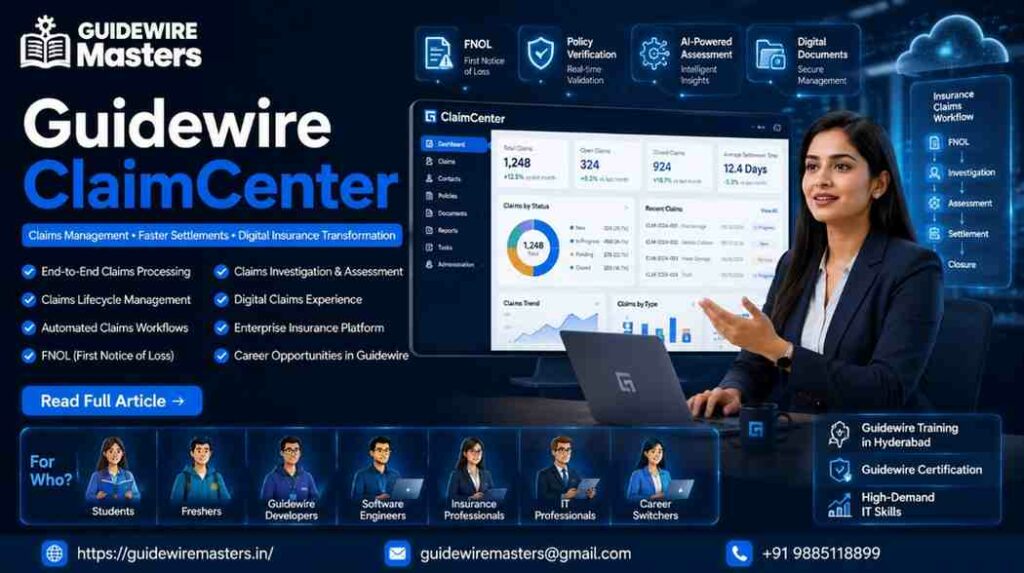
Guidewire ClaimCenter is widely regarded as one of the leading claims management platforms because it replaces slow, paper-heavy legacy systems with a configurable, rules-driven workflow. It improves the complete claims lifecycle by automating routine decisions, enforcing consistent reserving and payment controls, and giving adjusters a single 360-degree view of every claim. That combination of accuracy and speed is exactly why insurers invest heavily in it.
For IT professionals, this creates real opportunity. Guidewire ClaimCenter skills are in high demand precisely because relatively few developers have deep, hands-on experience with the platform. In India, that scarcity translates into strong career opportunities across consulting firms, system integrators, and captive insurance units—with attractive salaries and clear paths into architecture and cloud roles. This guide walks through everything from architecture and modules to salary and a step-by-step roadmap to becoming a ClaimCenter developer.
What is Guidewire ClaimCenter?
Guidewire ClaimCenter is a purpose-built claims management system for the Property & Casualty insurance industry. It is one of the three core applications in the Guidewire InsuranceSuite—alongside PolicyCenter and BillingCenter—and it owns the entire claims side of the business. Its purpose is simple to state and hard to execute well manage every claim accurately, quickly, and consistently from intake to closure.
The platform’s core features include First Notice of Loss capture, automated claim assignment, reserve and financial management, fraud detection support, litigation tracking, and rich reporting. Because it is highly configurable through business rules rather than raw code changes, insurers can tailor it to their products and regulations without rebuilding the system.
In the P&C world, ClaimCenter plays the role of the operational backbone for claims. Benefits for insurers are concrete: faster settlements, lower leakage (money lost to over-payment or fraud), better regulatory compliance, and a consistent customer experience. Understanding this business context is far more valuable than memorizing screens, which is why a good Guidewire tutorial for beginners always starts with insurance fundamentals.
Guidewire ClaimCenter Architecture Overview
ClaimCenter follows a classic multi-tier architecture, which keeps the user experience, business logic, and data cleanly separated. This layering is what makes the platform scalable and maintainable, and it mirrors the broader Guidewire InsuranceSuite architecture used across the product family.
- Presentation Layer: The web-based UI, built from PCF (Page Configuration Files), that adjusters and managers interact with.
- Business Logic Layer: Gosu-based rules, validation, and workflow that drive how claims behave.
- Persistence Layer: The object-relational mapping (ORM) that translates entities into database records.
- Database Layer: The relational database (SQL Server, Oracle, or cloud-managed) storing all claim data.
- Integration Layer: REST and SOAP services connecting ClaimCenter to other systems.
- Messaging Layer: Asynchronous, event-driven communication to other applications and partners.
This separation means a configuration change to a screen rarely disturbs the database, and an integration update rarely breaks business rules—an architecture that rewards developers who understand each tier’s boundaries.
Key Features of Guidewire ClaimCenter
The platform’s feature set maps directly to how a real claim is handled. Here are the capabilities that matter most day to day:
- First Notice of Loss (FNOL): Structured intake of a claim from any channel.
- Claims Registration & Assignment: Automatic routing to the right adjuster based on rules.
- Reserve Management: Setting and adjusting the money held aside for a claim.
- Exposure Management: Tracking each distinct loss or liability within a claim.
- Coverage Verification: Confirming the policy actually covers the loss.
- Financial Transactions & Payment Processing: Issuing and controlling payments.
- Recovery Management: Recovering funds through subrogation or salvage.
- Litigation Management: Handling claims that move into legal disputes.
- Fraud Detection: Flagging suspicious patterns for investigation.
- Reporting & Analytics: Dashboards on cycle time, leakage, and performance.
- Workflow & Activity Automation: Auto-generated tasks that keep claims moving.
Guidewire ClaimCenter Modules
ClaimCenter is organized into functional modules that adjusters use throughout a claim. The table below summarizes each one.
Module | What It Does |
Claims Intake | Captures FNOL and creates the claim record. |
Exposure Management | Tracks individual losses under a single claim. |
Reserve Management | Holds and adjusts estimated claim costs. |
Payments | Manages checks, transfers, and financial controls. |
Recoveries | Handles subrogation and salvage recovery. |
Activities & Workplan | Auto-creates and schedules adjuster tasks. |
Notes & Documents | Stores claim history and attached files. |
Contacts | Links claimants, witnesses, vendors, and experts. |
User Administration | Controls roles, permissions, and security. |
Guidewire ClaimCenter Workflow Explained
The real power of the platform is the claim lifecycle it orchestrates. Understanding this end-to-end flow is essential, and it closely mirrors the wider claims management process that insurers follow. Here is the journey a typical claim takes
In plain terms a loss is reported (FNOL) and a claim is created. ClaimCenter verifies the policy and validates coverage, then assignment rules route the claim to the right adjuster. The adjuster investigates, sets a reserve for expected costs, and issues payments as the claim progresses. Where possible, the insurer pursues recovery (for example, from an at-fault party), the claim is settled, and finally closed. Each step can trigger automated activities so nothing falls through the cracks.
Guidewire ClaimCenter Components
Under the hood, developers work with a well-defined set of components:
- User Interface (PCF): Configurable screens and layouts.
- Gosu Business Rules: The logic that governs claim behavior.
- Entity Model: The data structures (Claim, Exposure, Reserve, etc.).
- Typelists: Controlled dropdown values that keep data consistent.
- Database & Integration Services: Persistence and external connectivity.
- Batch Processes: Scheduled background jobs.
- Security Framework: Role-based permissions.
- Reporting Engine: Operational and management reporting.
Because so much behavior is expressed in Gosu, developers who want to specialize should invest early in Gosu programming fundamentals.

Guidewire ClaimCenter Integration Architecture
No claims platform lives in isolation. ClaimCenter integrates heavily with other systems using an API-first approach. Developers work with REST APIs and SOAP web services, an integration gateway, messaging queues, and increasingly with Apache Kafka for event-driven, asynchronous communication. Payloads typically use JSON for modern REST services and XML for older SOAP interfaces.
Common integration targets include:
- PolicyCenter — to verify policy and coverage details.
- BillingCenter — for premium and financial reconciliation.
- ContactManager — the shared repository of people and organizations.
- External payment systems — to disburse claim payments.
- Document management & fraud detection systems, plus a range of third-party APIs.
ClaimCenter’s tight relationship with Guidewire PolicyCenter is especially important, since accurate coverage validation depends on real-time policy data.
Guidewire ClaimCenter Data Model
Not everything happens in real time. ClaimCenter uses batch processing for high-volume, background work: nightly reserve recalculations, escalations, reminders, and data extracts. These run as scheduled batch jobs feeding work queues, coordinated with messaging so tasks are distributed efficiently. Well-tuned batch processing is central to performance optimization, especially for large insurers handling thousands of claims per day.
Guidewire ClaimCenter Batch Processing
When an insurer moves from a legacy system to Guidewire, data migration is one of the most critical and complex workstreams. Real-time data migration project examples include:
- Legacy System Migration from mainframe or older policy admin platforms.
- Data Mapping between legacy structures and the Guidewire entity model.
- ETL Process design for extract, transform, and load.
- Data Validation, Cleansing, and Conversion Tools to ensure accuracy and completeness.
- Go-live Strategy covering reconciliation, fallback, and cutover sequencing.
Guidewire ClaimCenter in Guidewire Cloud
The industry’s biggest shift is the move to the Guidewire Cloud Platform, a SaaS, cloud-native delivery model. Instead of managing their own servers, insurers consume ClaimCenter as a service. The platform runs on containerized infrastructure using Docker and Kubernetes, with CI/CD pipelines and DevOps practices enabling frequent, safe updates.
Cloud delivery brings built-in logging, monitoring, elastic scalability, high availability, and enterprise-grade security. For developers, this means cloud skills are no longer optional—which is why demand for professionals who understand Guidewire Cloud services and migration keeps climbing.
Guidewire ClaimCenter Roles and Responsibilities
ClaimCenter projects need a mix of specialists. Typical roles include:
- Configuration Developer — builds screens, rules, and data model changes.
- Integration Developer — builds REST/SOAP and messaging integrations.
- Support Engineer — keeps production systems healthy.
- Technical Lead — guides design and reviews code.
- Solution Architect — owns the overall technical solution.
- QA Engineer & Business Analyst — ensure quality and translate business needs.
Guidewire ClaimCenter Market Trends and Statistics
The demand for ClaimCenter skills is not a passing trend—it rests on structural shifts in the insurance industry. Guidewire is consistently ranked among the leading core system vendors for P&C insurers worldwide, and its customer base spans hundreds of insurers across dozens of countries. As those insurers modernize, three forces reinforce each other: growth in the underlying P&C market, a broad push toward insurance digital transformation, and an accelerating migration from on-premise systems to Guidewire Cloud.
The signals below capture why hiring for ClaimCenter professionals in India remains strong.
Trend | What It Means for Careers |
Claims software market growth | Global claims management software spend is rising steadily, keeping platform demand high. |
P&C insurance expansion | A growing Indian insurance market means more claims and more systems to run them. |
Cloud migration wave | Insurers moving to Guidewire Cloud create large, multi-year project pipelines. |
AI adoption in claims | Automation and predictive analytics raise demand for developers who can integrate them. |
Limited talent supply | Few experienced ClaimCenter developers means strong salaries and bargaining power. |
Guidewire ClaimCenter Career Opportunities in India
India is one of the world’s largest delivery hubs for Guidewire work. Global insurers and consulting firms run large ClaimCenter practices out of cities like Hyderabad, Bengaluru, Pune, and Chennai. Opportunities span greenfield implementation projects, support and maintenance engagements, and the fast-growing wave of cloud migration projects moving legacy on-premise systems to Guidewire Cloud.
The demand is anchored in a real market trend: India’s P&C insurance sector, regulated by the IRDAI, continues to expand and digitize, pushing insurers to modernize claims. Learners who complete structured Guidewire Training in Hyderabad are well positioned to enter this pipeline with the right mix of configuration and domain skills.
Top Companies Hiring Guidewire ClaimCenter Professionals
Most hiring flows through large system integrators and consulting firms that partner with insurers on Guidewire programs. Active recruiters include:
- Accenture, Cognizant, Capgemini, and Infosys
- Wipro, TCS, LTIMindtree, and HCLTech
- Deloitte, EY, PwC, and DXC Technology
These firms hire continuously because they run multi-year Guidewire implementation and cloud migration programs for global clients. A single insurer’s ClaimCenter rollout can occupy dozens of developers for years—so consistent project pipelines keep demand high.
Guidewire ClaimCenter Salary in India
Compensation is one of the strongest reasons professionals move into this niche. The scarcity of experienced talent pushes salaries well above generic development roles. The figures below are indicative ranges for 2025–2026.
Experience Level | Average Salary (INR / year) |
Fresher (0–2 years) | ₹4,00,000 – ₹7,00,000 |
Mid-Level (3–5 years) | ₹8,00,000 – ₹15,00,000 |
Senior (6–10 years) | ₹16,00,000 – ₹28,00,000 |
Lead (10+ years) | ₹28,00,000 – ₹40,00,000 |
Solution Architect | ₹35,00,000 – ₹60,00,000+ |
Ranges vary by city, employer, and cloud expertise.
Skills Required to Become a Guidewire ClaimCenter Developer
A strong ClaimCenter developer blends platform, programming, and domain skills:
- Platform: ClaimCenter configuration, PCF, data model, typelists.
- Programming: Gosu, Java, SQL, XML.
- Integration: REST APIs, SOAP APIs, the integration framework, and messaging.
- Cloud & DevOps: Guidewire Cloud, Docker, Kubernetes, CI/CD.
- Domain: Insurance fundamentals, claim processing, and the claims lifecycle.
Domain knowledge is the differentiator most developers underrate—understanding why a reserve or subrogation works the way it does makes configuration decisions obvious. Structured
Guidewire ClaimCenter Career Path
Careers in this space follow a fairly predictable ladder. Use the roadmap below to plan your learning.
Level | Skills to Focus On |
Beginner | Insurance basics, claims lifecycle, ClaimCenter UI, Gosu fundamentals. |
Intermediate | Configuration, business rules, PCF, data model, SQL, basic integrations. |
Advanced | REST/SOAP integrations, messaging, batch, cloud config, performance tuning. |
Expert | Solution architecture, cloud migration, DevOps, and technical leadership. |
Working through real-time ClaimCenter projects is what actually moves you from intermediate to advanced, because it forces you to solve problems textbooks never cover.
Guidewire ClaimCenter vs PolicyCenter vs BillingCenter
These three applications form the InsuranceSuite. They share technology and a data philosophy but own different parts of the business. The comparison below clarifies where each fits.
Aspect | ClaimCenter | PolicyCenter | BillingCenter |
Purpose | Manage claims | Manage policies | Manage billing |
Core Function | FNOL to settlement | Quote, bind, issue | Invoicing, payments |
Primary Users | Adjusters | Underwriters | Billing teams |
Technologies | Gosu, PCF, REST/SOAP, cloud | Gosu, PCF, REST/SOAP, cloud | Gosu, PCF, REST/SOAP, cloud |
Career Demand | Very high | Very high | High |
Growth Potential | Strong (cloud + AI) | Strong | Steady |
All three sit on the same foundation, so learning one makes the others easier—starting from Guidewire InsuranceSuite basics gives you the shared vocabulary quickly.
Why Guidewire ClaimCenter is One of the Best IT Careers in India
A few factors combine to make this a standout career choice. Salaries are high relative to mainstream development roles. Demand is genuinely global, so skills transfer across geographies and often unlock remote opportunities. The wider push of insurance digital transformation—especially cloud migration—guarantees a steady stream of projects. And because the talent pool is limited, experienced professionals enjoy long-term stability and strong bargaining power. overview of the Guidewire developer career explores these dynamics in more depth.
Future Scope of Guidewire ClaimCenter
The platform’s roadmap points firmly toward cloud and intelligence. Expect continued Guidewire Cloud adoption, AI-powered claims automation, and intelligent, straight-through claims processing for simple losses. Predictive analytics and machine learning will increasingly flag fraud and estimate reserves. Architecturally, the direction is API-first, microservices, and event-driven design—so developers who master integrations and cloud will lead the next decade of digital insurance transformation.
Guidewire ClaimCenter Certification
Certification signals credibility to employers. Guidewire’s official credentials—such as the Guidewire Certified Associate (GCA) and role-based Guidewire Certified Developer paths—are managed through Guidewire Education. Combining certification with real project work is the strongest possible profile, and our Guidewire certification guidance maps out which credential fits your goals.
Conclusion
Guidewire ClaimCenter sits at the center of modern Property & Casualty claims, and its importance is only growing as insurers move to the cloud and adopt AI-driven automation. For professionals, that means a rare combination of high demand, limited competition, and strong, stable compensation. The developers who thrive are the ones who pair deep platform configuration skills with genuine insurance domain understanding and hands-on project experience.
If you are serious about building a career in insurance technology, the smartest next step is structured learning followed by real project practice. Explore expert-led Guidewire Training in Hyderabad to master Guidewire ClaimCenter from the ground up, work on real-world claims scenarios, and position yourself for the roles that global insurers are actively hiring for today.
Frequently Asked Questions
1. What is Guidewire ClaimCenter?
Guidewire ClaimCenter is a claims management platform for Property & Casualty insurers that handles the entire claim lifecycle, from First Notice of Loss through investigation, payment, and closure.
2. What is Guidewire ClaimCenter used for?
It is used to register, assign, investigate, reserve, pay, and settle insurance claims consistently and efficiently, while reducing cost, fraud, and cycle time.
3. How does Guidewire ClaimCenter work?
A claim is created at FNOL, the policy and coverage are validated, assignment rules route it to an adjuster, and automated activities guide it through reserving, payment, recovery, and settlement.
4. What are the modules in Guidewire ClaimCenter?
Key modules include Claims Intake, Exposure Management, Reserve Management, Payments, Recoveries, Activities, Notes, Documents, Contacts, and User Administration.
5. Is Guidewire ClaimCenter a good career?
Yes. High demand, a limited talent pool, strong salaries in India, and the ongoing shift to Guidewire Cloud make it one of the most stable and rewarding niches in insurance technology.
6. What skills are required for Guidewire ClaimCenter developers?
Core skills include ClaimCenter configuration, Gosu, Java, SQL, XML, REST and SOAP integrations, messaging, cloud/DevOps tools, and solid insurance domain knowledge.
7. Which companies hire Guidewire ClaimCenter professionals?
Major recruiters include Accenture, Cognizant, Capgemini, Infosys, Wipro, TCS, LTIMindtree, HCLTech, Deloitte, EY, PwC, and DXC Technology.
8. What is the salary of a Guidewire ClaimCenter developer in India?
Freshers typically earn ₹4–7 LPA, mid-level developers ₹8–15 LPA, senior professionals ₹16–28 LPA, and solution architects ₹35 LPA and above.
9. How long does it take to learn Guidewire ClaimCenter?
With focused, structured training, most learners reach job-ready configuration skills in about three to five months, depending on prior programming and domain background.
10. Is Guidewire ClaimCenter the future of insurance claims management?
It is a central part of it. With cloud delivery, AI-assisted automation, and predictive analytics, ClaimCenter continues to define how modern P&C insurers process claims.

Mrs.jyosna
GuidewireMasters | 25+ articles published
Guidewire experts passionate about helping learners build successful careers in the insurance IT industry. Through in-depth guides, real-time training, certification support, and industry-focused resources, Guidewire Masters simplifies Guidewire technologies and provides practical knowledge to help students and professionals grow their careers confidently.
Share