What is Guidewire InsuranceSuite? A Complete Beginner-Friendly Guide
Guidewire InsuranceSuite is the leading cloud-based core software platform for Property & Casualty (P&C) insurers, combining PolicyCenter, ClaimCenter, and BillingCenter to run the full insurance lifecycle. It matters because more than 570 insurers across 43 countries rely on it to modernise operations. Professionals should learn it for high demand, a limited talent pool, and strong salaries — opening roles like Guidewire Developer, Consultant, Integration Developer, and Architect.

- Sanjay
- April 29, 2026
- 11:50 am
Table of Contents
What is Guidewire InsuranceSuite?
Guidewire InsuranceSuite is an integrated suite of core systems built specifically for Property & Casualty insurers. It is the operational engine that handles the three pillars of any insurance business: underwriting and policy administration, claims management, and billing.
Definition: InsuranceSuite is a unified platform that brings together PolicyCenter, ClaimCenter, and BillingCenter — supported by shared services such as ContactManager and a common data and integration layer — so that insurers can run the full policy-to-claim-to-payment lifecycle on one system.
Purpose: The purpose of InsuranceSuite is to replace fragmented, ageing legacy systems with a single modern platform. Many insurers historically ran separate, disconnected applications for each function, which made changes slow, expensive, and risky. InsuranceSuite consolidates those functions and gives carriers the agility to launch products faster and serve customers better.
Core capabilities include:
- End-to-end policy lifecycle management
- Automated claims processing from first notice of loss to settlement
- Flexible billing, invoicing, and collections
- A single source of truth for customer, agent, and vendor data
- Configurable business rules and product definitions
- Built-in analytics, reporting, and digital engagement
By unifying these capabilities, InsuranceSuite helps insurance companies modernise operations without ripping everything out at once. Carriers can configure products, automate manual steps, and connect to a wide ecosystem of partners — all while reducing the operational drag that comes from maintaining old systems.
Components of Guidewire InsuranceSuite
InsuranceSuite is best understood as a set of components that work together. Each handles a distinct part of the insurance business, but they share data and processes so the whole suite behaves as one system.
PolicyCenter — the policy administration system. It manages the entire policy lifecycle: quoting, underwriting, issuance, endorsements (policy changes), and renewals.
ClaimCenter — the claims management system. It handles everything from first notice of loss through investigation, adjustment, and settlement, with strong support for fraud detection and automation.
BillingCenter — the billing and financial system. It manages invoicing, payment processing, collections, commissions, and delinquency.
ContactManager — the centralised contact and relationship system. It maintains a single record for every customer, agent, vendor, and third party referenced across the other applications.
DataHub — an operational data store that aggregates and consolidates information from across the suite, giving insurers a reliable, cleansed source of data for downstream use.
InfoCenter — the analytics and reporting layer that sits on top of DataHub, turning consolidated data into business intelligence, dashboards, and regulatory reports.
A customer record created in ContactManager flows into PolicyCenter when a policy is written. If a claim is filed, ClaimCenter pulls the relevant policy and contact data automatically. BillingCenter handles the premium and any claim-related payments. DataHub and InfoCenter then aggregate all of this activity for reporting and analytics. The result is a connected ecosystem where data does not get re-keyed or lost between systems.
Guidewire InsuranceSuite Architecture Overview
Understanding the architecture helps explain why Guidewire is so flexible and scalable.
System architecture: InsuranceSuite uses a layered, modular design. Each application (PolicyCenter, ClaimCenter, BillingCenter) is configurable and extensible, sharing a common platform foundation rather than being a black box. For a deeper technical walkthrough, see our Guidewire architecture and documentation guide.
Business layer: This is where the insurance logic lives — product definitions, underwriting rules, claims workflows, and validation. Much of it is configured rather than hard-coded, which means insurers can adapt the system to their products without rewriting core software.
Data layer: A structured data model stores policies, claims, billing records, and contacts. Shared services and a consistent data model let the applications exchange information cleanly.
Integration layer: This is how Guidewire talks to the outside world — payment gateways, regulatory bodies, rating engines, document systems, and partner services. It supports modern APIs alongside traditional web services.
Cloud architecture: With the Guidewire Cloud Platform, InsuranceSuite runs as a cloud-native, software-as-a-service offering. This brings elastic infrastructure, managed updates, and built-in operational tooling.
Scalability and performance: Because the platform is cloud-native and modular, it scales to handle the volumes of the world’s largest insurers while remaining configurable for smaller, faster-moving carriers. This balance of scale and flexibility is a major reason Guidewire has 570-plus customers ranging from new ventures to global giants.
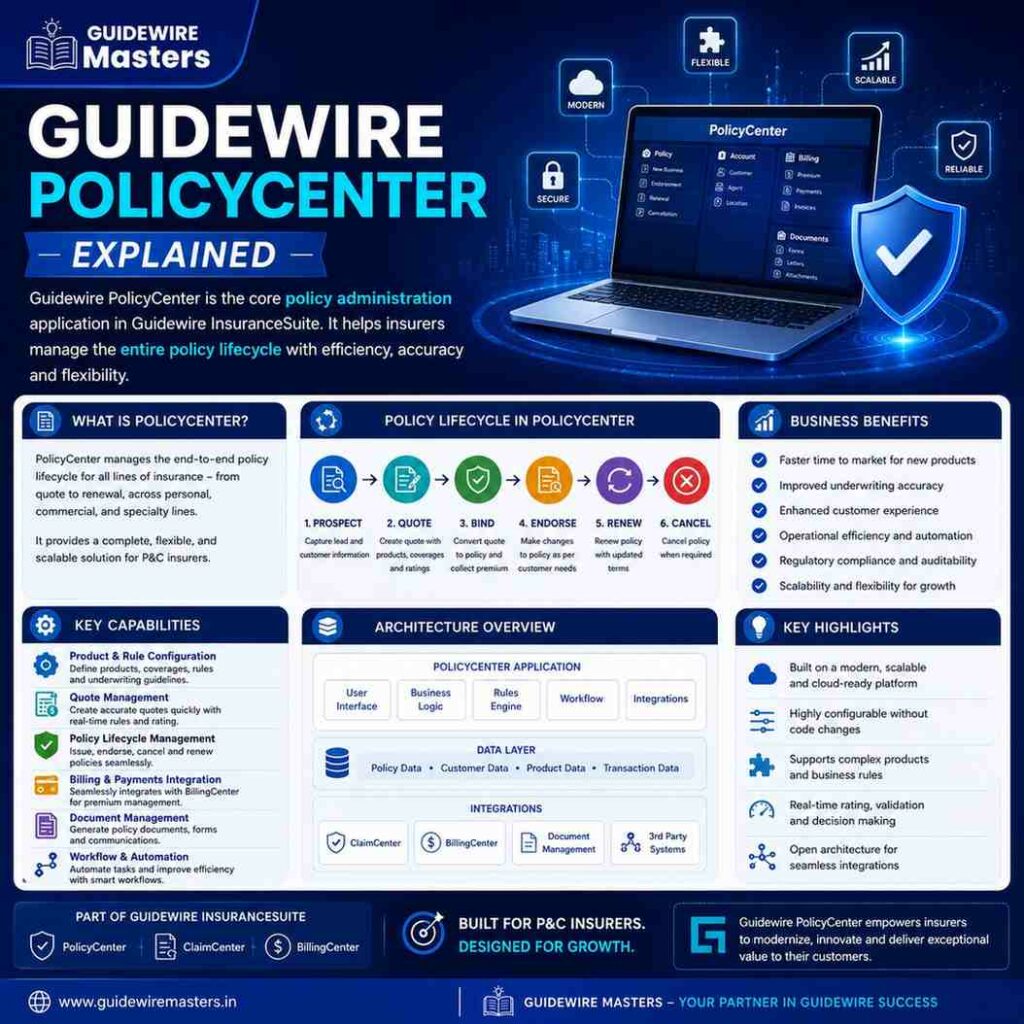
Guidewire PolicyCenter Explained
Guidewire PolicyCenter is the heart of the underwriting and policy administration process. It manages the complete policy lifecycle so insurers can sell and service products efficiently.
- Quoting: Generate accurate quotes quickly using configurable products and ratings.
- Underwriting: Apply automated and manual underwriting rules to assess and price risk consistently.
- Issuance: Issue policies with the correct coverages, terms, and documents.
- Policy changes (endorsements): Handle mid-term changes — adding a vehicle, adjusting coverage — without manual rework.
- Renewals: Automate renewal processing to retain customers and reduce administrative effort.
Customer experience benefits: Faster quoting, fewer errors, and self-service options mean a smoother experience for policyholders and agents alike. For insurers, PolicyCenter shortens speed-to-market for new products, which is a real competitive advantage in a market where rate momentum and competition are intensifying.
Guidewire ClaimCenter Explained
Guidewire ClaimCenter manages the claims lifecycle, which is where insurers most directly affect customer trust and operating costs.
- FNOL (First Notice of Loss): Capture the initial claim report through any channel and start the process immediately.
- Claim investigation: Assign adjusters, gather information, and track the claim through guided workflows.
- Claim settlement: Calculate reserves, issue payments, and close claims accurately.
- Fraud detection: Use rules, scoring, and analytics to flag suspicious claims early.
- Automation: Route, triage, and automate routine claims to free adjusters for complex cases.
Automation benefits: Faster settlements, lower leakage, and better fraud control directly improve the combined ratio — the core profitability metric for P&C insurers. ClaimCenter is increasingly enhanced with AI-driven tools; at Guidewire Connections 2025 the company introduced agentic AI capabilities that embed assistants into claims and underwriting workflows.

Guidewire BillingCenter Explained
Guidewire BillingCenter handles the money side of insurance — a function that is more complex than it sounds, with multiple billing plans, payment schedules, and regulatory requirements.
- Billing operations: Support diverse billing arrangements, from direct bill to agency bill and account-level billing.
- Payment processing: Accept and reconcile payments across channels.
- Invoicing: Generate accurate invoices on flexible schedules.
- Collections: Manage outstanding balances systematically.
- Delinquency management: Automate dunning, cancellations, and reinstatements based on configurable rules.
Financial benefits: Cleaner cash flow, fewer billing errors, and automated collections reduce revenue leakage and administrative cost. Accurate billing also supports compliance and improves the customer relationship — billing disputes are a common source of dissatisfaction, and BillingCenter helps eliminate them.
Guidewire ContactManager Explained
Guidewire ContactManager provides centralised contact management across the entire suite. It is the single source of truth for every person and organisation the insurer deals with.
- Customer data management: One consistent record for each policyholder, used by every application.
- Vendor management: Maintain records for repair shops, medical providers, and other service vendors used in claims.
- Agent management: Manage producers, agencies, and their relationships.
Benefits of a single source of truth: When PolicyCenter, ClaimCenter, and BillingCenter all reference the same contact data, insurers avoid duplicate records, conflicting information, and re-keying. This improves data quality, reporting accuracy, and the overall customer experience — a small policy change updates everywhere it needs to, automatically.
Guidewire Cloud Platform and InsuranceSuite
The biggest shift in Guidewire’s recent history is the move to the Guidewire Cloud Platform (GWCP). InsuranceSuite is now delivered primarily as a cloud-native, software-as-a-service offering rather than software insurers install and maintain themselves.
- SaaS model: Insurers subscribe to the platform, typically priced on the Direct Written Premium (DWP) managed on it, instead of owning and operating the infrastructure.
- Cloud-native capabilities: The platform is built for the cloud, with elastic scaling and managed operations.
- Continuous updates: Guidewire delivers regular, automatic updates so carriers stay current without disruptive upgrade projects.
- Security and compliance: Cloud delivery brings enterprise-grade security, monitoring, and compliance certifications.
- Scalability: Resources scale with demand, supporting both the largest carriers and fast-growing newcomers.
Behind the scenes, GWCP relies on a modern engineering stack. Docker containers package applications consistently, Kubernetes orchestrates and scales those containers, and CI/CD pipelines combined with DevOps practices enable frequent, reliable releases. Observability tooling monitors performance and health across the platform. This is why cloud skills — containers, orchestration, and DevOps — have become increasingly valuable for Guidewire professionals.
Cloud momentum is strong. Guidewire reported its 100th cloud customer go-live in 2025 (Spain’s Santalucía Seguros), and analysts have noted roughly 35% subscription growth on the strength of its live cloud base. The broader market backs this up: cloud will capture the majority of insurance software revenue in 2025, and Asia-Pacific is the fastest-growing region — directly relevant to anyone building a Guidewire career in India.
Guidewire InsuranceSuite Integration Capabilities
No core system runs in isolation, and Guidewire is built to connect. InsuranceSuite offers a rich set of integration capabilities so insurers can plug into rating engines, payment providers, regulators, document systems, and the wider ecosystem.
- REST APIs: Modern, lightweight APIs (typically exchanging JSON) for real-time integration with web and mobile applications and third-party services.
- SOAP Web Services: Traditional XML-based services still widely used for enterprise and legacy integrations.
- Integration Gateway: A managed component for connecting cloud-hosted InsuranceSuite to external systems securely.
- Messaging Framework: A built-in mechanism for sending data to external systems asynchronously and reliably.
- Event-driven architecture: The platform increasingly supports event streaming, where systems react to events (a claim opened, a policy bound) in near real time. Streaming platforms such as Apache Kafka are commonly used in these patterns.
- Third-party integrations: Through the Guidewire Marketplace — the largest integration ecosystem in P&C, with 290-plus integrations and more than 20,000 partner downloads — insurers can adopt pre-built connectors instead of building everything from scratch.
Middleware platforms often sit alongside Guidewire to route and transform data across the enterprise. For developers, integration is one of the most in-demand and well-paid specialisations within the Guidewire ecosystem.
Key Features of Guidewire InsuranceSuite
Capability | What it delivers |
End-to-end operations | One platform for policy, claims, and billing |
Automation | Reduced manual work across underwriting and claims |
Digital customer experience | Self-service portals and modern engagement |
Cloud readiness | Cloud-native SaaS with managed updates |
Analytics | Built-in reporting and business intelligence |
Scalability | Handles the largest carriers and the smallest ventures |
Security | Enterprise-grade controls and compliance |
These features combine to make InsuranceSuite a genuine platform for transformation rather than just another piece of software.
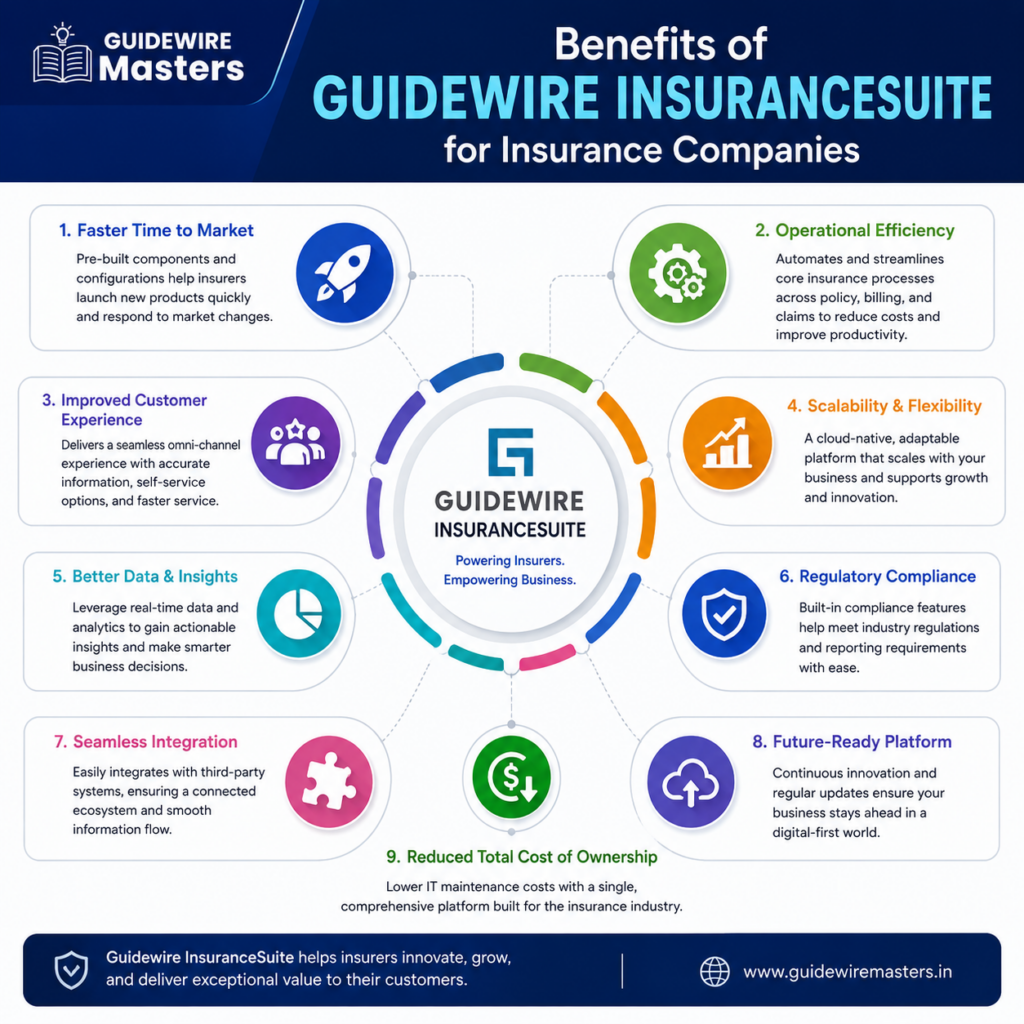
Benefits of Guidewire InsuranceSuite for Insurance Companies
For insurers, the value of InsuranceSuite shows up across the business:
- Faster policy processing: Configurable products and automated underwriting shorten speed-to-market.
- Improved claims handling: Automation and analytics speed settlements and reduce leakage.
- Better billing operations: Flexible, automated billing improves cash flow and reduces disputes.
- Reduced operational costs: Retiring legacy systems and automating manual work lowers the cost of running the business.
- Enhanced customer experience: Faster service, fewer errors, and digital self-service build loyalty.
- Regulatory compliance: Built-in reporting and controls help insurers meet evolving requirements.
- Digital transformation: A modern, cloud-native core becomes the foundation for AI, analytics, and new products.
In a market where premium growth is slowing and competition is rising, these efficiency and agility gains are not a luxury — they are how modern insurers stay competitive.
Guidewire InsuranceSuite Modules Comparison
Module | Primary Purpose | Key Users | Main Benefits |
PolicyCenter | Policy lifecycle management (quote, underwrite, renew) | Underwriters, agents, product teams | Faster product launch, accurate underwriting |
ClaimCenter | Claims lifecycle from FNOL to settlement | Adjusters, claims managers, SIU | Faster settlement, fraud control, lower leakage |
BillingCenter | Billing, invoicing, collections | Finance teams, billing staff | Improved cash flow, fewer billing errors |
ContactManager | Centralised contact and relationship data | All users (shared service) | Single source of truth, better data quality |
Guidewire InsuranceSuite in the P&C Insurance Industry
P&C insurance — auto, home, commercial property, liability, and similar lines — is operationally complex and tightly regulated by bodies such as the Insurance Regulatory and Development Authority of India (IRDAI). Carriers need systems that can model intricate products, process high claim volumes, and adapt quickly to new risks and regulations. InsuranceSuite was purpose-built for exactly this.
Market adoption is broad and deep: with 570-plus insurers across 43 countries and 1,700-plus implementations, Guidewire has become something close to an industry standard for core systems. Its reputation for handling the largest and most complex carriers gives buyers confidence.
Real-world business value comes from faster product launches, lower claims leakage, and reduced operating costs — measurable improvements to the combined ratio. And as insurers pursue digital transformation, the cloud-native InsuranceSuite serves as the modern foundation on which AI, analytics, and customer-facing digital services are built. Guidewire’s 2026 “Intelligent Insurance” direction, introduced at Connections 2025, reflects exactly this shift toward AI woven through core operations.
Top Companies Using Guidewire InsuranceSuite
Many of the world’s most recognisable insurers run on Guidewire. Commonly cited examples include:
- Nationwide
- Zurich Insurance
- CNA Insurance
- Tokio Marine
- AXA
- Farmers Insurance
- Liberty Mutual
Because the platform can handle their scale and complexity, it has a proven implementation record, and it is backed by the largest partner ecosystem in P&C. For these carriers, the core system is mission-critical — they cannot afford failure — so they choose the platform with the strongest track record. That concentration of large enterprise customers is also what creates steady, well-paid demand for skilled Guidewire professionals.
Guidewire InsuranceSuite Career Opportunities
Because so many insurers run on Guidewire, the platform supports a wide range of specialised roles:
- Guidewire Developer: Builds and customises functionality using Gosu and Java, primarily through configuration and extension.
- Guidewire Consultant: Bridges business and technical teams, advising on implementation and best practices.
- Guidewire Integration Developer: Specialises in connecting InsuranceSuite to external systems via APIs, messaging, and middleware.
- Guidewire Business Analyst: Translates insurance business requirements into configurable solutions.
- Guidewire Architect: Designs the overall solution, makes high-level technical decisions, and guides large implementations.
- Guidewire Cloud Engineer: Manages cloud deployments using containers, Kubernetes, CI/CD, and DevOps practices.
These roles exist across insurers, system integrators, and consulting firms — many with global delivery centres in India, which makes the Indian market especially active. If you are starting out, here is the full path to building a career as a Guidewire developer.
Guidewire InsuranceSuite Salary in India
Guidewire is a specialised, in-demand skill, and Indian salaries reflect that. The figures below are typical market ranges; actual pay varies with certification, integration expertise, and real implementation experience. For a fuller breakdown, see our detailed guide to Guidewire salaries in India.
Role | Experience | Average Salary (per year) |
Fresher / Trainee | 0–2 years | ₹4 – 7 LPA |
Guidewire Developer | 2–5 years | ₹8 – 14 LPA |
Senior Developer | 5–8 years | ₹14 – 22 LPA |
Lead / Tech Lead | 8–12 years | ₹22 – 32 LPA |
Architect | 12+ years | ₹30 – 50 LPA+ |
A clear pattern emerges: compensation jumps sharply after around five years, because real production experience — go-lives, data migrations, complex integrations — is far more valuable than theory alone. Certification, strong Gosu and integration skills, and hands-on project exposure are the levers that push you toward the higher end of each band.
Skills Required to Learn Guidewire InsuranceSuite
To build a Guidewire career, you will want a blend of domain knowledge, programming, and platform skills:
- Insurance domain knowledge: Understand P&C insurance concepts — policies, claims, billing.
- Guidewire fundamentals: Know the suite, its data model, and configuration approach.
- Gosu: Guidewire’s own object-oriented language, used heavily for configuration and business rules.
- Java: The foundation language behind the platform; useful for deeper customisation and integration.
- SQL: For working with the data model and writing queries.
- XML and JSON: The data formats used in SOAP and REST integrations.
- REST APIs and SOAP APIs: The two main integration styles you will work with.
- Integration frameworks: Messaging, the Integration Gateway, and event-driven patterns.
- Cloud technologies: Increasingly essential as InsuranceSuite runs on GWCP.
- Docker, Kubernetes, and DevOps: Containerisation, orchestration, and delivery practices for cloud roles.
You do not need every skill on day one. Start with the fundamentals and domain knowledge, then layer on programming, integration, and cloud over time.
How to Learn Guidewire InsuranceSuite
Here is a practical, step-by-step roadmap:
- Learn insurance fundamentals — understand P&C concepts before touching the software.
- Understand PolicyCenter — start with policy administration, the most common entry point.
- Learn ClaimCenter — move on to the claims lifecycle.
- Learn BillingCenter — round out the core suite with billing.
- Study Gosu programming — learn the language that powers configuration.
- Learn integrations — REST, SOAP, messaging, and event-driven patterns.
- Understand cloud concepts — GWCP, Docker, Kubernetes, CI/CD, and DevOps.
- Gain real-time project experience — apply your skills on realistic, hands-on projects.
- Pursue Guidewire certification — validate your skills and stand out to employers.
- Apply for Guidewire jobs — target developer, integration, or analyst roles to start, and prepare with the commonly asked Guidewire interview questions.
The single biggest accelerator is hands-on Guidewire project experience. Employers value people who have actually configured products, built integrations, and worked through realistic scenarios — which is why structured, project-based training matters so much.
Why Guidewire InsuranceSuite is a Great Career Choice
- High demand in India: Global insurers and system integrators run large Guidewire teams from Indian delivery centres.
- Limited talent pool: It is a specialised platform, so skilled professionals are scarce relative to demand — which keeps salaries strong.
- Attractive salaries: Even mid-level developers command premium pay, with architects reaching well into the 30–50 LPA range.
- Global opportunities: Guidewire skills are recognised worldwide, opening doors to international projects and roles.
- Cloud migration demand: The industry-wide shift to GWCP is creating a wave of cloud and migration work.
- Long-term career growth: A clear path runs from developer to senior developer to lead to architect, with consulting options along the way.
For someone choosing a niche to specialise in, Guidewire offers a rare combination: high demand, limited competition, and strong, durable salaries.
Future Scope of Guidewire InsuranceSuite
The trajectory of Guidewire InsuranceSuite points firmly toward cloud and intelligence:
- Guidewire Cloud adoption continues to accelerate, with cloud now the dominant deployment model in insurance software.
- AI integration is central to Guidewire’s roadmap — its “Intelligent Insurance” and agentic AI initiatives embed assistants directly into underwriting and claims.
- Predictive analytics is improving pricing, risk selection, and claims outcomes.
- API-first architecture makes the platform more open and connected than ever.
- Microservices and event-driven systems are shaping how new capabilities are built and scaled.
- Insurance digital transformation across India and Asia-Pacific — the fastest-growing region for insurance software — will keep demand high for years.
For professionals, this means the skills you build today will stay relevant, and the cloud-plus-AI direction creates entirely new specialisations to grow into.
Conclusion
It is the modern, cloud-native core platform that powers the global Property & Casualty insurance industry — the system that the world’s largest insurers trust to run their policies, claims, and billing. For insurers, it is the foundation of digital transformation. For professionals, it is one of the most rewarding and future-proof niches in technology today.
The combination of high demand, a limited talent pool, strong salaries, and a clear cloud-and-AI growth path makes this an exceptional time to build a Guidewire career — especially in India, where global insurers and system integrators are hiring actively. The best way to break in is through structured, hands-on, project-based learning that takes you from fundamentals to real implementation experience.
FAQs
1.What is Guidewire InsuranceSuite?
A.Guidewire InsuranceSuite is the core software platform that Property & Casualty insurers use to manage policies, claims, and billing on a single, modern, cloud-native system. It combines PolicyCenter, ClaimCenter, and BillingCenter with shared services like ContactManager.
2.What are the modules in Guidewire InsuranceSuite?
A.The main modules are PolicyCenter, ClaimCenter, and BillingCenter, supported by ContactManager, DataHub, and InfoCenter.
3.What is PolicyCenter?
A.PolicyCenter is Guidewire’s policy administration system. It manages the full policy lifecycle — quoting, underwriting, issuance, endorsements, and renewals.
4.What is ClaimCenter?
A.ClaimCenter is the claims management system. It handles the claims lifecycle from first notice of loss through investigation, settlement, and fraud detection.
5.What is BillingCenter?
BillingCenter manages billing, invoicing, payment processing, collections, and delinquency for insurers.
6.What is Guidewire Cloud?
A.Guidewire Cloud (GWCP) is the cloud-native, software-as-a-service platform on which InsuranceSuite now runs, offering continuous updates, scalability, and enterprise-grade security.
7.Is Guidewire InsuranceSuite a good career?
A.Yes. High demand, a limited talent pool, attractive salaries, and global opportunities make it one of the strongest niches in insurance technology, especially in India.
8.What skills are required for Guidewire InsuranceSuite?
Insurance domain knowledge, Guidewire fundamentals, Gosu, Java, SQL, XML/JSON, REST and SOAP APIs, integration frameworks, and increasingly cloud skills like Docker, Kubernetes, and DevOps.
9.What is the salary of a Guidewire professional in India?
A.Freshers typically earn ₹4–7 LPA, developers ₹8–14 LPA, senior developers ₹14–22 LPA, and architects ₹30–50 LPA or more, depending on experience and certification.
10.How long does it take to learn Guidewire InsuranceSuite?
A.With focused, project-based learning, most people reach job-ready proficiency in roughly 3–6 months, depending on prior programming and domain experience.

Mrs.jyosna
GuidewireMasters | 25+ articles published
Guidewire experts passionate about helping learners build successful careers in the insurance IT industry. Through in-depth guides, real-time training, certification support, and industry-focused resources, Guidewire Masters simplifies Guidewire technologies and provides practical knowledge to help students and professionals grow their careers confidently.
Share