Guidewire Developer Career

- Sanjay
- January 17, 2025
- 11:23 am
Table of Contents
Guidewire Developer Career: Skills, Salary, and the Complete 2026 Roadmap
If you are looking for an IT career that pays well, stays in demand, and does not get commoditized overnight, a Guidewire Developer Career deserves a serious look. Guidewire sits at the heart of the global Property and Casualty (P&C) insurance industry, and the people who can build on it are genuinely hard to find.
A Guidewire developer configures and customizes Guidewire’s insurance applications, builds integrations between Guidewire and other systems, migrates data, supports production environments, and increasingly works with cloud-native deployments. It is part software engineering, part insurance domain expertise — and that combination is exactly why the role is so valuable.
Guidewire dominates P&C insurance for a clear reason: it replaced the slow, expensive legacy mainframes insurers were stuck on with a modern, configurable core platform. Today, 570 insurers across 42 countries rely on Guidewire’s platform, and the company holds an estimated 25 to 30 percent market share among Tier 1 and Tier 2 P&C insurers globally. As those carriers move to the cloud, demand for developers keeps climbing.
That demand lands heavily on India, where global consulting firms run large Guidewire delivery teams out of Hyderabad, Bengaluru, Pune, and Chennai. Because the skill set is niche and domain-heavy, Guidewire professionals often earn 15–30% more than comparable generic Java or testing roles. For anyone willing to learn it properly, a Guidewire Developer Career is becoming one of the most lucrative and dependable paths in Indian IT.
This guide covers the whole picture: what the role is, why it is in demand, the opportunities and salaries in India, the skills and products to master, certifications, career paths, and a step-by-step plan to get started.
What is a Guidewire Developer Career?
A Guidewire Developer Career is a professional path centered on developing, configuring, and integrating Guidewire’s insurance software products — primarily PolicyCenter, ClaimCenter, and BillingCenter.
In practice, a Guidewire developer’s responsibilities include:
- Configuring screens, rules, products, and workflows using Gosu and the platform’s tooling.
- Building integrations to external systems through REST and SOAP web services and messaging.
- Migrating data from legacy systems into Guidewire.
- Designing and tuning batch processes.
- Supporting and troubleshooting production environments.
- Increasingly, deploying and operating applications on Guidewire Cloud.
Guidewire developers are essential because insurance runs on these core systems. A P&C insurer’s ability to launch products, quote policies, process claims, and bill customers depends directly on how well their Guidewire platform is built and maintained. A skilled developer is the difference between a system that adapts quickly to market needs and one that holds the business back.
Why a Guidewire Developer Career is a High-Demand Career in India?
Several forces are converging to make this one of the hottest niches in Indian IT.
Growth of the insurance industry. The broader insurance software market is forecast to grow from USD 14.14 billion in 2025 to USD 20.41 billion by 2031, and India’s insurance sector — regulated by the IRDAI — is digitizing rapidly, fueling demand for core-system talent.
Increasing Guidewire Cloud adoption. The migration to the cloud is the defining trend. Cloud-native deployment already accounts for 65.7% of insurance software revenue, and Guidewire’s subscription business is growing fast, with ARR up 22% year-over-year in its first quarter of fiscal 2026.
Shortage of experienced Guidewire professionals. Because the platform combines insurance knowledge with specialized engineering, the talent pool simply cannot keep up with demand. That scarcity protects both jobs and salaries.
Digital transformation trends. Insurers now treat cloud migration and modernization as a competitive requirement, not an optional cost exercise — which means years of project work and a steady appetite for skilled developers.
Guidewire Developer Career Opportunities in India
A Guidewire career is not a single job — it is a ladder of specialized roles you can grow through:
- Configuration Developer. Builds and customizes screens, rules, and products inside PolicyCenter, ClaimCenter, or BillingCenter.
- Integration Developer. Connects Guidewire to external systems using APIs, messaging, and the integration framework.
- Support Developer. Maintains production environments, resolves issues, and handles upgrades.
- Senior Developer. Takes ownership of complex modules and mentors junior team members.
- Technical Lead. Guides the development team, reviews designs and code, and bridges architecture and delivery.
- Guidewire Architect. Owns the end-to-end technical design, standards, and high-stakes decisions.
- Guidewire Cloud Developer. Specializes in cloud-native development, deployment, and operations on the Guidewire Cloud Platform.
Most people enter as configuration or support developers and progress toward integration, lead, and architect roles as they gain experience.
Industries Hiring Guidewire Developers
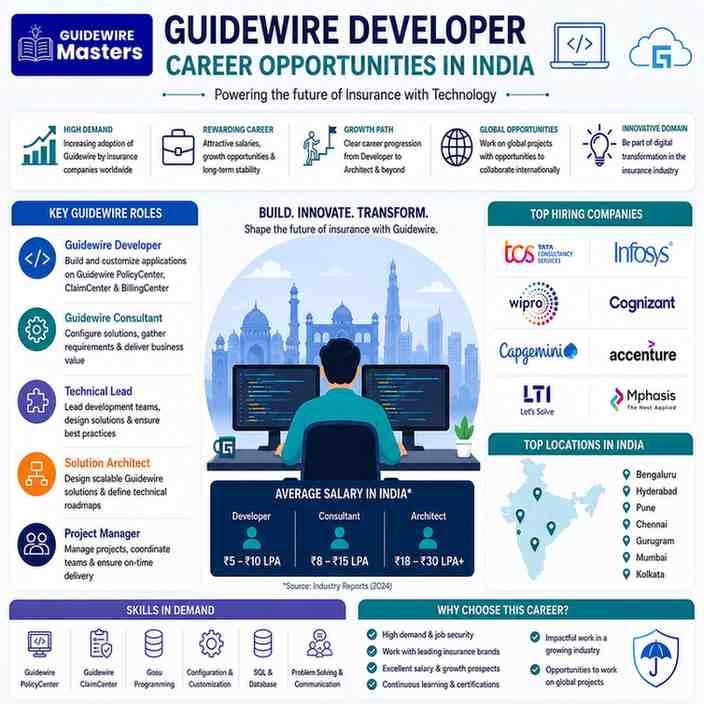
Although Guidewire is best known for P&C insurance, demand spans several connected industries:
- Property and Casualty Insurance. The core market — auto, home, commercial, and specialty lines carriers.
- Health Insurance. Insurers adapting core-system capabilities for health and benefits administration.
- Reinsurance. Firms managing risk transfer who need robust policy and claims data handling.
- InsurTech Companies. Startups and scale-ups building modern insurance products on flexible platforms.
- IT Consulting Firms. The largest employers, delivering Guidewire implementations and migrations for insurers worldwide.
- Digital Transformation Companies. Organizations modernizing legacy insurance technology end to end.
The common thread is that any business running or modernizing insurance operations needs people who can build on Guidewire.
Top Companies Hiring Guidewire Developers in India
Most Guidewire hiring in India flows through major IT services and consulting firms that hold Guidewire delivery partnerships, including:
- Accenture
- Cognizant
- Capgemini
- Infosys
- Wipro
- TCS
- Deloitte
- EY
- PwC
- LTIMindtree
These companies actively recruit Guidewire professionals because they win large, multi-year insurance transformation contracts and need certified talent to deliver them. Replacing or migrating a core insurance system is a long commitment, so these firms maintain dedicated Guidewire practices, invest in training and certification, and continuously bid for new implementation and cloud-migration mandates. The result is a reliable, long-term pipeline of demand for developers, leads, and architects.
Guidewire Developer Roles and Responsibilities
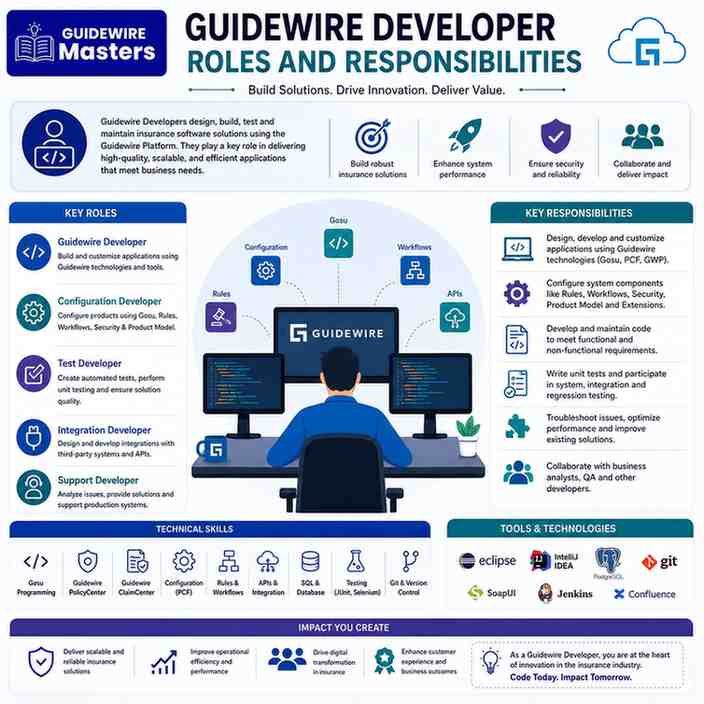
Day to day, a Guidewire developer’s work spans several technical areas:
- Configuration development. Tailoring PolicyCenter, ClaimCenter, and BillingCenter through screens, rules, products, and workflows.
- Integration development. Building the connective tissue between Guidewire and external systems.
- REST API implementation. Creating and consuming modern, JSON-based services — the default for Guidewire Cloud.
- SOAP web services. Working with XML-based services common in established deployments.
- Data migration. Moving and transforming data from legacy systems into the Guidewire data model.
- Batch processing. Designing scheduled, high-volume jobs that run reliably during off-peak windows.
- Performance optimization. Tuning queries, batch jobs, and configuration for speed and scale.
- Cloud deployments. Releasing and operating applications on the Guidewire Cloud Platform.
- Production support. Monitoring, troubleshooting, and maintaining live systems.
The strongest developers can move fluidly across configuration and integration — and that versatility is what fast-tracks a career.
Guidewire Developer Salary in India
Guidewire pay outpaces many comparable IT roles because the skill set is scarce and business-critical. The table below shows typical India ranges; actual figures vary by city, employer, certifications, and cloud expertise.
Experience Level | Average Salary (per year) |
Fresher (0–2 Years) | ₹4 – ₹7 LPA |
Mid-Level (3–5 Years) | ₹8 – ₹16 LPA |
Senior (6–10 Years) | ₹16 – ₹30 LPA |
Lead / Architect (10+ Years) | ₹30 – ₹55+ LPA |
These ranges align with current market reporting, where Guidewire salaries in India run from around ₹4 LPA for freshers to ₹60+ LPA for senior architects, with most mid-level professionals earning between ₹8 LPA and ₹22 LPA. Integration specialists and cloud-skilled developers tend to sit at the upper end of their band. For a more detailed, role-by-role breakdown, see our guide to Guidewire salaries in India.
Skills Required to Become a Guidewire Developer
Building a successful Guidewire Developer Career means combining platform skills, core programming, and domain knowledge. The essentials are:
- Gosu — Guidewire’s native, Java-like language for business logic.
- Java — the foundation the platform and Gosu build on.
- SQL — for working with and tuning the data layer.
- XML — used heavily in configuration and SOAP services.
- REST APIs — the modern integration standard.
- SOAP APIs — still common in established integrations.
- JSON — the data format behind most modern API calls.
- Web Services — both REST and SOAP design and consumption.
- Messaging — asynchronous, event-driven communication.
- Insurance Domain Knowledge — understanding policy, claims, and billing processes.
- Guidewire Cloud — the cloud platform and its operating model.
- Docker — containerization of application components.
- Kubernetes — orchestration of those containers at scale.
- CI/CD and DevOps — automated, reliable build-test-deploy pipelines.
The domain knowledge is the hardest part to fake and the clearest differentiator. To gauge where you stand, work through these Guidewire interview questions covering Gosu, configuration, and integrations.
Guidewire Products Every Developer Should Learn
Mastering the core product suite is non-negotiable. Here is what each one does and why it matters.
Guidewire PolicyCenter. The policy administration system handling quoting, underwriting, issuance, renewals, and endorsements. Developers learn product modeling — defining insurance products, coverages, and the rules that govern them. You can review the full suite on Guidewire’s official InsuranceSuite page.
Guidewire ClaimCenter. The claims management system covering the full claims lifecycle, from first notice of loss through investigation, reserving, settlement, and closure.
Guidewire BillingCenter. The billing engine handling invoicing, payment plans, collections, commissions, and disbursements — all the money movement between insurer, agent, and policyholder.
ContactManager. The shared service that maintains a single, consistent view of customer data — people and organizations — across all three core applications.
Guidewire Cloud Platform. The managed, SaaS version of InsuranceSuite, built for cloud-native development. Learning how applications are deployed, scaled, and operated here is increasingly what separates modern Guidewire developers from the rest.

Guidewire Integration Technologies Every Developer Should Learn
Integration is one of the most valued — and best-paid — areas of a Guidewire developer’s skill set. Key technologies include:
- REST APIs. The modern, lightweight standard, central to Guidewire Cloud’s API-first design.
- SOAP APIs. Contract-driven, XML-based services still widely used in existing systems.
- JSON. The data format for most modern API communication.
- XML. Used in configuration and SOAP messaging.
- Messaging queues. Asynchronous delivery that ensures data reaches downstream systems reliably.
- Kafka. High-throughput event streaming for real-time data flows.
- Event-driven architecture. Systems that react to events rather than constantly polling, keeping the ecosystem responsive.
- Middleware integrations. Connecting Guidewire to rating engines, document systems, and third-party data providers. Many prebuilt connectors are distributed through the Guidewire Marketplace.
A developer who is strong in integrations is rarely short of opportunities.
Guidewire Developer Career Path
Progression follows a fairly predictable ladder. Here is a roadmap of what to focus on at each stage.
Level | Focus Skills |
Beginner | Insurance fundamentals, Java basics, SQL, Gosu, PolicyCenter configuration |
Intermediate | ClaimCenter and BillingCenter, advanced Gosu, page configuration, rules, basic integrations |
Advanced | REST/SOAP integrations, messaging, Kafka, Guidewire Cloud, performance tuning, batch design |
Expert | Solution architecture, DevOps and Kubernetes, end-to-end design, mentoring, technical leadership |
Most professionals spend a few years at each stage, moving from configuration into integration, then technical leadership, and finally architecture.
Certifications That Boost a Guidewire Developer Career
Certifications carry real weight in the Guidewire world because employers use them to validate skills quickly. The main credentials are:
- Guidewire Associate Certification. Entry-level proof of foundational product knowledge.
- Guidewire Specialist Certification. Demonstrates deeper, role-specific expertise.
- Guidewire ACE (Certified Ace). An advanced credential combining product mastery with best-practice implementation knowledge — often expected of lead developers.
- Guidewire Cloud Certification. Validates cloud-platform skills, increasingly the most in-demand area.
Certifications improve both salary and job opportunities. Certified professionals stand out in a competitive market, are easier for consulting firms to staff onto client projects, and frequently command higher pay. You can explore the official credentials and learning paths through Guidewire’s developer training and certification resources.
Guidewire Developer vs Java Developer vs Guidewire Architect
These roles are often confused. Here is how they compare.
Aspect | Java Developer | Guidewire Developer | Guidewire Architect |
Responsibilities | General application development | Configures and integrates Guidewire apps | Owns overall design, standards, scalability |
Skills Required | Java, frameworks, general engineering | Gosu, Java, configuration, integrations, insurance domain | Broad design, cloud, integration, domain, leadership |
Technologies Used | Java stack, databases, web frameworks | Gosu, PCF, REST/SOAP, messaging, Guidewire Cloud | Whole platform, cloud, CI/CD, observability |
Salary Range (India) | ₹4 – ₹20 LPA | ₹4 – ₹30 LPA | ₹30 – ₹55+ LPA |
Career Growth | Senior engineer, tech lead | Lead, integration specialist, architect | Principal architect, delivery leadership |
The pattern is clear: a Guidewire developer typically out-earns a comparable generic Java developer, and the architect role is the natural long-term destination.
Why a Guidewire Developer Career is One of the Best IT Careers in India
A few factors combine to make this a standout choice:
- High salaries. Specialized skills mean pay that outruns many comparable IT roles.
- Global demand. Insurers worldwide are modernizing, and that work flows to Indian delivery teams.
- Limited talent pool. Domain-heavy skills stay scarce, protecting both employability and pay.
- Long-term job stability. Core insurance systems are sticky and long-lived, so demand does not vanish overnight.
- Cloud migration projects. A massive migration wave guarantees years of project work.
- Clear path to architect. The role offers a defined route to senior, high-paying architecture positions.
It is rare to find a niche that combines high pay, scarcity, and durable demand all at once — and Guidewire does.
Future Scope of a Guidewire Developer Career
The trajectory points firmly toward cloud, intelligence, and modular design:
- Guidewire Cloud migration. The defining trend, with cloud-native deployments now leading insurance software spend and growing at roughly a 10.5% CAGR.
- AI and analytics integration. Guidewire is embedding intelligence into its products, and more than 60% of P&C insurers are piloting or deploying AI, though fewer than 15% have scaled it — leaving enormous room to grow, as Guidewire details in its 2026 P&C insurance trends report.
- API-first architecture. New capabilities are designed to be consumed as services, making integration skills central.
- Microservices. The platform continues to decompose into smaller, independently deployable services.
- Event-driven architecture. Real-time, event-based processing is becoming the norm.
- Digital transformation in insurance. A broad, multi-year wave that keeps the demand for skilled developers strong.
For anyone building skills today, the platform’s direction means the investment keeps paying off.
How to Start a Guidewire Developer Career
Here is a practical, step-by-step roadmap.
- Learn insurance fundamentals. Understand how insurance works before touching the software.
- Understand Property and Casualty insurance. Get familiar with policies, claims, billing, and underwriting in the P&C context.
- Learn Java and SQL. Build the core programming and data foundation.
- Master Gosu. Learn Guidewire’s native language for business logic.
- Study Guidewire PolicyCenter. Start with configuration — screens, rules, products, and the data model.
- Learn ClaimCenter and BillingCenter. Broaden across the suite to understand the full insurance lifecycle.
- Understand REST and SOAP integrations. Learn how Guidewire connects to the wider ecosystem.
- Gain project experience. There is no substitute for delivering real work — practising on real-world Guidewire projects accelerates this.
- Learn Guidewire Cloud. Get comfortable with cloud-native development, containers, and CI/CD.
- Move toward Technical Lead and Architect roles. Take on design responsibility and mentor others.
Structured training plus hands-on practice is the fastest route. Many professionals accelerate this with focused Guidewire training in Hyderabad and certification before joining delivery teams. For a broader view of entry routes, see our guide on how to become a Guidewire professional.
Guidewire Cloud Careers and Future Opportunities
The cloud shift is creating an entirely new tier of specialized roles:
- Guidewire Cloud Developer. Builds and customizes applications natively for the cloud platform.
- Cloud Integration Engineer. Designs and operates integrations in a cloud, API-first environment.
- Technical Lead. Guides cloud delivery teams and translates architecture into working software.
- Guidewire Architect. Designs end-to-end cloud solutions and sets technical standards.
- Cloud Architect. Focuses on the underlying cloud infrastructure, scalability, security, and DevOps.
These roles tend to pay a premium because cloud-skilled Guidewire talent is the scarcest of all right now.
Conclusion
A Guidewire Developer Career sits at the meeting point of two powerful trends: an insurance industry under pressure to modernize, and a platform that has become the default way to do it. With hundreds of insurers worldwide on the platform, a relentless shift to the cloud, and a talent pool that cannot grow fast enough, developers who understand Guidewire deeply are positioned for one of the most rewarding and durable careers in Indian IT.
The opportunity is real, but it rewards genuine skill — the blend of insurance domain knowledge, Guidewire engineering, integration expertise, and cloud fluency that few professionals have all at once. The good news is that the roadmap is clear and the demand is patient. Start with the fundamentals, build hands-on experience across the suite, earn your certifications, and grow into cloud and integration work.
If you are serious about a future in insurance technology, now is the time to start. The fastest way in is structured, job-oriented Guidewire training in Hyderabad with hands-on projects, certification guidance, and placement support. Begin learning Guidewire today, build real project experience, and launch a Guidewire Developer Career that stays in demand for years to come.
Frequently Asked Questions
Q1. What is a Guidewire Developer Career?
Answer: It is a professional path focused on developing, configuring, and integrating Guidewire’s insurance software — PolicyCenter, ClaimCenter, and BillingCenter — for P&C insurers, increasingly on Guidewire Cloud.
Q2. Is a Guidewire Developer a good career in India?
Answer: Yes. It offers high salaries, scarce-skill job security, strong global demand, and a clear path to senior architect roles, making it one of the most stable and rewarding niches in Indian IT.
Q3. What skills are required to become a Guidewire Developer?
Answer: Gosu, Java, SQL, XML, JSON, REST and SOAP web services, messaging, insurance domain knowledge, and cloud skills including Docker, Kubernetes, CI/CD, and DevOps.
Q4. What is the salary of a Guidewire Developer in India?
Answer: Freshers typically earn ₹4–₹7 LPA, mid-level developers ₹8–₹16 LPA, senior developers ₹16–₹30 LPA, and leads or architects ₹30–₹55+ LPA, varying by city, employer, and cloud expertise.
Q5. Which companies hire Guidewire Developers?
Answer: Major consulting and IT services firms such as Accenture, Cognizant, Capgemini, Infosys, Wipro, TCS, Deloitte, EY, PwC, and LTIMindtree, all of which run dedicated Guidewire practices.
Q6. Is Guidewire better than Java development?
Answer: They are different. Guidewire builds on Java but adds insurance domain depth and platform-specific skills, which makes Guidewire roles scarcer and often higher-paid than generic Java roles.
Q7. What is Guidewire Cloud?
Answer: Guidewire Cloud is the managed, SaaS version of InsuranceSuite, delivered on a cloud-native platform that handles hosting, upgrades, and scalability so insurers can focus on their business.
Q8. How long does it take to learn Guidewire?
Answer: With focused study and hands-on practice, foundational skills can take a few months, while becoming job-ready typically takes six months to a year depending on prior Java and domain experience.
Q9. Can freshers start a Guidewire Developer Career?
Answer: Yes. Freshers with Java and SQL basics plus structured Guidewire training and certification can enter as configuration or support developers and grow from there.
Q10. What is the future scope of Guidewire Developers?
Answer: Strong and growing. Cloud migration, AI integration, API-first design, and microservices are expanding the role, and demand for cloud-skilled Guidewire developers in particular continues to rise.

Mrs.Jyosna
GuidewireMasters | 25+ articles published
Guidewire experts passionate about helping learners build successful careers in the insurance IT industry. Through in-depth guides, real-time training, certification support, and industry-focused resources, Guidewire Masters simplifies Guidewire technologies and provides practical knowledge to help students and professionals grow their careers confidently.
Share