Guidewire Marketplace

- Sanjay
- February 8, 2025
- 8:08 am
Table of Contents
Introduction to Guidewire Marketplace
If you have spent any time around property and casualty (P&C) insurance technology, you already know that integrations are where most projects either sail or sink. Connecting a core system to a fraud engine, a payment gateway, a document service, or a data provider used to mean months of custom code, brittle interfaces, and expensive maintenance. The Guidewire Marketplace exists to change that equation.
Think of the Guidewire Marketplace as an app store built specifically for insurers running on Guidewire. Instead of building every connection from scratch, carriers can browse a catalog of pre-validated apps and integrations, pick what they need, and deploy faster. Each listing is a packaged solution — a connector, an accelerator, or a complete application — that has been tested to work cleanly with Guidewire products.
This matters more than ever because the insurance industry is mid-migration to the cloud. Guidewire Cloud already supports more than 570 insurers worldwide, and the company reported roughly 35% subscription growth on the back of that adoption. As carriers move onto the cloud platform, the Marketplace becomes the natural front door for extending their core systems without the risk and cost of bespoke engineering.
For insurers, that means faster time-to-market and lower implementation cost. For Guidewire professionals, it means something equally important: a fast-growing, well-paid specialization. Integration developers, cloud engineers, and solution architects who understand how the Marketplace works are in strong demand — and in India, where a huge share of global Guidewire delivery happens, that demand translates into real career opportunity. This guide walks through what the Marketplace is, how it is built, the solutions it offers, and how you can turn that knowledge into a career.
Features of Guidewire Marketplace
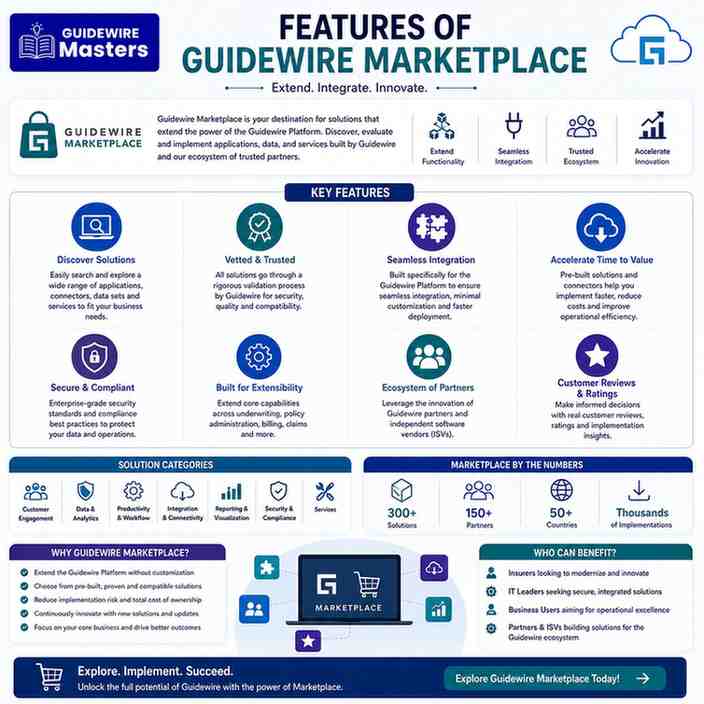
The Marketplace is more than a list of links. Its real value lies in a set of features that make adoption genuinely low-risk:
- Pre-built integrations – Connectors that link InsuranceSuite to external systems without writing integration logic from scratch.
- Ready-to-use applications – Plug-and-play apps for payments, document generation, communications, analytics, and more.
- Accelerators – Reusable components and content that speed up implementation and configuration projects.
- APIs and connectors – Standardized REST-based interfaces that follow Guidewire Cloud conventions.
- A large third-party ecosystem – Hundreds of integrations from a partner network that spans data providers, insurtechs, and global consultancies.
- Cloud compatibility – Every solution is aligned with Guidewire Cloud Standards and validated to work on the cloud-native platform.
Two additional features matter for buyers: integrations carry validation badges for security and compatibility, and Guidewire has introduced ratings and reviews so customers can see real feedback from peers before adopting a solution.
What is Guidewire Marketplace?
The Guidewire Marketplace is Guidewire’s official online catalog of applications, integrations, and accelerators that extend the InsuranceSuite core systems. Think of it as an app store built specifically for P&C insurers: instead of downloading games or productivity tools, carriers download validated insurance solutions that snap into their existing Guidewire platform.
Its purpose is to remove the friction from extending core insurance software. Traditionally, connecting a policy system to an external data provider or payment processor meant a bespoke development effort—expensive to build and even more expensive to maintain through upgrades. The Marketplace replaces that pattern with standardized, reusable solutions.
There are two main types of solutions you will see:
- Built by Guidewire – Standardized integrations that Guidewire itself builds, manages, and keeps current with the latest product and vendor releases. These leverage the Integration Framework for Guidewire Cloud and can be provisioned and maintained by Guidewire under an optional services agreement.
- Ready for Guidewire – Partner-built solutions that Guidewire validates for security, quality, and compatibility before they appear in the Marketplace.
The Marketplace supports InsuranceSuite directly. Whether an insurer runs PolicyCenter for underwriting, ClaimCenter for claims, or BillingCenter for billing, Marketplace apps are designed to work inside those trusted workflows rather than bolting on awkwardly from the outside.
Insurers use Marketplace applications because they want speed without sacrificing reliability. A pre-validated app means less custom code, fewer upgrade headaches, faster compliance, and a quicker path to launching new products or improving customer experience.
Guidewire Marketplace Architecture
Under the hood, the Marketplace is built on the principles that define modern Guidewire Cloud: an API-first, integration-friendly architecture.
- Integration framework – Guidewire Cloud’s Integration Framework lets developers implement connections between InsuranceSuite and third-party apps using multiple APIs, messaging systems, and protocols.
- API-first architecture – Capabilities are exposed through well-defined REST APIs, so integrations are predictable and reusable.
- Event-driven architecture – Many integrations react to business events (a claim opened, a policy bound) in near real time rather than relying on slow batch jobs.
- Microservices approach – Cloud-native services are modular, independently deployable, and easier to scale.
- Security and scalability – Solutions are validated against Guidewire’s security standards and run on infrastructure designed to scale with insurer demand.
In practical terms, integrations exchange data using REST APIs, with payloads typically formatted as JSON (and XML where legacy systems require it). A messaging framework underpins event-driven flows, allowing systems to communicate asynchronously and reliably. This combination—APIs for synchronous calls, messaging for asynchronous events—is what makes Marketplace solutions both responsive and resilient.
Guidewire Marketplace and Guidewire Cloud
The Marketplace and Guidewire Cloud are deeply intertwined. The Guidewire Cloud Platform delivers InsuranceSuite as a SaaS offering on a cloud-native architecture, which means insurers get:
- Continuous upgrades – Regular, predictable releases instead of disruptive multi-year upgrade projects.
- Scalability – Elastic infrastructure that expands and contracts with workload.
- Security – Centralized, standardized security controls maintained by Guidewire.
Marketplace applications shine in this model. Because every solution is built to Guidewire Cloud Standards, it stays compatible release after release. Built by Guidewire integrations are even kept current automatically, so adopting a Marketplace app does not create technical debt that breaks at the next upgrade. For insurers, this is the difference between innovation that compounds and integrations that quietly rot. The cloud model plus a curated Marketplace means a carrier can keep adding capabilities indefinitely without rebuilding its foundation.
Types of Solutions Available in Guidewire Marketplace
The Marketplace spans many solution categories. The representative examples below illustrate the kinds of providers and capabilities insurers commonly adopt:
Category | What it does | Representative providers |
Data providers | Enrich underwriting and claims with external data | LexisNexis, Verisk, Experian |
Payment integrations | Accept and disburse premiums and claims | One Inc (PremiumPay, ClaimsPay); modern gateways like Stripe and PayPal in the broader ecosystem |
Document management | Generate, sign, and deliver documents | DocuSign, Adobe Sign, GhostDraft |
Communication providers | Omnichannel customer messaging | Twilio, SendGrid, Genesys |
Analytics & reporting | Dashboards and insight on policies and claims | BI and embedded analytics partners |
AI & automation | Decisioning, document intelligence, automation | Indico Data, Gradient AI, Convr |
Fraud detection | Flag suspicious claims and applications | AI-driven fraud and risk-scoring tools |
Digital customer experience | Self-service portals and engagement | CX and portal accelerators |
Note that some named providers (such as One Inc, Verisk, Vertafore, Genesys, and GhostDraft) appear as formal Built by Guidewire or Ready for Guidewire solutions, while others represent the broader category of technology that integrates with Guidewire through the same framework.

Guidewire Marketplace for InsuranceSuite
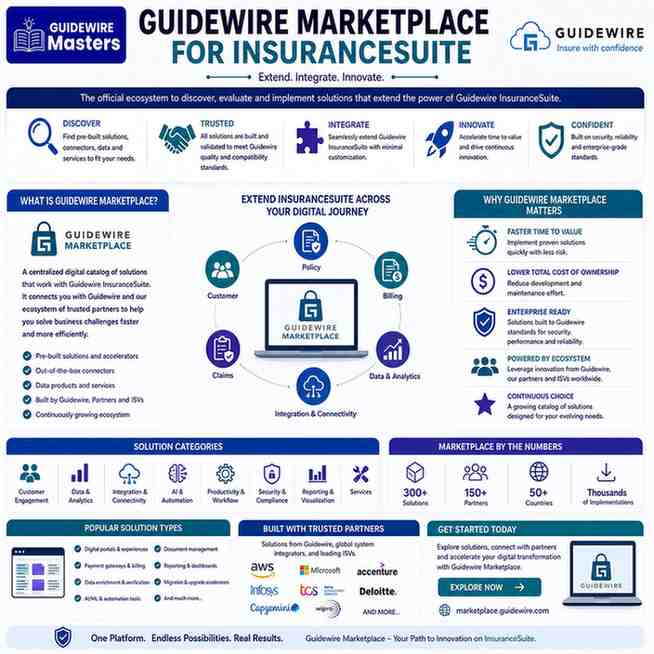
The Marketplace enhances every pillar of InsuranceSuite:
- Guidewire PolicyCenter – Underwriting and policy administration benefit from data enrichment, compliance/licensing checks (for example, Vertafore’s Sircon for Guidewire), and rating support.
- Guidewire ClaimCenter – Claims processing gains fraud detection, claims intelligence, estimating, and payment disbursement capabilities.
- Guidewire BillingCenter – Billing operations connect to digital payment engines for premium collection and refunds.
- ContactManager – The shared contact repository stays consistent across systems as integrations exchange party and contact data.
Because Marketplace solutions are validated for these specific systems, they enhance rather than disrupt core workflows. A claims integration behaves the way ClaimCenter expects; a payment integration respects BillingCenter’s data model. That tight fit is exactly why insurers prefer Marketplace apps over generic third-party tools.
Guidewire Marketplace Integration Architecture
Integration is the heart of the Marketplace, so it is worth understanding the technologies involved:
- REST APIs – The primary, modern interface for cloud integrations.
- SOAP web services – Still used where legacy systems require it.
- JSON and XML – JSON dominates modern payloads; XML appears in legacy and document-heavy flows.
- API Framework – Guidewire’s standardized way of exposing and consuming services.
- Integration Gateway – Manages and routes traffic between InsuranceSuite and external systems.
- Kafka – Apache Kafka is widely used for event streaming and high-throughput, real-time data movement.
- Middleware integrations – Enterprise integration platforms orchestrate complex, multi-system flows.
- Event-driven architecture – Business events trigger downstream processing automatically.
In larger insurer environments, you will often see middleware and integration platforms such as MuleSoft, Apache Kafka, Informatica, and Boomi working alongside the Guidewire Integration Framework. These tools handle transformation, routing, and orchestration when integrations span many systems, while Guidewire’s own framework governs how data enters and leaves InsuranceSuite.
Benefits of Guidewire Marketplace
The business case for the Marketplace is straightforward:
- Faster implementation – Pre-built solutions replace months of custom work.
- Reduced development costs – Less bespoke code means lower build and maintenance spend.
- Seamless integrations – Solutions are validated for compatibility before they ship.
- Improved customer experience – Modern payments, communications, and self-service raise satisfaction.
- Enhanced automation – AI and workflow tools reduce manual effort in claims and underwriting.
- Faster time-to-market – New products and capabilities launch quicker.
- Cloud readiness – Everything aligns with Guidewire Cloud Standards.
- Scalability – Cloud-native solutions grow with the business.
Popular Applications in Guidewire Marketplace
While the catalog is large, certain application types consistently attract insurers:
- Payment gateways – Digital premium collection and claims disbursement (e.g., One Inc).
- Fraud detection solutions – AI models that flag suspicious claims and applications.
- CRM and engagement integrations – Connecting policyholder data to service platforms.
- Document generation tools – Automated, brand-compliant communications (e.g., GhostDraft, DocuSign).
- Geospatial and property data services – Location intelligence for underwriting and catastrophe risk.
- Analytics platforms – Embedded dashboards for claims and portfolio insight.
- AI-powered solutions – Document intelligence, decisioning, and predictive models (e.g., Indico Data, Gradient AI).
These categories map directly to where insurers feel the most pressure: cost, fraud, speed, and customer experience.
Guidewire Marketplace and Digital Transformation
The Marketplace is not just a convenience—it is one of the engines of insurance modernization. Guidewire’s own 2026 industry outlook describes ecosystems like the Marketplace as a “one-stop shop” of trusted insurtech partners that can be integrated seamlessly into core systems, accelerating innovation while reducing integration costs.
Several transformation themes converge here:
- Insurance modernization – Replacing rigid legacy systems with flexible, cloud-native cores.
- API-first architecture – Capabilities become reusable building blocks rather than one-off projects.
- Cloud migration – Carriers move from on-premise InsuranceSuite to Guidewire Cloud.
- AI integration – Predictive and generative AI move into claims and underwriting workflows.
- Automation – Repetitive tasks shift from people to systems.
- Customer experience improvements – Digital payments, omnichannel communication, and self-service become standard.
The net effect is that insurers can experiment faster and adopt specialized capabilities directly, with the confidence that each piece is validated and supported.
Guidewire Marketplace and Event-Driven Architecture
Modern Marketplace integrations increasingly rely on event-driven architecture (EDA) rather than scheduled batch jobs. The building blocks include:
- Messaging framework – Reliable, asynchronous communication between systems.
- Kafka – Apache Kafka streams events at high volume with durability and ordering guarantees.
- Real-time processing – Business events are handled the moment they occur.
- Microservices – Small, independent services consume and produce events.
- Integration events – Domain events (claim created, payment received) drive downstream automation.
EDA matters because insurance is full of moments that should trigger immediate action: a first notice of loss should kick off fraud screening, a payment should update billing instantly, a policy change should ripple to connected systems. Event-driven Marketplace integrations make those reactions fast, decoupled, and resilient.
Guidewire Marketplace Roles and Responsibilities
Building, validating, and operating Marketplace solutions involves a range of roles:
- Guidewire Developer – Configures and customizes InsuranceSuite; builds and consumes integrations.
- Integration Developer – Specializes in APIs, messaging, and connecting Guidewire to external systems.
- Technical Lead – Owns integration design quality and guides the development team.
- Guidewire Architect – Defines the overall integration and platform architecture.
- Cloud Engineer – Manages Guidewire Cloud environments, CI/CD pipelines, and deployments.
- Solution Architect – Maps business needs the right mix of Marketplace apps and custom work.
As insurers adopt more Marketplace solutions, integration-focused roles are becoming especially valuable—someone has to design, deploy, and maintain those connections reliably.
Guidewire Marketplace Career Opportunities in India
India is one of the world’s most important Guidewire delivery hubs, which makes it a strong market for Marketplace and integration skills. Global insurers outsource large portions of their Guidewire implementation, integration, and support work to Indian IT firms and global capability centers.
Key opportunity areas include:
- Strong demand for Guidewire professionals – Driven by ongoing cloud migrations and integration projects.
- Integration developer roles – Among the most sought-after as Marketplace adoption grows.
- Guidewire architect roles – Senior positions defining cloud and integration strategy.
- Cloud engineering opportunities – Managing Guidewire Cloud environments and pipelines.
- Consulting opportunities – Advisory and implementation work for carriers worldwide.
Because Guidewire skills are specialized and relatively scarce, professionals often command a premium over comparable generic Java or testing roles. If you are starting out, structured Guidewire Training in Hyderabad is one of the fastest ways to build the hands-on InsuranceSuite and integration skills these roles require.
Top Companies Hiring Guidewire Professionals
The following firms actively recruit Guidewire talent in India because they run large Guidewire practices and serve global P&C insurers:
- Accenture
- Cognizant
- Capgemini
- Infosys
- Wipro
- TCS
- Deloitte
- EY
- PwC
- LTIMindtree
These companies are Guidewire consulting and delivery partners. They handle implementations, cloud migrations, and integration projects for insurers across North America, Europe, and Asia-Pacific—which means a steady pipeline of Guidewire and Marketplace integration work, and a constant need for skilled professionals to staff it.
Guidewire Marketplace Salary in India
Guidewire skills are domain-heavy and business-critical, so compensation tends to run above generic software roles. The ranges below are indicative and vary by employer, city, and certification.
Experience Level | Average Salary (per annum) |
Fresher (0–2 Years) | ₹6–10 LPA |
Mid-Level (3–5 Years) | ₹12–20 LPA |
Senior (6–10 Years) | ₹22–35 LPA |
Architect (10+ Years) | ₹35–55+ LPA |
A recurring theme in the Guidewire job market is that salary growth is not linear—it tends to accelerate sharply once you cross roughly five years of solid implementation and integration experience and move toward architect-level roles.
Skills Required to Work with Guidewire Marketplace
To build and integrate Marketplace solutions, professionals typically need a blend of Guidewire, programming, and cloud skills:
- Guidewire InsuranceSuite – PolicyCenter, ClaimCenter, BillingCenter fundamentals
- Gosu – Guidewire’s domain-specific language
- Java – Core programming foundation
- SQL – Data querying and manipulation
- XML and JSON – Data formats for integrations
- REST APIs and SOAP APIs – Service interfaces
- API Framework – Guidewire’s integration approach
- Kafka – Event streaming and messaging
- Middleware technologies – MuleSoft, Boomi, Informatica, and similar
- Cloud technologies – Guidewire Cloud and general cloud concepts
- Docker and Kubernetes – Containerization and orchestration
- DevOps and CI/CD – Automated build, test, and deployment
- Insurance domain knowledge – Understanding P&C products and processes
Domain knowledge is the differentiator. Plenty of engineers can write code; far fewer understand both the technology and the insurance business well enough to design integrations that actually fit how carriers work.
Guidewire Marketplace Career Path
A typical progression from beginner to expert looks like this:
Level | Focus Skills |
Beginner | Insurance basics, Guidewire InsuranceSuite overview, Gosu, Java, SQL |
Intermediate | PolicyCenter/ClaimCenter/BillingCenter configuration, REST APIs, JSON/XML, basic integrations |
Advanced | API Framework, Kafka, middleware, Guidewire Cloud, CI/CD, Docker/Kubernetes |
Expert | Integration and solution architecture, cloud strategy, performance, security, team leadership |
The path rewards persistence: each stage builds on the last, and the move from “skilled developer” to “architect” is where both responsibility and compensation rise most steeply.
Guidewire Marketplace vs Custom Integrations
Should an insurer adopt a Marketplace solution or build a custom integration? This comparison summarizes the trade-offs:
Factor | Guidewire Marketplace | Custom Integration |
Implementation effort | Low—pre-built and validated | High—built from scratch |
Development cost | Lower | Higher |
Maintenance | Often managed by Guidewire/partner | Owned entirely by the insurer |
Scalability | Cloud-native, built to scale | Depends on in-house design |
Security | Validated to Guidewire standards | Insurer must assure it |
Time-to-market | Fast | Slow |
Flexibility | High for common needs; bounded by the app | Unlimited, but costly |
Cloud readiness | Aligned with Guidewire Cloud Standards | Must be engineered in |
The rule of thumb: use the Marketplace for common, well-defined needs (payments, data, documents, communications) and reserve custom development for genuinely unique business logic that no app covers.
Why Guidewire Marketplace is Important for Insurance Companies
For insurers and developers looking to leverage Guidewire Marketplace, here’s a step-by-step guide to getting started.
Step-by-Step Guide for New Users
Create a Guidewire Account – Sign up on the official Guidewire Marketplace website.
Explore Available Solutions – Browse through categories such as claims, billing, AI, and customer service.
Check Compatibility – Ensure the selected application is compatible with your Guidewire software (PolicyCenter, ClaimCenter, or BillingCenter).
Request a Demo or Free Trial – Many applications offer free trials to test functionality before committing.
Install and Configure the Application – Follow the integration guidelines to seamlessly add the solution to your system.
Tips for Insurers and Developers
For Insurers: Choose applications that align with your business needs and customer experience goals.
For Developers: Focus on building solutions that address industry pain points such as fraud prevention, automation, and AI-driven insights.
Common Mistakes to Avoid
Not checking for compatibility before installation
Overlooking security and compliance requirements
Ignoring user reviews and ratings before selecting an application
By following these best practices, insurers and developers can maximize the benefits of Guidewire Marketplace.
Future Scope of Guidewire Marketplace
The trajectory points firmly upward. Guidewire was named a Leader in the 2025 Gartner Magic Quadrant for SaaS P&C Core Platforms in North America, and its cloud business continues to grow strongly. Several trends will shape the Marketplace’s future:
- Guidewire Cloud adoption – Continued migration drives more Marketplace usage.
- AI and analytics integration – Generative and agentic AI move deeper into core workflows.
- API-first architecture – Integrations become ever more standardized and reusable.
- Microservices – Cloud-native services keep replacing monolithic patterns.
- Event-driven architecture – Real-time processing becomes the default.
- Embedded insurance – Coverage offered at the point of sale through partner ecosystems.
- Digital transformation – Modernization remains a multi-year industry priority.
- Intelligent automation – AI plus automation reshapes claims and underwriting.
As more insurers standardize on Guidewire Cloud, the Marketplace becomes the default route to new capabilities—and the demand for professionals who can work with it grows in step.
How to Learn Guidewire Marketplace
There is no shortcut to Marketplace expertise, but there is a logical path. Here is a step-by-step roadmap:
- Learn insurance fundamentals – Understand P&C products, policies, claims, and billing.
- Understand Guidewire InsuranceSuite – Get the big picture of how the suite fits together.
- Master PolicyCenter – Learn underwriting and policy administration configuration.
- Learn ClaimCenter and BillingCenter – Round out the core systems.
- Understand REST APIs and integrations – The foundation of Marketplace work.
- Learn JSON and XML – The data formats integrations rely on.
- Study Kafka and middleware – Event streaming and orchestration.
- Learn the Guidewire Cloud Platform – Cloud-native deployment, CI/CD, and standards.
- Gain project experience – Apply skills on real or simulated implementations.
- Progress to architect roles – Move from building integrations to designing them.
Working through this roadmap with structured guidance and hands-on practice is far more effective than self-study alone, especially when it comes to the integration and cloud topics that employers value most.
Conclusion
The Guidewire Marketplace has quietly become one of the most important pieces of the modern insurance technology stack. By turning integrations into validated, reusable, cloud-ready solutions, it lets P&C insurers innovate faster, spend less, and modernize with confidence. As Guidewire Cloud adoption accelerates and AI works its way deeper into claims and underwriting, the Marketplace will only grow in importance.
For technology professionals, that growth is an opportunity. The carriers and consultancies building on Guidewire need people who understand InsuranceSuite, integrations, APIs, event-driven architecture, and the cloud—exactly the skills the Marketplace demands. If you are ready to build a future-proof career in insurance technology, now is the time to invest in these capabilities. Explore structured, hands-on Guidewire Training in Hyderabad to master InsuranceSuite, integrations, and Guidewire Cloud—and position yourself for some of the most rewarding roles in the insurtech industry.
FAQS
- What is Guidewire Marketplace?
A.The Guidewire Marketplace is Guidewire’s official catalog of pre-built apps and validated integrations that extend InsuranceSuite, letting P&C insurers add capabilities like payments, data, and fraud detection without custom development.
- How does Guidewire Marketplace work?
- Insurers browse the Marketplace, choose a validated solution, and integrate it into their Guidewire platform using the Cloud Integration Framework. Built by Guidewire apps can even be provisioned and maintained by Guidewire.
- What are the benefits of Guidewire Marketplace?
A.Faster implementation, lower development and maintenance costs, validated security, seamless integration with core systems, and quicker time-to-market for new capabilities.
- Is Guidewire Marketplace part of Guidewire Cloud?
A.Yes. Marketplace solutions are built to Guidewire Cloud Standards and are central to how insurers extend their cloud-based InsuranceSuite deployments.
- Which applications are available in Guidewire Marketplace?
A.Hundreds of integrations across payments, data enrichment, document management, communications, analytics, AI/automation, and fraud detection—from a network of 220+ technology partners.
- How does Guidewire Marketplace support PolicyCenter?
A.It offers PolicyCenter-validated solutions for data enrichment, rating, and compliance/licensing checks (such as Vertafore’s Sircon for Guidewire), enhancing underwriting and policy administration.
- What skills are required for Guidewire Marketplace professionals?
A.Guidewire InsuranceSuite, Gosu, Java, SQL, REST/SOAP APIs, JSON/XML, Kafka, middleware, Guidewire Cloud, Docker/Kubernetes, DevOps, and insurance domain knowledge.
- Which companies hire Guidewire experts?
A.Major firms include Accenture, Cognizant, Capgemini, Infosys, Wipro, TCS, Deloitte, EY, PwC, and LTIMindtree, along with insurers and global capability centers.
- Is Guidewire Marketplace a good career option?
A.Yes. As cloud adoption and Marketplace usage grow, integration developers, cloud engineers, and architects with these skills are in high demand and command premium salaries in India.
- What is the future of Guidewire Marketplace?
A.Strong growth, driven by Guidewire Cloud adoption, AI and analytics integration, event-driven architecture, embedded insurance, and ongoing insurance digital transformation.

Mrs.Jyosna
GuidewireMasters | 25+ articles published
Guidewire experts passionate about helping learners build successful careers in the insurance IT industry. Through in-depth guides, real-time training, certification support, and industry-focused resources, Guidewire Masters simplifies Guidewire technologies and provides practical knowledge to help students and professionals grow their careers confidently.
Share