Guidewire Architecture: A Beginner-Friendly Guide
Guidewire Architecture syllabus in 2026 at Guidewire Masters covers InsuranceSuite architecture, APIs, integrations, cloud concepts, Gosu scripting, and database architecture. Training includes PolicyCenter, BillingCenter, ClaimCenter, workflows, microservices, and real-time insurance projects. Hands-on learning and Guidewire certification guidance help learners build practical, industry-ready skills and grow their careers in the insurance IT industry

- Sanjay
- February 6, 2025
- 10:09 am
Table of Contents
What is Guidewire Architecture?
Overview of Guidewire Platform
If you’ve ever wondered how large insurance companies manage millions of policies, claims, and billing transactions without chaos, the answer often lies in Guidewire Architecture. At its core, Guidewire is a powerful software platform specifically designed for property and casualty (P&C) insurers. It provides a structured and scalable way to handle critical business operations while keeping everything organized behind the scenes.
Think of Guidewire Architecture like the blueprint of a modern smart city. Every system traffic, electricity, water supply works independently yet connects seamlessly. Similarly, Guidewire organizes insurance operations into structured components that communicate efficiently, ensuring data flows smoothly across the system. This architecture helps insurers automate processes, reduce manual errors, and improve customer experience significantly.
One of the most interesting aspects of Guidewire Architecture is how it separates concerns. Instead of mixing user interfaces, business logic, and database operations into one messy block, it splits them into layers. This makes the system easier to maintain, scale, and customize. For beginners, this layered approach might feel complex at first, but once you grasp the basics, it becomes surprisingly intuitive.
Another key point is flexibility. Insurance companies don’t all operate the same way. Guidewire allows customization without breaking the core system, which is crucial in an industry that constantly evolves due to regulatory changes and market demands. This adaptability is one reason why Guidewire has become a dominant player in the insurance technology space.
Why Guidewire is Popular in Insurance
The popularity of Guidewire Architecture isn’t accidental; it’s earned through consistent performance and industry-focused design. Insurance companies deal with enormous volumes of data and require systems that are both reliable and scalable. Guidewire checks both boxes with ease.
One major reason for its popularity is its domain-specific design. Unlike generic enterprise software, Guidewire is built exclusively for insurance. That means every feature, from claims processing to policy management, is tailored to real-world insurance workflows. This specialization reduces the need for heavy customization, saving both time and cost.
Another factor is its robust integration capabilities. Modern insurers rely on multiple systems—CRM tools, payment gateways, analytics platforms, and third-party services. Guidewire Architecture supports seamless integration with these systems, making it easier to create a unified digital ecosystem. Whether it’s through APIs or messaging queues, Guidewire ensures smooth communication between systems.
Scalability also plays a huge role. As an insurance company grows, its system must handle increased workloads without slowing down. Guidewire’s architecture is designed to scale horizontally, allowing businesses to expand without major overhauls. This makes it a future-proof investment.
Security and compliance are equally important. Insurance companies deal with sensitive customer data, and any breach can be disastrous. Guidewire incorporates strong security measures and supports compliance with industry regulations, giving organizations peace of mind.
Core Components of Guidewire Architecture
Guidewire InsuranceSuite Overview
At the heart of Guidewire Architecture lies the InsuranceSuite, a collection of core applications that handle different aspects of insurance operations. Instead of building everything from scratch, companies can rely on these pre-built modules to manage their workflows efficiently.
The InsuranceSuite is like a well-coordinated team where each member has a specific role but works toward a common goal. The three primary components PolicyCenter, BillingCenter, and ClaimCenter are tightly integrated yet function independently. This modular approach allows organizations to implement one component at a time or all together, depending on their needs.
Each module is designed with scalability and flexibility in mind. Businesses can customize workflows, add new features, and integrate external systems without disrupting the entire architecture. This is particularly useful for companies undergoing digital transformation.
PolicyCenter
PolicyCenter is responsible for managing the entire lifecycle of an insurance policy. From creating a new policy to renewing or canceling it, everything happens within this module. It acts as the brain of underwriting operations.
Imagine PolicyCenter as a digital assistant for insurance agents. It helps them evaluate risks, calculate premiums, and issue policies quickly and accurately. This reduces manual work and speeds up the entire process, leading to better customer satisfaction.
BillingCenter
BillingCenter handles all financial transactions related to policies. This includes billing, invoicing, and payment processing. It ensures that all monetary operations are accurate and transparent.
You can think of BillingCenter as the financial engine that powers the entire Guidewire Architecture.
It keeps track of every transaction, ensuring that customers are billed correctly and payments are processed without errors.
ClaimCenter
ClaimCenter is where claims are managed from start to finish. It helps insurers process claims efficiently, detect fraud, and settle cases quickly.
In simple terms, ClaimCenter is like a case management system for insurance claims. It ensures that every claim is handled fairly and promptly, improving customer trust and loyalty.
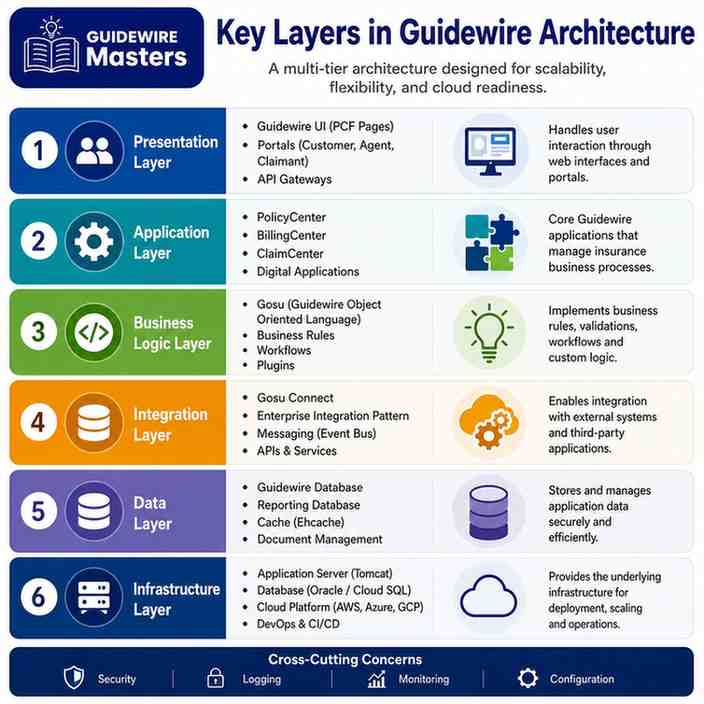
Key Layers in Guidewire Architecture
Presentation Layer
The presentation layer is the part of the system that users directly see and interact with. It includes the user interface, dashboards, and screens that agents, customers, and administrators use daily.
This layer is designed to be intuitive and user-friendly. It ensures that users can perform tasks without needing technical expertise. A well-designed presentation layer improves productivity and reduces training time.
Application Layer
The application layer contains the business logic. This is where all the rules, workflows, and processes are defined.
Think of it as the decision-making engine of Guidewire Architecture. It determines how data is processed, how rules are applied, and how workflows are executed.
Data Layer
The data layer is where all information is stored. It includes databases and data management systems.
This layer ensures data integrity and consistency. It plays a critical role in reporting, analytics, and decision-making.
Guidewire Integration Architecture
Types of Integrations
Integration is a crucial part of Guidewire Architecture. Without it, the system would operate in isolation, limiting its effectiveness.
There are several types of integrations, including system-to-system, third-party, and external service integrations. Each serves a specific purpose and helps create a connected ecosystem.
Integration Methods (SOAP, REST, Messaging)
Guidewire supports multiple integration methods, including SOAP, REST APIs, and messaging queues. These methods allow seamless communication between systems.
REST APIs are widely used due to their simplicity and scalability, while messaging ensures reliable asynchronous communication.
Guidewire Data Model Explained
Entities and Relationships
The data model in Guidewire Architecture is based on entities and relationships. Entities represent real-world objects like policies, customers, and claims.
Understanding these relationships is key to mastering Guidewire.
Customization of Data Model
Guidewire allows customization of its data model to meet specific business needs. This flexibility makes it highly adaptable.
Guidewire Cloud vs On-Premise Architecture
Key Differences
Cloud-based Guidewire offers scalability and reduced infrastructure costs, while on-premise provides more control.
Benefits of Cloud Adoption
Cloud adoption enables faster deployment, better scalability, and improved performance.
Steps to Understand Guidewire Architecture
Getting started with Guidewire Architecture can feel overwhelming, but breaking it down into structured steps makes it manageable and even enjoyable. The first step is to understand the core modules PolicyCenter, BillingCenter, and ClaimCenter. These are the foundation, and without a clear grasp of their roles, everything else will feel scattered. Spend time exploring how each module functions individually and how they interact with one another. Think of it like learning the basic rules of a game before trying advanced strategies.
The second step is to familiarize yourself with the layered architecture. Focus on how the presentation, application, and data layers interact. Visualizing this as a three-tier structure helps: the top layer handles user interaction, the middle processes logic, and the bottom stores data. Once you see how data flows between these layers, the system becomes far less intimidating.
Next, dive into integration concepts. Guidewire doesn’t operate in isolation, so understanding how it communicates with external systems is essential. Start with REST APIs since they are beginner-friendly, then gradually explore SOAP and messaging queues. Hands-on practice here makes a big difference.
Another important step is learning the data model. Begin with basic entities and slowly move toward more complex relationships. This helps you understand how information is structured and retrieved. Finally, practice using real-world scenarios. Try to map business processes like policy issuance or claim settlement within Guidewire. This practical approach bridges the gap between theory and application.

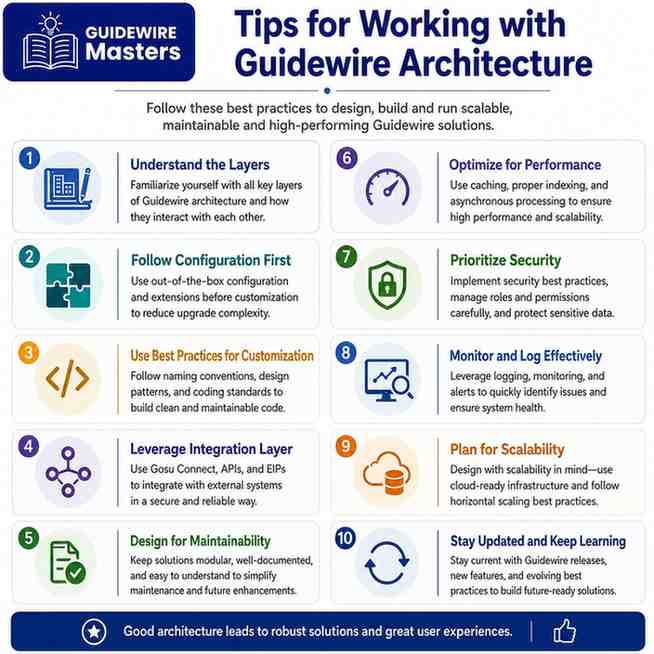
Tips for Working with Guidewire Architecture
Working efficiently with Guidewire Architecture requires more than just technical knowledge it demands strategy and smart practices. One of the most valuable tips is to always follow Guidewire’s best practices for customization. Avoid modifying core code directly, as it can create issues during upgrades. Instead, use extension points and configuration options provided by the platform.
Another useful tip is to maintain clear documentation. Guidewire systems can become complex over time, especially with multiple integrations and customizations. Keeping detailed documentation ensures that anyone working on the system can understand its structure and functionality without confusion.
Performance optimization is another critical area. Keep a close eye on system performance and proactively spot any bottlenecks before they impact efficiency.
Simple actions like optimizing database queries or reducing unnecessary API calls can significantly improve efficiency. Think of it like tuning a car engine, small adjustments can lead to big improvements.
Collaboration also plays a key role. Guidewire projects often involve cross-functional teams, including developers, business analysts, and testers. Effective communication ensures that everyone is aligned and working toward the same goals.
Lastly, stay updated with new features and updates from Guidewire. The platform evolves continuously, and keeping up with these changes helps you leverage new capabilities and stay competitive in the industry.
Future Trends in Guidewire Architecture
The future of Guidewire Architecture is closely tied to advancements in technology and evolving business needs. A key trend shaping the industry is the growing move toward cloud-based solutions. More organizations are moving to Guidewire Cloud to take advantage of scalability, flexibility, and reduced infrastructure costs.
Another trend is the integration of artificial intelligence and machine learning. These technologies are being used to automate processes, detect fraud, and improve decision-making. Imagine a system that can predict claim outcomes or identify suspicious activities in real time—that’s where Guidewire is headed.
API-driven architecture is also gaining prominence. With the rise of digital ecosystems, seamless integration with external systems is becoming more important than ever. Guidewire is continuously enhancing its API capabilities to support this trend.
User experience is another area of focus. Modern interfaces and intuitive designs are being developed to improve usability and productivity. This ensures that users can perform tasks quickly and efficiently.
Finally, data analytics and insights are becoming a key part of Guidewire Architecture. Advanced analytics tools are being integrated to provide actionable insights, helping businesses make informed decisions and stay ahead of the competition.
Conclusion
Guidewire Architecture serves as the backbone of modern insurance systems, offering a structured and scalable approach to managing complex operations. By understanding its core components, layers, and integration methods, even beginners can start to see how everything fits together. The platform’s flexibility and robust design make it a powerful tool for insurance companies looking to improve efficiency and customer experience.
Mastering Guidewire Architecture takes time and practice, but the effort pays off. With the right approach, clear understanding, and continuous learning, anyone can build expertise in this field. As technology continues to evolve, Guidewire remains a key player, adapting to new trends and setting standards in the insurance industry.
FAQs
1. What are the main components of Guidewire Architecture?
Guidewire Architecture refers to the framework and technical structure of Guidewire InsuranceSuite applications used by insurance companies to manage policies, billing, claims, integrations, and enterprise workflows efficiently.It includes application layers, integration frameworks, APIs, database architecture, cloud deployment models, workflows, and system communication between PolicyCenter, BillingCenter, and ClaimCenter.
2.Why is Guidewire Architecture important in the insurance industry?
Guidewire Architecture helps insurance companies build scalable, secure, and efficient enterprise applications. It improves policy administration, claims management, billing automation, customer experience, and digital transformation in the insurance IT industry.
3.What skills are required to learn Guidewire Architecture?
To learn Guidewire Architecture, professionals should understand:
- Insurance domain concepts
- Java basics
- Gosu programming
- APIs and web services
- Database concepts
- Cloud computing
- Integration frameworks
- Software architecture fundamentals
- Having good analytical thinking and effective problem-solving abilities can help professionals succeed in Guidewire Architecture and related insurance IT roles.
4.What is covered in the Guidewire Architecture syllabus in 2026?
The Guidewire Architecture syllabus in 2026 covers:
- InsuranceSuite architecture fundamentals
- Guidewire integration architecture
- REST and SOAP APIs
- Gosu scripting
- Cloud architecture concepts
- Database architecture
- Workflow configuration
- Messaging services
- Microservices concepts
- Real-time insurance projects
- PolicyCenter, BillingCenter, and ClaimCenter architecture
- Hands-on training helps learners gain practical industry-ready experienc
5.What are the career opportunities after learning Guidewire Architecture?
After learning Guidewire Architecture, professionals can apply for roles such as:
- Guidewire Developer
- Guidewire Architect
- Guidewire Integration Developer
- Guidewire Consultant
- Insurance Business Analyst
- Guidewire Cloud Developer
- Technical Lead
- Guidewire professionals are in high demand in insurance IT companies worldwide.
6.Why is Guidewire Architecture considered a strong career choice in 2026?
Guidewire Architecture offers excellent career opportunities in 2026 as the insurance technology industry continues adopting Guidewire solutions for modern insurance operations, cloud platforms, and enterprise system modernization.
7.What is the role of APIs in Guidewire Architecture?
APIs in Guidewire Architecture help different applications communicate securely and efficiently. REST APIs and SOAP-based web services are widely used to connect insurance platforms with payment systems, customer-facing portals, and external third-party applications for smooth data exchange and communication.
8.How does cloud technology impact Guidewire Architecture?
Cloud technology improves scalability, performance, security, and deployment flexibility in Guidewire Architecture. Modern Guidewire applications increasingly use Guidewire Cloud, AWS, and Azure for enterprise insurance solutions.
9.What is Gosu scripting in Guidewire Architecture?
Gosu is the programming language used in Guidewire applications. It helps developers customize business rules, workflows, integrations, validations, and insurance processes within PolicyCenter, BillingCenter, and ClaimCenter.
10.Does Guidewire Architecture require coding?
Guidewire Architecture involves coding, especially using Gosu scripting, APIs, integrations, workflows, and configuration logic. Basic programming knowledge helps learners understand customization and enterprise implementation concepts more effectively.

Mrs.Jyosna
GuidewireMasters | 25+ articles published
Guidewire experts passionate about helping learners build successful careers in the insurance IT industry. Through in-depth guides, real-time training, certification support, and industry-focused resources, Guidewire Masters simplifies Guidewire technologies and provides practical knowledge to help students and professionals grow their careers confidently.
Share