Guidewire PC Developer
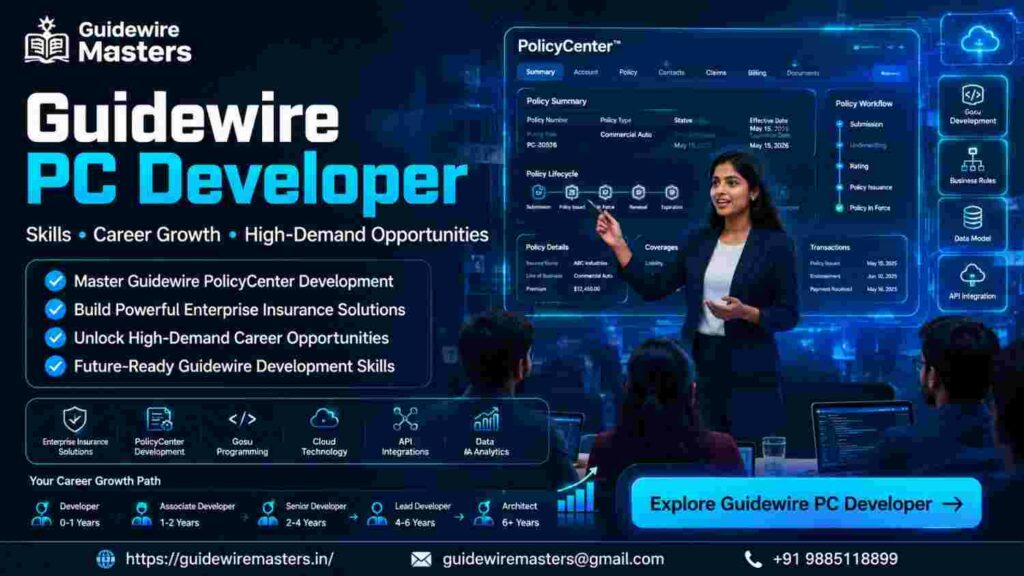
A Guidewire PC Developer builds and configures Guidewire PolicyCenter, the policy administration system used by property and casualty insurers. The role covers product model and data model configuration, Gosu business logic, UI and rules setup, and REST/SOAP integrations. Core skills include Gosu, Java fundamentals, SQL and the Guidewire Cloud Platform. Demand comes from insurers, consultancies and IT services firms running PolicyCenter implementations and cloud migrations.

- Sanjay
- August 24, 2026
- 9:41 am
Table of Contents
Every property and casualty insurer runs on three things: quoting a risk, issuing a policy, and paying a claim. Guidewire PolicyCenter handles the first two. When an insurer replaces a twenty-year-old policy administration system, it is a Guidewire PC Developer who turns underwriting rules, rating logic and product definitions into working software.
The scale is real. Guidewire’s corporate disclosures put its footprint at more than 570 insurers across 43 countries and 1,700+ completed implementations. In fiscal Q3 2026 (quarter ended 30 April 2026), it reported annual recurring revenue of $1,147 million, up 19% year over year, with total revenue up 27% — growth management attributed to core system modernisation and cloud migration. These figures come from Guidewire’s published investor relations disclosures.
That wave creates the work, and much of the global delivery runs from Hyderabad, Bengaluru, Pune and Chennai. This guide covers what a Guidewire PolicyCenter Developer does day to day, the architecture and skills involved, how the role is changing under Guidewire Cloud, and what a realistic career path looks like in India.
What is a Guidewire PC Developer?
A Guidewire PC Developer is a software developer who configures, extends and integrates Guidewire PolicyCenter for property and casualty insurers. The “PC” is short for PolicyCenter — not “personal computer” and not “property and casualty,” though PolicyCenter serves the P&C market.
The work sits across several layers:
- Product model configuration — defining lines of business, coverages, terms and availability rules
- Data model work — entity extensions, typelists, effective-dated structures
- Gosu development — business rules, validation, enhancements and utility logic
- UI configuration — PCF screens, field visibility, edit rules
- Integration development — REST APIs, SOAP services, messaging and events
- Testing, debugging and performance work — including production support
Configuration vs customisation
This distinction shapes almost every design decision on a PolicyCenter project. Configuration uses the mechanisms Guidewire provides — product model, typelists, rule sets, PCF files, APD. Customisation means code that departs from base product behaviour.
Configuration survives upgrades; customisation must be re-tested and often re-worked at every release. Since Guidewire Cloud updates on a fixed cadence and enforces an N-3 currency policy, heavy customisation is a direct cost, not just a maintainability preference. Guidewire’s Extension Layer exists precisely to keep custom work separate from core. See our guide on Guidewire configuration vs customization.
What is Guidewire PolicyCenter?
Guidewire PolicyCenter is a policy administration system that manages the full insurance policy lifecycle for personal and commercial P&C lines. It is part of Guidewire InsuranceSuite, alongside ClaimCenter and BillingCenter.
PolicyCenter handles these transaction types, each of which a developer will eventually configure or debug:
| Lifecycle Stage | What Happens |
|---|---|
| Submission | New business enters, is cleared against existing accounts, prepared for rating |
| Quote | Rating runs against the product model; quote versions can be compared |
| Issuance / Bind | Underwriting approves; the policy binds and a policy period is created |
| Policy Change (Endorsement) | Mid-term amendment re-rates the term and produces a premium delta |
| Renewal | The next term is generated, re-rated and offered |
| Cancellation | Early termination with a return premium calculation |
| Reinstatement | A cancelled policy is restored, usually after payment |
| Rewrite / Rebind | The policy is re-issued under changed terms |
Around these sit account management, contacts, producer management, activities, and the underwriting rules that gate each transition. If you are new to the product, the PolicyCenter step-by-step tutorial walks through these screens in order.
Guidewire PC Developer Roles and Responsibilities
Day to day, a Guidewire PolicyCenter Developer moves between requirement analysis, configuration, coding and defect resolution. Responsibilities differ sharply by seniority, and understanding that difference helps you target the right roles.
| Level | Typical Responsibilities |
|---|---|
| Junior | PCF screen changes, simple validation rules, typelist additions, defect fixes, unit testing, following existing patterns under review |
| Mid-level | Product model changes, rating table configuration, Gosu rule sets, REST/SOAP integrations, data model extensions, debugging production defects independently |
| Senior | Design ownership for modules, performance tuning, complex integration patterns, migration and upgrade work, code review, mentoring, technical decisions on configure-vs-customise |
Across all levels, documentation and code review are non-negotiable on insurance core systems: a misconfigured rating routine can misprice thousands of policies before anyone notices. Our breakdown of Guidewire job roles and responsibilities covers adjacent roles such as BA, tester and integration specialist.
Guidewire PC Developer Architecture
PolicyCenter is a Java-based enterprise application with a Gosu configuration layer on top. Developers need a working mental model of how a request travels through it.
Core request flow:
User → PolicyCenter UI (PCF) → Business Rules / Gosu → Domain (Entity) Model → Persistence Layer → Database
Outbound integration flow:
PolicyCenter → Integration Layer (APIs / Messaging / Integration Gateway) → External System → Response → PolicyCenter
The layers that matter most in practice:
- Presentation / UI — PCF files defining screens, widgets and field behaviour
- Business logic — rule sets (validation, pre-update, underwriting) executed at defined points in the bundle lifecycle
- Gosu layer — classes, enhancements and blocks carrying custom logic
- Entity / data model — entities, typelists, arrays and foreign keys defined in metadata
- Persistence — the bundle and commit mechanism that writes changes atomically
- Integration and messaging — REST APIs, SOAP services, app events, message destinations
- Batch processing — scheduled work items for renewals, purges and periodic jobs
- Security — roles, permissions and authority limits
Our Guidewire Architecture guide expands each layer, and the official Guidewire documentation is the authoritative reference for release-specific behaviour.
Guidewire PolicyCenter Modules a PC Developer Should Know
These functional areas connect end to end. A change in one usually ripples into another — which is why senior developers get paid for judgement, not just syntax.
- Policy Administration — the transaction engine covering all job types
- Product Model — the definitional backbone of what can be sold
- Rating — rate tables, rate routines and rating factors that produce premium
- Underwriting — rules, referrals, authority limits and blocking conditions
- Account Management — the container linking policies, contacts and producers
- Activities — the task and workflow layer driving user work queues
- Contacts and Producer Management — parties, agencies and commission-relevant relationships
Guidewire PC Developer Skills
Not every skill matters at once. The table separates what you need to start from what you need to progress.
| Skill | Priority | Why It Matters |
|---|---|---|
| Gosu | Essential from day one | The language for rules, enhancements and business logic |
| Java fundamentals & OOP | Essential | Gosu runs on the JVM; the mental model transfers directly |
| SQL | Essential | Debugging, data verification and migration work |
| PolicyCenter configuration | Essential | Product model, typelists, rules, PCF — the core of the job |
| Guidewire Studio | Essential | The IDE for configuration and Gosu development |
| Data model & effective dating | Essential by 6–12 months | The most common source of production defects |
| REST APIs / JSON | Important | The dominant integration pattern on Guidewire Cloud |
| SOAP / XML | Situational | Still present in older and on-premise implementations |
| Git, Jenkins, CI/CD | Important | Cloud delivery runs through automated pipelines |
| Messaging / Kafka / events | Advanced | Event-driven integration is increasingly standard |
| Docker / Kubernetes | Advanced | Context for cloud-native delivery and DevOps |
| P&C insurance domain | Compounding | Most reliably accelerates progression to lead and architect |
Fuller detail sits in our Guidewire skills guide.

Guidewire Gosu for PC Developers
Gosuis Guidewire’s statically typed, JVM-based programming language, used for business rules, entity manipulation and custom logic inside InsuranceSuite applications.
What a PC Developer actually writes in Gosu:
- Classes and methods for reusable utility logic
- Enhancements that add methods to entity types without modifying base code — a core maintainability technique
- Blocks (closures) for concise collection operations
- Queries using the Query API to retrieve entities efficiently
- Rule sets — validation, pre-update, underwriting and event rules
- Exception handling around integrations
The relationship worth internalising: Gosu + Java + the Guidewire framework. Gosu compiles to JVM bytecode and calls Java libraries directly, which is why Java developers ramp up quickly. But framework knowledge — bundles, effective dating, rule execution order — separates working code from correct code. Start with our Guidewire Gosu tutorial.
Guidewire PolicyCenter Configuration
Configuration work concentrates in a few areas:
- Product configuration — lines, coverages, terms, availability
- Data model configuration — entity extensions, typelists, arrays
- Business rules and validation — what must be true before a job can proceed
- UI configuration — PCF screens, field visibility, required-field logic
- Workflows and activities — how work routes to users
- Localisation and application configuration — display keys, jurisdictional variation
The maintainability principle is simple: solve it in configuration if configuration can solve it. Every avoided customisation is one less thing to regression-test at the next cloud update.
Guidewire PC Developer and the Product Model
The product model defines what an insurer can sell. It is hierarchical, and once you see the hierarchy the rest of PolicyCenter becomes far more readable.
Worked example — Personal Auto:
Personal Auto (Product) → Personal Auto Line → Vehicle (Coverable) → Liability Coverage → Limit & Deductible Terms → Rating → Premium
Key building blocks: products, lines, coverables, coverages, coverage terms (limits, deductibles, options), conditions, exclusions, modifiers and availability rules governing which combinations are legal in which jurisdiction.
Modern implementations increasingly build products in Advanced Product Designer (APD), a low-code tool that generates the underlying configuration. Guidewire also ships tooling to convert non-APD lines to APD, so familiarity with both approaches helps.
Guidewire PC Developer and the Data Model
PolicyCenter’s data model is metadata-driven. Understanding it is what lets you build solutions that scale rather than solutions that work in demo and break at volume.
| Concept | What It Means in Practice |
|---|---|
| Entity | A persistent business object (Policy, Account, Contact) defined in metadata |
| Typelist | A controlled set of allowed values — extending one is a common early task |
| Entity extension | Adding fields without altering the base definition |
| Effective dating | Lets one policy hold different values across time slices; central to endorsements and out-of-sequence changes |
| Retireable entities | Soft-delete — records are retired, not physically removed |
| Arrays & foreign keys | How one-to-many and one-to-one relationships are expressed |
| Bundle | The unit of work; all changes commit together or not at all |
Effective dating deserves special attention — it is the most common source of subtle defects for developers new to the platform. Our Guidewire data model guide goes deeper.
Guidewire PC Developer Integration Skills
No insurer runs PolicyCenter in isolation. A typical implementation connects to rating engines, document generation, payment providers, CRM, identity and downstream analytics systems.
Example flow — external rating:
PolicyCenter (Quote) → Integration Layer → External Rating System → Rate Response → PolicyCenter → Premium Displayed
What you will work with:
- Cloud APIs (REST/JSON) — the primary pattern on Guidewire Cloud, with the Schema Editor available for managing API extensions
- SOAP web services — still common in legacy and hybrid landscapes
- Integration Gateway — Guidewire’s cloud service for orchestrating outbound flows
- App events and messaging — publishing business events to downstream systems without custom code
- Integration Data Manager — storing third-party data outside the core application
Integration developers typically command a premium over pure-configuration peers because the failure modes are harder and the debugging spans systems.
Guidewire PC Developer and Guidewire Cloud
This is the most important shift in the role, and the one most likely to be out of date in older training material.
Guidewire Cloud Platform ships on a continuous release cadence, with releases named after ski destinations in alphabetical order. Recent Guidewire Cloud Platform releases: Qusar (August 2026), Palisades (April 2026), Olos (December 2025), Niseko (August 2025) and Mammoth (April 2025).
What this changes for developers:
- Upgrades became updates. Staying current is continuous. Certifications carry an N-3 rule — stay within three releases.
- CI/CD is the delivery path. Quality gates, automated testing and pipeline familiarity are baseline expectations now.
- Customisation is architecturally discouraged. The Extension Layer and Package Manager keep custom work modular and independently updatable.
- AI tooling sits inside the developer workflow. Qusar made Developer Assistants for Gosu, integrations and Jutro generally available, and introduced an Agentic Framework for building governed AI agents with native core-system access.
- New PolicyCenter capabilities keep arriving — Qusar shipped a Quoting Service for async quoting and external rating routing, plus Rebind Transaction, Schedule Management and a Renewal Insights Dashboard.
Release features move between Early Access, Restricted Access and Generally Available. Check current Guidewire documentation for the release your project runs.
See our overviews of Guidewire Cloud and Guidewire Cloud services.
Guidewire PC Developer Tools
| Tool / Technology | Purpose |
|---|---|
| Guidewire Studio | Primary IDE for configuration, Gosu development and PCF editing |
| Gosu | Business logic, rules and entity manipulation |
| Advanced Product Designer (APD) | Low-code product model design and generation |
| SQL | Data verification, debugging and migration analysis |
| Git | Source control for configuration and code |
| Jenkins / CI-CD pipelines | Automated build, test and deployment |
| REST APIs (Cloud API) | Modern system integration |
| SOAP web services | Integration with established enterprise systems |
| Integration Gateway | Cloud-based outbound integration orchestration |
| Kafka / app events | Event streaming and real-time data flows |
| Docker / Kubernetes | Containerisation and orchestration context |
| Guidewire Cloud Platform | Deployment, observability and platform services |
Guidewire PC Developer vs General Guidewire Developer
| Factor | Guidewire PC Developer | General Guidewire Developer |
|---|---|---|
| Primary Product | PolicyCenter | Any of PolicyCenter, ClaimCenter, BillingCenter |
| Core Responsibilities | Product model, rating, underwriting rules, policy transactions | Varies — claims workflows, billing plans or policy admin |
| Main Skills | Gosu, product model, data model, PolicyCenter configuration | Gosu, InsuranceSuite fundamentals, cross-product configuration |
| Insurance Knowledge | Underwriting, rating, policy lifecycle | Broader — may span claims and billing |
| Integrations | Rating engines, document generation, producer and CRM systems | Payment gateways, claims vendors, document systems |
| Career Opportunities | Deep specialisation; policy is where most implementations begin | Broader mobility across InsuranceSuite programmes |
| Typical Projects | New product launches, rating changes, policy admin modernisation | Full suite implementations, cloud migrations |
A Guidewire PC Developer is a specialist; a general Guidewire Developer is a generalist. Specialisation usually pays better earlier; breadth pays better at architect level.
Guidewire PC Developer vs Java Developer
| Factor | Guidewire PC Developer | Java Developer |
|---|---|---|
| Technology | Gosu on the Guidewire framework (JVM-based) | Java, Spring and general-purpose frameworks |
| Domain | P&C insurance — specialised | Cross-industry — general |
| Programming | Configuration-first, code where necessary | Code-first |
| Framework | Prescriptive; base product defines patterns | Flexible; architecture chosen per project |
| Skills | Product model, data model, rating, integrations, insurance domain | Core Java, frameworks, databases, system design |
| Project Types | Core system implementation and cloud migration | Web, enterprise and microservice applications |
| Career Growth | Developer → Lead → Architect within the Guidewire ecosystem | Broader but more competitive market |
| Talent Supply | Narrow — fewer trained professionals | Very large |
Java experience transfers well. The JVM foundation, OOP thinking and debugging instincts all carry over. What Java developers must add is the insurance domain and the framework’s conventions — and that, not syntax, is the real learning curve.
Guidewire PC Developer Salary in India
Compensation is driven by experience first, then by the depth of your PolicyCenter, integration and cloud skills. Employer type matters too: product companies and captive insurer GCCs typically pay above pure services firms for comparable experience.
| Experience Level | Typical Salary Range (INR) |
|---|---|
| Fresher / 0–2 years | ₹4 – ₹7 LPA |
| 3–5 years | ₹10 – ₹16 LPA |
| 6–9 years | ₹16 – ₹28 LPA |
| 10+ years | ₹28 – ₹60+ LPA |
These are indicative ranges compiled from publicly reported salary data and Indian market hiring patterns. Actual compensation varies by employer, city, project, certification status, negotiation and prevailing market conditions. They are estimates, not guaranteed offers.
Factors that move you within a band: PolicyCenter depth, Gosu fluency, integration experience, Guidewire Cloud and DevOps skills, insurance domain understanding, certification, and whether you carry design or leadership accountability. For city-level and role-level detail, see Guidewire salaries in India.
Guidewire PC Developer Jobs in India
Job titles you should be searching for — the wording varies more than the work does:
- Guidewire PolicyCenter Developer
- Guidewire PC Configuration Developer
- Guidewire PolicyCenter Rating Developer
- Guidewire Integration Developer (PolicyCenter)
- Senior PolicyCenter Developer
- Guidewire Technical Lead
- Guidewire Solution / Technical Architect
Main hiring hubs: Hyderabad, Bengaluru, Pune, Chennai, Mumbai, Gurugram, Noida and Delhi NCR, with Kolkata active through delivery centres.
A practical search tip: pair the platform term with a skill term rather than searching “Guidewire” alone. “PolicyCenter Gosu”, “PolicyCenter rating” and “Guidewire Cloud integration” surface far more relevant postings than the product name by itself.
Companies Hiring Guidewire PC Developers
Guidewire work reaches India through three channels: global system integrators, consulting firms, and captive Global Capability Centres run by insurers themselves.
Organisations with established Guidewire practices include Accenture, Cognizant, Capgemini, Infosys, Wipro, TCS, HCLTech, Tech Mahindra, LTIMindtree, Deloitte, EY and PwC, alongside specialist insurance-technology firms and insurer-owned GCCs.
They hire because a single insurer’s PolicyCenter programme runs for years, and cloud migration has added a second wave of work on top of new implementations. That said, hiring is project-driven — no company hires continuously in every location, and demand cycles with programme starts and go-lives.
Guidewire PC Developer Career Path
| Career Level | Focus Skills |
|---|---|
| Beginner | P&C insurance basics, Java fundamentals, Gosu syntax |
| Junior Developer | PolicyCenter configuration, product model, data model, PCF screens |
| Mid-Level Developer | Advanced Gosu, rating, integrations, workflows, debugging |
| Senior Developer | Module design, performance tuning, complex integrations, technical ownership |
| Technical Lead | System design, cloud delivery, team leadership, client communication |
| Architect | Enterprise architecture, cloud strategy, integration landscape, solution design |
Progression: Beginner → PC Developer → Senior PC Developer → Technical Lead → Guidewire Architect. See the fuller Guidewire developer career roadmap.
How to Become a Guidewire PC Developer
Step 1 — Learn insurance fundamentals. P&C basics: policy, coverage, premium, deductible, underwriting, endorsement, claim. Without this, configuration decisions will feel arbitrary.
Step 2 — Build Java fundamentals. OOP, classes, interfaces, collections, exceptions. You do not need to be a Java expert; you need the mental model.
Step 3 — Learn Gosu. Syntax, type system, blocks, enhancements, the Query API and rule sets.
Step 4 — Master PolicyCenter. Product model, data model, PCF configuration, rules, workflows, activities. This is the longest step and the one worth the most.
Step 5 — Learn integrations. REST, SOAP, JSON, XML, messaging and app events.
Step 6 — Build project experience. Work through realistic scenarios end to end — configure a product, rate it, quote it, issue it, endorse it. See real-time Guidewire project examples.
Step 7 — Learn Guidewire Cloud. Platform concepts, CI/CD, observability, the update model and the Extension Layer approach to customisation.
Step 8 — Prepare for interviews. Practise explaining your own project decisions, not just definitions. Our Guidewire interview questions guide is a useful drill set.
Guidewire PC Developer Projects
Project 1 — Personal Auto. Configure the product model, set up vehicle and driver coverables, build rate tables and routines, generate a quote, apply underwriting rules and issue the policy. The canonical first project: it exercises the full path from product definition to premium.
Project 2 — Home Insurance. Property coverables, dwelling and contents coverages, underwriting referral rules, then the full lifecycle: renewal, mid-term endorsement, cancellation and reinstatement. Teaches effective dating properly.
Project 3 — Commercial Insurance. Multi-line products, schedules of values, complex validation and an external integration such as a rating call or document generation service. This is the project that makes a resume credible for mid-level roles.
Interviewers can tell within minutes whether you have debugged a real rating issue or only read about one. Browse more Guidewire projects.
Guidewire PC Developer Interview Preparation
Expect questions across these areas: PolicyCenter architecture, Gosu, product model, data model, typelists, effective dating, rule sets, workflows, PCF configuration, integrations (REST and SOAP), messaging, batch processes, performance tuning, debugging and production support.
Scenario questions you should be able to answer out loud:
- A mid-term endorsement is producing an incorrect premium delta. How do you diagnose it?
- An out-of-sequence policy change is applied after a later transaction already exists. What does effective dating do, and what breaks?
- You need a new field on Policy visible only for one jurisdiction. Configuration or customisation — and why?
- An outbound rating call intermittently times out. How do you make the integration resilient without blocking quoting?
- A batch process is running past its window after a data volume increase. Where do you look first?
Guidewire PC Developer Certification
Guidewire’s certification programme is run through Guidewire Education and, per its official certification pathways for developers, is organised into two levels:
- Guidewire Certified Associate — validates that you can apply Guidewire fundamentals and best practices to implement and support products on Guidewire Cloud, with guidance from a certified Ace.
- Guidewire Certified Ace — the highest level, for professionals who can design and lead solutions. Required for cloud leads.
Certifications sit in role-based pathways: InsuranceSuite Configuration / Core Developer (the standard PC Developer path), InsuranceSuite Cloud Integration Developer, and Jutro Digital Experience Developer. The core-developer Ace requires the relevant Associate certification, advanced PolicyCenter courses and a proctored exam.
Older articles still reference retired tiers such as “Certified Specialist” and “Certified Professional”. Guidewire’s current published structure is Associate and Ace. Verify against Guidewire Education before planning an exam.
Two practical points. Certification is required for professionals working on Guidewire Cloud implementations under Guidewire’s own cloud standards, so it is often a project prerequisite rather than a nice-to-have. And it is release-bound: fall more than three releases behind and you retake proctored exams.
Certification signals verified competence but does not substitute for delivery experience. Employers hire for both. Read our Guidewire certifications guide.
Why Become a Guidewire PC Developer?
The case for: a narrow talent pool relative to demand; mission-critical systems insurers fund seriously; multi-year project cycles that create stability; a clear ladder from developer to architect; and global exposure, since Indian teams work directly on North American, European and APAC programmes.
The case against, honestly stated: the skill is platform-specific and less portable than general software engineering. Demand tracks the P&C modernisation cycle, not the whole tech market. Learning resources are thinner than for mainstream languages, real environment access usually requires an employer or training provider, and certification needs ongoing maintenance.
For most people the trade is worth it — but it is a trade, better made with open eyes.
Future Scope of Guidewire PC Development
- Cloud migration is moving from early adoption to mainstream, sustaining a multi-year pipeline of re-platforming work.
- AI inside the platform. Qusar made Developer Assistants generally available and introduced an Agentic Framework. This shifts developer value toward design judgement and review rather than raw code volume.
- API-first and event-driven architecture makes integration skills more central than configuration alone.
- Low-code product design via APD reduces manual configuration effort while raising the premium on people who understand the underlying model.
- Continuous delivery makes upgrade-safe, modular design a core competency.
The direction is consistent: less repetitive configuration, more design, integration and domain judgement. Developers who invest in cloud, integration and insurance depth are positioned well; those who stay purely on legacy on-premise configuration are not.
Guidewire PC Developer Skills Checklist
| Skill Category | Skills |
|---|---|
| Programming | Gosu, Java fundamentals, OOP |
| Database | SQL, query optimisation basics |
| Guidewire Product | PolicyCenter, Guidewire Studio, APD |
| Configuration | Product model, rating, rules, PCF/UI, workflows |
| Data | Entities, typelists, effective dating, bundles |
| Integration | REST/Cloud API, SOAP, JSON, XML, Integration Gateway |
| Messaging | App events, Kafka, message destinations |
| Cloud | Guidewire Cloud Platform, Extension Layer, observability |
| DevOps | Git, Jenkins, CI/CD, automated testing |
| Domain | P&C insurance, underwriting, policy lifecycle |
Statistics and Market Trends
Verified figures, with sources named:
- Customer base: more than 570 insurers in 43 countries, with 1,700+ successful implementations — Guidewire corporate disclosures, FY2026 filings.
- Business momentum: ARR of $1,147 million as of 30 April 2026, up 19% year over year; quarterly revenue up 27%; FY2026 ARR guidance of $1,229–$1,237 million — Guidewire Q3 FY2026 results, 4 June 2026.
- Cloud demand: 11 cloud wins in Q3 FY2026, with management citing core system modernisation and cloud migration as primary drivers — Q3 FY2026 earnings call.
- Release cadence: Qusar (August 2026), Palisades (April 2026), Olos (December 2025), Niseko (August 2025) — Guidewire Cloud Platform release page.
- Indian non-life market: FY26 premiums reached approximately ₹3.4 lakh crore, growing 9.3% year over year versus 6.2% in FY25 — CareEdge Ratings, using General Insurance Council and IRDAI data.
- Market structure: 74 registered insurers and reinsurers as of March 2025; non-life penetration roughly 1.0% of GDP — IRDAI Annual Report 2024–25.
Industry observations, not verified statistics: Guidewire skills are widely reported as scarce relative to demand in India, and cloud-capable professionals are understood to command a premium. These are consistent patterns in hiring commentary rather than measured figures.
Guidewire PC Developer Career Opportunities in India
Opportunities concentrate in IT services and consulting, insurance-technology specialists, systems integration, digital transformation programmes, insurer-owned Global Capability Centres and product implementation teams. The typical progression is Senior Developer → Technical Lead → Technical Architect → Solution Architect, with Hyderabad and Bengaluru carrying the deepest concentration of Guidewire delivery work.
Conclusion
PolicyCenter is where a P&C insurer’s revenue engine lives, and a Guidewire PC Developer is the person who makes it work. The role rewards a specific combination: Gosu fluency, disciplined configuration over customisation, a solid grasp of the product model and data model, real integration capability, and enough insurance knowledge to know why a rule exists before changing it.
The platform is not standing still. Continuous cloud releases, AI-assisted development tooling and low-code product design are moving developer value away from repetitive configuration and toward design, integration and judgement — good news for anyone willing to keep learning.
If you are starting out, the sequence is straightforward: insurance fundamentals, Java basics, Gosu, PolicyCenter configuration, integrations, real projects, then cloud. Work each step properly rather than skipping ahead — depth is what employers pay for.
Frequently Asked Questions
1. What is a Guidewire PC Developer?
A Guidewire PC Developer is a developer who configures, extends and integrates Guidewire PolicyCenter for property and casualty insurers. “PC” stands for PolicyCenter.
2. What does a Guidewire PolicyCenter Developer do?
They configure the product model and data model, write Gosu business rules, set up rating and underwriting logic, build REST and SOAP integrations, and support the policy lifecycle from quote through renewal.
3. What skills are required to become a Guidewire PC Developer?
Gosu, Java fundamentals, SQL, PolicyCenter configuration, the data model and effective dating, REST/SOAP integration, Git and CI/CD, plus working knowledge of P&C insurance.
4. Is Guidewire PC development a good career?
It offers strong demand, long project cycles and a clear path to architect roles because the talent pool is narrow. The trade-off is that the skill is platform-specific and tied to the insurance modernisation cycle.
5. What is the salary of a Guidewire PC Developer in India?
Indicative ranges run from around ₹4–7 LPA for freshers to ₹10–16 LPA at 3–5 years, ₹16–28 LPA at 6–9 years, and ₹28 LPA and above for architect-level roles. Actual pay varies by employer, city and skills.
6. Is Gosu required for PolicyCenter development?
Yes. Gosu is Guidewire’s native language for business rules, enhancements and entity logic. Configuration-only roles exist, but developer roles require Gosu.
7. Is Java required to become a Guidewire PC Developer?
Java is not strictly mandatory, but strongly recommended. Gosu runs on the JVM and interoperates with Java, so the OOP mental model transfers directly and shortens the learning curve.
8. What is the difference between a Guidewire PC Developer and a Guidewire Developer?
A PC Developer specialises in PolicyCenter — product model, rating and policy lifecycle. A general Guidewire Developer may work across PolicyCenter, ClaimCenter and BillingCenter.
9. How long does it take to learn Guidewire PolicyCenter?
With focused study, most learners reach a working configuration level in roughly three to six months. Guidewire notes that new developers can prepare for the Certified Associate exam in two to three weeks of course preparation, though genuine project competence takes longer.
10. What is the future of Guidewire PolicyCenter development?
The role is shifting toward cloud-native delivery, API-first integration, low-code product design through APD, and AI-assisted development. Configuration volume decreases; design, integration and domain judgement become more valuable.

Mrs.Jyosna
GuidewireMasters | 25+ articles published
Guidewire experts passionate about helping learners build successful careers in the insurance IT industry. Through in-depth guides, real-time training, certification support, and industry-focused resources, Guidewire Masters simplifies Guidewire technologies and provides practical knowledge to help students and professionals grow their careers confidently.
Share