Guidewire PolicyCenter Data Model
The Guidewire PolicyCenter Data Model is the metadata-driven, object-oriented structure that defines how policy administration data — accounts, policies, policy periods, coverages, and contacts — is stored, related, and versioned inside PolicyCenter. It matters because every configuration, rule, integration, and screen reads from this model. Developers who master its entities, typelists, effective dating, and relationships can customize PolicyCenter safely and unlock high-paying insurance-technology careers

- Sanjay
- July 6, 2026
- 6:01 am
Table of Contents
Introduction
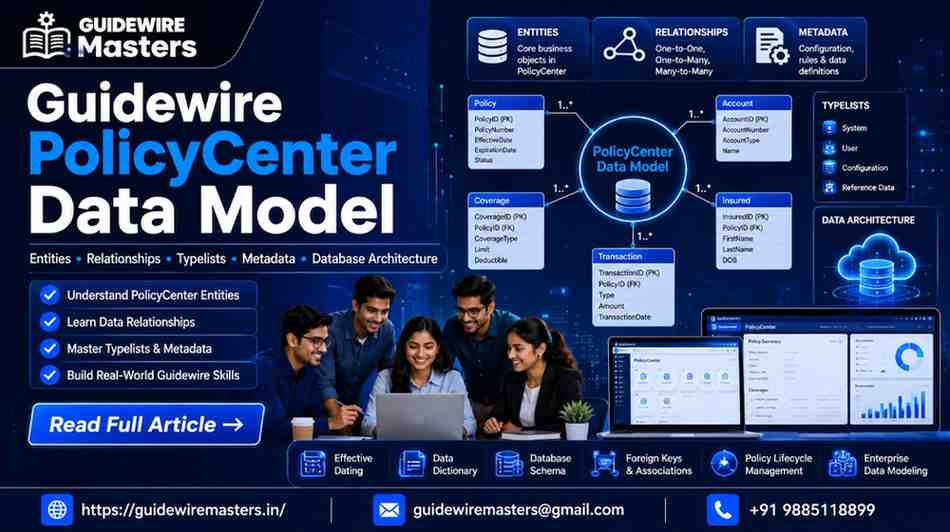
The data model is essential for every Guidewire developer because everything in the platform is built on top of it. Product model definitions, Gosu business rules, PCF screen bindings, and every REST or messaging integration ultimately read from and write to entities defined in the model. The data model is not a side topic you learn after the basics — it is the basics. It sits at the heart of Guidewire PolicyCenter and shapes how the entire policy administration lifecycle behaves.
The model directly supports insurance policy administration by giving structure to real-world concepts: a customer becomes an Account, a sold policy becomes a policy with one or more Policy period versions, each transaction (new business, endorsement, cancellation) becomes a job, and every insured item, coverage, and party is captured as a related entity. Because insurance is inherently time-sensitive — coverage changes mid-term, premiums recalculate, endorsements backdate — the model uses effective- dated entities.
What is Guidewire PolicyCenter?
The Guidewire PolicyCenter Data Model is the complete, metadata-driven definition of every business object PolicyCenter uses to run property and casualty insurance operations. It describes the entities , their fields, the typelists that constrain their values, and the relationships that connect them into a coherent policy administration system.
The data model exists to translate messy real-world insurance concepts into a structured, queryable, versioned representation that software can reliably operate on. It ensures that a policy, a renewal, and a coverage mean the same thing everywhere in the application — in rules, screens, batch processes, and integrations.
Guidewire PolicyCenter Data Model Architecture
The architecture of the data model is what makes Guidewire flexible and upgrade-friendly. Rather than hardcoding a fixed database schema, Guidewire generates the model from metadata, giving configuration teams a controlled way to extend the platform.
Metadata-driven design
Entities, fields, typelists, and relationships are declared in metadata files (for example, entity definitions in .eti files and extensions in .etx files). At build time, Guidewire reads this metadata and generates the corresponding Java/Gosu classes and the physical database tables.
Object-oriented architecture
Every entity is exposed as an object with typed properties and methods. Entities support inheritance through subtypes (for example, specialized Contact subtypes such as Person and Company), so shared behavior lives in a parent and specifics live in children. Developers interact with these objects in Gosu much like any object-oriented language.
Persistence framework
Guidewire includes its own object-relational persistence layer. When you load, modify, and commit a business object, the framework tracks changes in a “bundle” and writes them to the database transactionally. Developers rarely write SQL directly; instead they use the Query API and Gosu, and the persistence framework handles the mapping.
Database mapping
Each entity maps to a database table, each field to a column, and each foreign key or array to the appropriate relational construct. Guidewire manages primary keys and a public-facing Public Id, plus system columns for optimistic locking and effective dating. Because the mapping is generated from metadata, the schema stays consistent with the object model automatically.
Core Components of Guidewire PolicyCenter Data Model
The Guidewire PolicyCenter Data Model is assembled from a small set of reusable building blocks. Understanding each one — and how they combine — is the practical core of Guidewire configuration.
| Component | What it is | Practical example |
|---|---|---|
| Entities | Business objects that map to database tables | Policy, Account, PolicyPeriod |
| Entity Extensions | Add fields/relationships to base entities safely | Add LoyaltyTier to Account via an .etx file |
| Typelists | Controlled lists of allowed values | PolicyStatus, Gender, State |
| Foreign Keys | A field pointing to one row of another entity | PolicyPeriod.Policy points to a Policy |
| Arrays | The “one-to-many” side of a relationship | Policy.Periods is an array of PolicyPeriod |
| Relationships | Links between entities (via FKs and arrays) | Account ↔ Policy ↔ PolicyPeriod |
| Metadata | The declarations that define the whole model | .eti, .etx, .tti, .ttx files |
| Columns | Physical fields on the table | EffectiveDate, ExpirationDate |
| Indexes | Structures that speed up lookups | Index on Account.AccountNumber |
Guidewire Entity Model Explained
The Guidewire Entity Model — a central pillar of the wider Guidewire data model — is the catalog of business objects and the rules governing how they behave. Entities fall into several important categories.
- Base Entities — shipped with the platform (e.g.,
Account,Policy,Contact). You extend them; you do not modify their originals. - Custom Entities — entirely new objects you create for business needs the base model doesn’t cover, such as a custom
InspectionReportentity. - Effective-Dated Entities — objects that keep a full history of changes over time, like
PolicyPeriod. Crucial for insurance, where mid-term edits must not overwrite history. - Retireable Entities — objects that can be logically retired (soft-deleted) rather than physically removed, preserving auditability.
- Editable Entities — standard objects that can be created and modified within a transaction bundle.
- Version Lists — the mechanism that groups all effective-dated versions (slices) of an entity so the system can reconstruct any point in time.
Entity lifecycle. A business object is loaded into a bundle, modified in memory, validated, and then committed to the database as a single transaction. Effective-dated entities add a versioning dimension on top of this, so a single logical policy can have many stored versions.
Guidewire Typelists Explained
Typelists are one of the most-used and most-misunderstood parts of the model. A typelist is a controlled set of allowed values for a field — Guidewire’s version of a strongly typed enumeration backed by the database.
- Internal typelists — values the platform depends on internally; these should not be altered.
- Custom typelists — new lists you define for business-specific choices.
- Typecodes — the individual entries within a typelist (e.g., Active, Cancelled, Expired within PolicyStatus).
- Categories — a way to group typecodes so one typelist can filter another (for example, filtering coverage options by product line).
Extending typelists. You add new typecodes through a typelist extension (.ttx) file rather than editing the base typelist — the same upgrade-safe principle used for entities. Best practices: use clear, stable codes; never reuse a retired code for a new meaning; prefer categories over hardcoded conditional logic; and document business meaning for each typecode.
Relationships in Guidewire PolicyCenter Data Model
Relationships define how entities connect, and they are implemented through foreign keys and arrays. Getting relationships right is what turns a pile of tables into a working policy administration system.
Relationship | Meaning | Insurance example |
One-to-One | One record links to exactly one other | A PolicyPeriod to its primary UWCompany |
One-to-Many | One parent owns many children (array side) | One Policy → many PolicyPeriod versions |
Many-to-Many | Records on both sides link to many of the other | Producer ↔ PolicyPeriod via a join entity |
Parent-Child | Ownership; child is deleted with the parent | PolicyPeriod owns its Coverage rows |
Foreign keys implement the “to-one” direction: a field on one entity holds a reference to a single row of another. Arrays implement the “to-many” direction: the parent exposes a collection of child rows. A one-to-many relationship is simply a foreign key on the child paired with an array on the parent.
Cascading relationships. Owned children participate in cascade behavior — when a parent PolicyPeriod is removed, its owned coverages and exposures go with it, keeping the database consistent. Non-owned references do not cascade, because those objects live independently.

Effective-Dated Data Model in Guidewire PolicyCenter
Effective dating is the feature that makes Guidewire genuinely suited to insurance, and it is the concept new developers most need to master. Because policies change over time and those changes must be tracked precisely, PolicyCenter stores time-aware versions of key entities.
- Effective dating — every change is recorded with the date it takes effect, not just the date it was entered.
- Branches — a PolicyPeriod branch represents one line of change (for example, an in-progress endorsement) that can be quoted and bound independently.
- Slices — a slice is the state of the policy as of a specific effective date; the system “slices” the version history to view any moment.
- Windows — an effective-dated window is the span between two dates during which a particular set of values applies.
- Policy Period — the term of coverage (e.g., a 12-month auto policy) that anchors all effective-dated data.
- Versioning — multiple stored versions let PolicyCenter reconstruct exactly what the policy looked like on any date.
Guidewire PolicyCenter Database Architecture
Under the object model sits a relational database, and understanding how the two connect helps developers write performant, upgrade-safe configuration.
Layer | Role in the data model |
Database schema | Physical tables generated from entity metadata |
ORM framework | Maps objects ↔ rows; manages the change bundle |
Metadata | Source of truth from which schema and classes are generated |
Persistence layer | Commits bundles transactionally, enforces locking |
Entity mapping | Entity → table, field → column, FK → relationship |
Primary keys | Internal ID plus a stable PublicID |
Foreign keys | Enforce referential links between tables |
Indexes | Accelerate frequent lookups and joins |
Performance optimization. Because effective-dated entities can accumulate many rows, well-chosen indexes and lean queries matter. Retrieve only the fields you need, prefer the Query API over loading large object graphs, and index columns used in frequent filters. These habits keep large policy portfolios responsive.
Guidewire PolicyCenter Data Model Customization
Customization is where the data model’s design pays off — but only if you follow the upgrade-safe path, the same discipline that governs a full PolicyCenter implementation project.
- Adding custom entities — create new objects (with an _Ext or company suffix by convention) for concepts the base model lacks.
- Extending existing entities — add fields and relationships to base entities via extension files instead of editing base definitions.
- Adding fields — introduce new columns with appropriate data types, nullability, and defaults.
- Extending typelists — add typecodes to support new business values.
- Custom metadata — declare indexes, foreign keys, and arrays to support your extensions.
- Database upgrade considerations — every schema change must migrate cleanly; plan for data conversion when altering existing structures.
Guidewire PolicyCenter Data Model Best Practices
These conventions align with the fundamentals covered in Guidewire documentation guide, which is worth keeping open while you design entities and plan extensions.
- Naming conventions — use clear, consistent names and the standard extension suffix so custom elements are instantly identifiable.
- Performance optimization — load only what you need and avoid pulling large object graphs into memory unnecessarily.
- Indexing — index columns used in frequent filters and joins; avoid over-indexing write-heavy tables.
- Avoiding unnecessary joins — design relationships around real access patterns rather than adding links “just in case.”
- Entity design — model real business concepts; keep each entity focused on a single responsibility.
- Database normalization — normalize to reduce redundancy, denormalizing only with a measured performance reason.
- Upgrade-safe customization — always extend, never overwrite base definitions.
Guidewire PolicyCenter Data Model and Integrations
The data model is also the contract that integrations speak to. Whatever the transport, external systems ultimately read and write the same entities.
- REST APIs — modern Guidewire Cloud integrations expose entity data as JSON resources through the Cloud API.
- SOAP web services — traditional integrations use SOAP endpoints for request/response exchanges.
- JSON & XML — the two dominant payload formats; JSON dominates REST, XML underpins SOAP and many legacy feeds.
- Integration Gateway — the cloud-native layer for building and hosting integrations outside the core application.
- Messaging & Kafka — event-driven flows publish entity changes so downstream systems stay in sync; many modern architectures use Apache Kafka as the streaming backbone.
- Middleware & third-party systems — billing, document, rating, and analytics platforms — including Guidewire Data Hub — all bind to data-model entities through these channels.
Because integrations depend on entity and field names, a stable, well-designed data model keeps external interfaces resilient
Common Guidewire PolicyCenter Entities
These are the entities you will touch most often when configuring the PolicyCenter application. Knowing how they relate is the fastest way to become productive.
Entity | Represents | Relates to |
Account | The customer/organization holding policies | Owns many Policy records |
Policy | A logical insurance policy over time | Belongs to Account; owns PolicyPeriods |
PolicyPeriod | An effective-dated term/version of a policy | Owns PolicyLine, Coverage |
Job | A transaction (Submission, Policy Change, Renewal, Cancellation) | Drives a PolicyPeriod |
Producer | Agent/broker who sells the policy | Linked to PolicyPeriod |
PolicyLine | A line of business (e.g., auto, property) | Under PolicyPeriod; owns coverages |
Coverage | A specific protection with limits/deductibles | Under PolicyLine |
Vehicle / Driver | Insured item and rated operator (auto) | Under the auto PolicyLine |
Contact | People/companies (insured, additional interests) | Linked to policy roles |
Address | Physical location data | Attached to Contact/risk |
Activity / Note / Document | Work items, annotations, and attachments | Attached to accounts/policies/jobs |
The through-line is clear: an Account holds Policy records; each policy is realized as effective-dated PolicyPeriod versions driven by Job transactions; and each period contains lines, coverages, insured items, contacts, and supporting work items.
Guidewire PolicyCenter Data Model Career Opportunities in India
Demand for Guidewire talent in India is strong and rising, driven by global insurers modernizing onto the platform and by consulting firms staffing large transformation programs. Data-model expertise sits at the center of nearly every configuration role, making it one of the most bankable Guidewire skills.
Common roles include Guidewire developer, configuration analyst, integration developer, business analyst, and technical architect. India’s insurance sector — overseen by the regulator IRDAI — continues to digitize, adding domestic demand on top of the export-oriented consulting work. Global opportunities are equally real: Guidewire skills transfer directly to projects in the US, UK, Europe, and APAC.
Guidewire Training in Hyderabad from is built specifically around the configuration and data-model skills employers screen for. To understand exactly what these positions involve day to day, review our breakdown of Guidewire job roles and responsibilities.
Top Companies Hiring Guidewire PolicyCenter Developers
The firms below run large Guidewire practices and recruit PolicyCenter talent consistently, largely because they lead insurance-modernization programs for global P&C carriers.
Company | Why they hire Guidewire developers |
Accenture | Major Guidewire delivery partner on global implementations |
Cognizant | Large insurance practice with ongoing PolicyCenter programs |
Capgemini | Runs end-to-end Guidewire transformation projects |
Infosys | Strong insurance vertical and Guidewire capability |
Wipro | Delivers configuration and integration engagements |
TCS | Extensive P&C modernization portfolio |
Deloitte / EY / PwC | Advisory-led Guidewire implementation and QA |
LTIMindtree | Dedicated Guidewire teams across multiple accounts |
Guidewire PolicyCenter Developer Salary in India
Guidewire pays a premium over generic development roles because the skills are specialized and demand outstrips supply. The ranges below are indicative and vary by city, employer, and certification status.
Experience Level | Average Salary (₹ / year) |
Fresher (0–2 years) | ₹4,00,000 – ₹7,00,000 |
Mid-Level (3–5 years) | ₹8,00,000 – ₹15,00,000 |
Senior (6–10 years) | ₹16,00,000 – ₹28,00,000 |
Technical Lead | ₹25,00,000 – ₹40,00,000 |
Architect | ₹40,00,000 – ₹70,00,000+ |
For a deeper regional and role-wise breakdown, see detailed guide on Guidewire salaries in India.
Skills Required to Master Guidewire PolicyCenter Data Model
Mastering the data model is far easier when these foundational skills are built in parallel, which is exactly structured Guidewire training sequences them:
- Guidewire PolicyCenter — the application itself and its configuration surfaces.
- Gosu — Guidewire’s JVM language for rules and logic; the open Gosu language docs are a solid reference.
- Java — for deeper integration and plugin work.
- SQL — to reason about the underlying schema and troubleshoot data.
- XML — for metadata files and SOAP payloads.
- REST & SOAP APIs — the two integration styles you will build against.
- Entity modeling & database design — the heart of data-model work.
- Integration framework — messaging, gateways, and event streaming.
- Insurance domain knowledge — P&C concepts that give the model meaning.
- Cloud technologies — increasingly essential as carriers move to Guidewire Cloud.
Guidewire PolicyCenter Developer Career Path
Level | Focus & Skills |
Beginner | Insurance basics, PolicyCenter navigation, entity/typelist fundamentals |
Intermediate | Gosu rules, PCF configuration, relationships, effective dating |
Advanced | Custom entities, extensions, performance tuning, database upgrades |
Senior Developer | Integrations, complex product model work, mentoring |
Technical Lead | Solution design, code standards, delivery ownership |
Architect | Enterprise data-model strategy, cloud migration, cross-system design |
Guidewire PolicyCenter Data Model vs Guidewire ClaimCenter Data Model
Both applications share Guidewire’s platform architecture, but their data models serve different business domains. The comparison below highlights the key differences.
Aspect | PolicyCenter Data Model | ClaimCenter Data Model |
Purpose | Policy administration (quote to renewal) | Claims handling (FNOL to settlement) |
Core entities | Account, Policy, PolicyPeriod, Coverage | Claim, Exposure, Reserve, Payment |
Database structure | Heavy on effective-dated policy versions | Heavy on claim/exposure transaction records |
Effective dating | Central (policies change over time) | Less central; claims are event-anchored |
Customization | Product model, coverages, rating | Claim workflows, financials, segmentation |
Use cases | Underwriting, issuance, endorsements | Loss reporting, adjudication, payments |
Career opportunities | Very high P&C demand | Very high P&C demand |
Skills transfer strongly between the two. If claims interests you, our dedicated Guidewire ClaimCenter resource covers its data model and workflows in depth.
Why Learning Guidewire PolicyCenter Data Model is a Smart Career
- High demand — nearly every configuration role requires data-model fluency.
- Excellent salaries — specialized skills command a clear premium in India and abroad.
- Global opportunities — Guidewire skills travel across the US, UK, Europe, and APAC.
- Cloud migration — carriers moving to Guidewire Cloud need modernization talent now.
- Enterprise insurance projects — long, well-funded programs mean steady work.
- Long-term growth — a clear ladder from developer to architect.
Future Scope of Guidewire PolicyCenter Data Model
The data model is evolving alongside the wider shift to cloud-native insurance technology.
- Guidewire Cloud adoption — SaaS delivery is now the default, reshaping how models are extended and deployed.
- AI-powered insurance — richer, cleaner data models feed underwriting and claims automation.
- API-first architecture — the Cloud API exposes entities as first-class resources.
- Event-driven systems — streaming entity changes powers real-time downstream processing.
- Cloud-native applications — container platforms such as Kubernetes underpin modern Guidewire deployments.
- Modern policy administration — faster product launches demand flexible, well-governed data models.
How to Learn Guidewire PolicyCenter Data Model
- Learn insurance fundamentals — understand P&C policies, terms, and coverages.
- Understand PolicyCenter basics — navigation, jobs, and the policy lifecycle.
- Study the entity model — base vs custom vs effective-dated entities.
- Learn typelists — typecodes, categories, and extensions.
- Master relationships — foreign keys, arrays, ownership, and cascade.
- Understand effective-dated entities — branches, slices, and windows.
- Learn database architecture — ORM, schema, keys, and indexes.
- Practice customization — extend entities and typelists the upgrade-safe way.
- Study integrations — REST, SOAP, messaging, and Kafka.
- Build real-time projects — apply the model end to end.
- Prepare for interviews — rehearse role-graded questions.
Guidewire Education pair well with instructor-led, project-based coaching. For the broader platform context that surrounds the policy model, Guidewire InsuranceSuite overview
Conclusion
The Guidewire PolicyCenter Data Model is not just another module to memorize — it is the lens through which the entire platform makes sense. Once you can navigate entities, typelists, relationships, and effective dating fluently, PolicyCenter stops feeling like a black box and starts feeling like a system you can shape. That fluency is exactly what separates capable Guidewire developers from those who merely follow tickets.
Frequently Asked Questions
1. What is Guidewire PolicyCenter Data Model?
It is the metadata-driven structure defining every business object PolicyCenter uses — entities, fields, typelists, and relationships — that governs how policy administration data is stored, related, and versioned.
2. What are entities in Guidewire PolicyCenter?
Entities are business objects mapped to database tables, such as Account, Policy, and Coverage. Developers extend base entities rather than editing them.
3. What are Typelists?
Typelists are controlled lists of allowed values (typecodes) for a field — Guidewire’s strongly typed, database-backed enumerations, like PolicyStatus.
4. What is an Effective-Dated Entity?
An entity that stores a full history of changes over time, such as PolicyPeriod. It lets PolicyCenter reconstruct the policy’s state as of any date.
5. How does Guidewire store policy data?
Through an object-relational persistence layer that maps entities to tables, tracks changes in a bundle, and commits them transactionally, using effective-dated versions for time-sensitive data.
6. What is the PolicyPeriod entity?
PolicyPeriod represents an effective-dated term/version of a policy. It owns policy lines and coverages and is the anchor for all effective-dated policy data.
7. How do relationships work in Guidewire?
Relationships are implemented with foreign keys (to-one references) and arrays (to-many collections), supporting one-to-one, one-to-many, and many-to-many links with ownership and cascade rules.
8. Why is the Guidewire Data Model important?
Because every rule, screen, and integration reads from it. Fluency lets developers customize safely, debug quickly, and build upgrade-proof extensions.
9. What skills are required for Guidewire PolicyCenter developers?
PolicyCenter configuration, Gosu, Java, SQL, XML, REST/SOAP APIs, entity modeling, integration frameworks, insurance domain knowledge, and cloud technologies.
10. Is learning the Guidewire PolicyCenter Data Model worth it?
Yes. It is one of the highest-demand, best-paid, and most transferable skills in insurance technology, with a clear path from developer to architect.

Mrs.Jyosna
GuidewireMasters | 25+ articles published
Guidewire experts passionate about helping learners build successful careers in the insurance IT industry. Through in-depth guides, real-time training, certification support, and industry-focused resources, Guidewire Masters simplifies Guidewire technologies and provides practical knowledge to help students and professionals grow their careers confidently.
Share