Guidewire Certification Roadmap
The Guidewire Certification Roadmap is the sequence of skills and credentials that takes you from property & casualty insurance basics through Gosu, configuration, the data model and integration, to Guidewire’s two official developer designations — Certified Associate and Certified Ace. Certification matters because Guidewire runs the core systems of most large P&C insurers, and cloud projects require certified staff. Learn one InsuranceSuite application deeply first, then broaden.

- Sanjay
- August 12, 2026
- 12:17 pm
Table of Contents
Guidewire Certification Roadmap get one important thing wrong. They present Guidewire certification as something you can sign up for on a Sunday afternoon, pay a fee, and sit the following week — like an AWS or Azure exam. It does not work that way, and building a learning plan on that assumption wastes months.
Guidewire certification is delivered through Guidewire Education, and access is generally tied to an organisation: a Guidewire customer (an insurer), or a consulting partner working on a Guidewire implementation. That single fact reshapes the entire roadmap. It means the goal for an individual learner is not “get certified, then get hired.” It is the reverse: build genuinely employable skills, get placed with a company that has Guidewire work, and certify from inside that role — usually because your employer needs you certified to staff you on a cloud project.
This guide lays out that path honestly. It covers what Guidewire InsuranceSuite actually consists of in 2026, which application to learn first, how Gosu and configuration fit together, why integration is the highest-leverage specialisation, what Guidewire Cloud skills genuinely matter (and which ones you can safely skip), realistic timelines, and what the salary data does and does not support. It is written for beginners, for Java and .NET developers considering a move, for QA engineers and business analysts, and for insurance professionals moving into technology.
No guaranteed outcomes, no invented exam names, no fabricated statistics. Where something is likely to change — pricing, exam availability, release names — this guide says so and points you to the official source.
What Is the Guidewire Certification Roadmap?
A Guidewire Certification Roadmap is a structured, ordered learning path that moves a professional from insurance domain fundamentals to a recognised Guidewire credential and, beyond that, to senior implementation roles. It is a sequence, not a checklist — each stage assumes the one before it.
The reason structure matters so much here is that Guidewire is not a general-purpose technology. It is a domain platform. A developer who knows Gosu syntax perfectly but cannot explain what an exposure is, or why a policy transaction is different from a policy change, will struggle in interviews and on projects. The insurance knowledge is not optional background reading; it is the thing the code is about.
It also helps to separate two goals that are often confused:
- Becoming skilled in Guidewire — you can configure a PCF page, write a validation rule, trace a claim through the data model, and debug a failed integration message. This is what makes you hireable.
- Becoming certification-ready — you have completed the official Guidewire Education curriculum for a track and can pass a proctored exam. This is what makes you staffable on a cloud project.
Skills come first, and they come from practice. Certification validates them. For most people reading this in India, the realistic order is: learn the platform properly, get into a Guidewire role at a services company or insurer, then certify through that employer. Treating certification as the entry ticket rather than the confirmation step is the single most common planning mistake
How Guidewire Certification Actually Works in 2026
Guidewire’s current developer certification path has two levels — Certified Associate and Certified Ace. Exams are proctored online through the Guidewire Education portal, Ace requires Associate first, and certifications must be kept current with each release.
This is a meaningful change from what most of the internet still says. For years, Guidewire’s developer path was described as a four-designation ladder: Associate, then Specialist, then Professional, then Ace. You will still find that four-tier structure repeated across training-provider blogs, forum answers and older articles. Guidewire’s own certification checker still validates the legacy Specialist and Professional designations, because people who earned them still hold them. But the current earn-path that Guidewire markets to developers is the Associate and Ace structure. If a roadmap tells you to plan for Specialist next, it is working from stale information.
Three operational details matter more than the level names:
1. Exams are proctored and portal-delivered. Associate and Ace exams are taken online through the Guidewire Education portal under remote proctoring, with results typically returned within a few business days. There is no open public marketplace for these exams.
2. Certifications decay. Guidewire operates an N-3 policy: your certification must stay within three releases of current. You maintain it by completing “New Features” eLearning and knowledge checks for each new release. Fall outside N-3 and you retake the proctored exam. This is why “I got certified in 2023” is not, by itself, a current credential.
3. Preparation time is shorter than most people assume — but only after the fundamentals. Guidewire’s own guidance for teams is that a new developer can reach Certified Associate with roughly two to three weeks of course preparation. That figure describes someone already working on a Guidewire project with employer-provided training access. It is not a from-zero timeline, and quoting it as one is misleading.
There are also separate certification tracks for business analysts and quality analysts, not just developers. If your background is requirements, testing or insurance operations rather than code, the Guidewire business analyst certification route is often the faster and more natural fit.
Finally, a caution that applies to every claim in this section: certification programmes, exam names, prerequisites, availability and pricing change. Verify current details at Guidewire Education before you plan around them.
What You Certify On InsuranceSuite in 2026, and Which Module to Learn First
Certification tracks are organised around Guidewire’s applications, so you need an accurate picture of what those applications are before choosing a track.
A great deal of older content — including a lot of training-institute content — describes InsuranceSuite as “three applications plus ContactManager.” That is out of date. InsuranceSuite now spans five core applications:
| Application | What it handles | What you learn on it |
|---|---|---|
| PolicyCenter | Underwriting and policy administration — quote, bind, endorsement, renewal, cancellation | Product model, policy transactions, rating integration, UW rules |
| ClaimCenter | The claim lifecycle from FNOL through investigation, reserving, payment and closure | Exposures, activities, financials, claim workflow, assignment |
| BillingCenter | Accounts, invoicing, payment allocation, delinquency and collections | Billing plans, payment instruments, financial transactions, disbursements |
| PricingCenter | Unified pricing and rating, so rate changes ship faster | Rating logic, rate tables, product-to-rate mapping |
| UnderwritingCenter | Underwriting workbench and risk decisioning | Referral rules, risk evaluation, submission triage |
ContactManager is not a sixth application to certify on. It is a shared service that centralises people and organisation records — insureds, claimants, vendors, adjusters, agents — so that the same contact resolves consistently across PolicyCenter, ClaimCenter and BillingCenter. You need to understand what it does, because contact data crosses every application boundary. You do not choose it as a career track.
Which application should you learn first?
ClaimCenter is the gentler entry point. The claims process is intuitive even if you have never worked in insurance — something happens, it gets reported, someone investigates, money is paid or the claim is denied, the file closes. You can hold the whole lifecycle in your head in an afternoon. The data model is comparatively readable, and demand for ClaimCenter work is consistently strong.
PolicyCenter is harder, because the product model is genuinely abstract and rating logic takes time to internalise. But it is also where a large share of complex, well-paid configuration work sits, and hands-on PolicyCenter practice compounds over a career. If you already have strong Java or object-oriented experience and enough patience for a slower start, PolicyCenter is the higher-ceiling choice.
BillingCenter is the least crowded of the three, and that is an argument for it, not against it. Fewer people specialise in billing operations, which means competent BillingCenter people are harder for staffing managers to find. If you have an accounting or finance background, this is your unfair advantage.
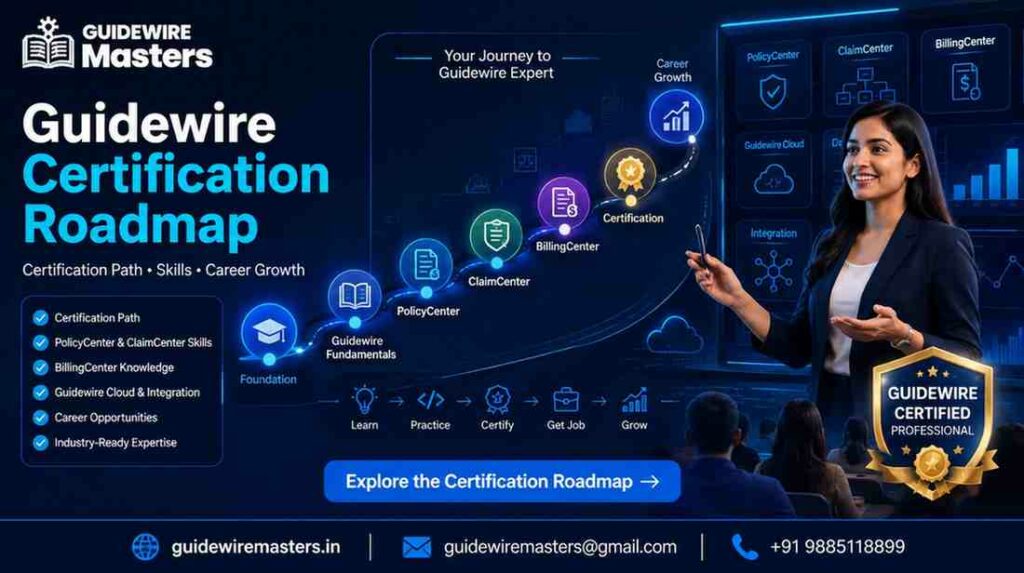
The Guidewire Certification Roadmap at a Glance
Here is the full sequence in order. Each arrow assumes the stage above is genuinely done, not merely watched.
↓
2. Guidewire Platform & InsuranceSuite Fundamentals
↓
3. Choose One Application — PolicyCenter, ClaimCenter or BillingCenter
↓
4. Gosu — the language everything is written in
5. Configuration — PCF, rules, validation, workflow
↓
6. Data Model — entities, typelists, extensions
↓
7. Integration — Cloud API, events, messaging
↓
8. Hands-On Project Work — the stage most people skip
↓
9. Guidewire Cloud Concepts — the deployment reality
↓
10. Certification Preparation — official curriculum, exam guides
↓
11. Certified Associate
↓
12. Project Delivery Experience — 2 to 4 years
↓
13. Certified Ace / Technical Lead
↓
14. Solution or Technical Architect
Building the Technical Foundation Insurance, Gosu, Configuration, Data Model
Stage 1: P&C insurance fundamentals
Budget two to three weeks. You need working fluency in: policy, insured, risk, coverage, limit, deductible, premium, endorsement, underwriting, reinsurance, first notice of loss (FNOL), reserve, subrogation and salvage. You should be able to describe how a motor claim moves from a phone call to a payment, and how a commercial property policy differs from a personal auto policy in structure.
This stage feels like a detour when you are eager to write code. It is not. In every Guidewire interview worth having, someone will test whether you understand the business, and it is the fastest thing to fake and the fastest thing to catch.
Stage 2 & 3: Platform fundamentals and choosing your application
Learn how InsuranceSuite is put together: the application layer, the shared platform services, how the applications exchange data, where ContactManager sits, and how Guidewire Cloud Platform hosts all of it. Then commit to one application, as covered above.
Stage 4: Gosu
Yes, you need Gosu. This comes up constantly and the answer has not changed. Gosu is Guidewire’s own JVM language, and it is what business rules, enhancements, validation and much of the configuration logic are written in. You cannot meaningfully configure InsuranceSuite without it.
The good news: if you know Java, Gosu is a short bridge, not a new mountain. It is statically typed, object-oriented, runs on the JVM, and interoperates with Java. What you actually need to master is the Guidewire-specific layer — classes and enhancements, collections and blocks, the query API, bundle and transaction management, and how rules are structured and fired. Three to four weeks of daily practice gets most developers to working competence.
Stage 5: Configuration
Configuration is the daily work of a Guidewire developer. It covers PCF files (the UI definition layer), business rules, validation rules, workflow, user roles and permissions, and application-level settings. The skill being tested is judgement as much as syntax: knowing when to configure within the product’s intended extension points versus when you are drifting into customisation that will hurt at upgrade time. Cloud has made that distinction much sharper than it was on-premise, and it is a favourite interview topic.
Stage 6: Data model
The Guidewire data model is where competent developers separate from confident ones. You need to understand entities and their relationships, typelists and typecodes, arrays and foreign keys, effective-dated entities, and how to extend the model correctly with extension entities and columns rather than fighting it. Reading an unfamiliar entity graph and correctly predicting where a piece of data lives is a genuinely valuable skill.

Integration The Highest-Leverage Specialisation
Integration is the part of the Guidewire Certification Roadmap with the best return on effort, because every implementation needs it, fewer people specialise in it, and Guidewire’s advanced developer certification includes a cloud integration focus.
No insurer runs Guidewire in isolation. PolicyCenter talks to rating engines, credit bureaux, vehicle and property data providers, document generation, and the general ledger. ClaimCenter talks to payment systems, medical bill review, fraud scoring and vendor networks. That connective work is where a lot of project risk — and therefore a lot of budget — lives.
What to learn, roughly in order:
- Cloud API (REST/JSON) — the primary modern integration surface. Resource modelling, authentication, error semantics, pagination, idempotency.
- Application events — how InsuranceSuite publishes business events so downstream systems can react without polling.
- Integration Gateway — for orchestration and transformation outside the core application.
- SOAP web services — still present in older estates. Worth understanding; not worth specialising in.
- Batch and file-based flows — unglamorous, ubiquitous, and frequently the source of production incidents.
One correction worth making because it appears in a lot of Guidewire study material: Kafka is not a Guidewire component you configure. Kafka typically belongs to the carrier’s own event backbone, sitting downstream of Guidewire. Guidewire publishes events; the insurer’s platform team may consume them into Kafka topics. Understanding event-driven architecture is genuinely useful. Listing “Kafka administration” as a required Guidewire developer skill is not accurate, and an experienced interviewer will notice.
If you want to see how these pieces fit on a real project, our walkthrough of ClaimCenter integration patterns covers the message flow end to end.
Guidewire Cloud Skills: What Actually Matters
Guidewire Cloud Platform runs on AWS. Not Azure, not GCP, not a multi-cloud arrangement you choose. That single fact eliminates a lot of noise from cloud study plans.
Here is the more useful correction. Many roadmaps tell aspiring Guidewire developers to learn Docker, Kubernetes, Terraform and Jenkins. For the vast majority of Guidewire roles, this is misdirected effort. Those are platform-layer concerns that Guidewire manages as part of the cloud service. You are not provisioning clusters or writing Terraform for a carrier’s Guidewire environment.
What you should actually understand:
| Genuinely useful | Why | Lower priority for most roles |
|---|---|---|
| Configuration vs. customisation discipline | Cloud upgrades are frequent; heavy customisation becomes a recurring cost | Kubernetes administration |
| The release cadence and N-3 certification decay | Directly affects whether your credential stays valid | Writing Terraform modules |
| Cloud API and event-driven integration | The main integration surface on cloud | Docker image authoring |
| Deployment pipeline concepts and environment promotion | You participate in the process even if you don’t own it | Jenkins server administration |
| Observability, logging and troubleshooting in a hosted estate | Debugging looks different when you don’t own the box | Network/VPC design |
Learn the concepts of CI/CD, containers and infrastructure-as-code so you can hold a conversation and read a pipeline. Do not spend three months chasing a Kubernetes certification expecting it to advance a Guidewire career. The time is better spent on the data model and integration.
Guidewire Certification Roadmap by Background
Very few people arrive at Guidewire as a first job. Most transfer in, and what you already know changes where you start and how fast you move.
| Your background | Transfers directly | Biggest gap to close | Natural first target |
|---|---|---|---|
| Java developer | OOP, JVM, collections, debugging, build tooling | Insurance domain; the product model mindset | Configuration developer on one application |
| .NET / C# developer | Strong typing, OOP, enterprise patterns | JVM ecosystem plus the domain | Configuration developer; allow extra ramp time |
| QA / test engineer | Test design, defect analysis, regression discipline | Gosu and the data model | Guidewire QA, then automation or configuration |
| Business analyst | Requirements, stakeholder handling, process mapping | Technical depth in the application | Guidewire BA certification track |
| Integration / middleware developer | REST, SOAP, messaging, transformation, error handling | InsuranceSuite internals and the domain | Integration developer — the fastest route in |
| Insurance operations professional | Deep domain knowledge others lack entirely | Programming fundamentals | BA or configuration analyst |
| Support / production engineer | Incident triage, log reading, root-cause analysis | Configuration and Gosu | Application support, then development |
| Technical lead (other stack) | Design judgement, code review, mentoring | Platform-specific depth | Senior developer, then lead within 12–18 months |
Integration developers and insurance operations professionals are consistently the two most underrated entry profiles. Both bring something scarce, and both tend to be surprised at how quickly they become useful. A broader view of entry points is covered in our guide to the Guidewire skills employers screen for.
Guidewire Certification Roadmap by Experience Level
Priorities shift as you progress. The mistake at every level is to keep optimising for the previous level’s goal.
| Experience | Primary focus | Key skills to build | What to stop doing |
|---|---|---|---|
| 0–1 years | Fundamentals and getting into a Guidewire role | Insurance domain, one application, Gosu basics, configuration | Chasing certification you cannot yet access |
| 1–3 years | Depth in one application; Associate certification through your employer | Data model, rules, PCF, debugging, basic integration | Copying patterns without understanding them |
| 3–5 years | Specialisation — integration, rating, or a second application | Cloud API, events, performance, upgrade impact analysis | Staying a single-application generalist |
| 5–8 years | Technical leadership and design ownership | Solution design, code review, estimation, mentoring, Ace-level depth | Measuring yourself only by tickets closed |
| 8+ years | Architecture and cross-application design | Data and integration architecture, migration strategy, stakeholder communication | Waiting for a certification to confer the title |
A Realistic Guidewire Certification Roadmap Timeline
The honest answer is that timelines vary enormously with prior experience, study hours per week, and whether you have access to a real environment. The ranges below assume a working professional studying roughly 8–12 hours a week, with no prior insurance exposure.
| Stage | Indicative time | Main focus |
|---|---|---|
| P&C insurance fundamentals | 2–3 weeks | Vocabulary, policy and claim lifecycles |
| Platform & InsuranceSuite fundamentals | 2–3 weeks | Architecture, application boundaries, ContactManager |
| Gosu | 3–5 weeks | Syntax, enhancements, query API, rules |
| Configuration | 6–8 weeks | PCF, rules, validation, workflow |
| Data model | 3–4 weeks | Entities, typelists, extensions |
| Integration | 5–7 weeks | Cloud API, events, messaging, error handling |
| Guidewire Cloud concepts | 2–3 weeks | Release cadence, deployment model, troubleshooting |
| Hands-on project practice | 6–10 weeks (overlapping) | End-to-end scenarios, debugging, testing |
| Certification preparation | 2–4 weeks | Official curriculum, exam guides, revision |
Added up with realistic overlap, most career changers reach interview-ready competence in roughly six to nine months of consistent effort. Experienced Java developers often compress this to four to six months. Certification itself typically follows employment, not the other way round.
What this guide will not do is tell you that you can be certified and job-ready in 30 or 45 days. That claim is common in Guidewire training marketing and it is not credible for someone starting from zero.
Is Guidewire Business Analyst Certification Worth It?
Once you have employer access to the official curriculum, preparation becomes a fairly mechanical process. The structure that works:
- Read the exam guide first, not last. Guidewire publishes exam guides describing the objectives for each certification. Map your study plan to those objectives rather than to a generic syllabus.
- Complete the official curriculum properly. The base and platform courses are the source of truth. Third-party material is supplementary, and much of it is outdated.
- Build, do not just read. For every concept, produce something — a working rule, a configured PCF page, a functioning API call. Recognition is not recall.
- Practise with the product open. Environment access is the single biggest predictor of who passes comfortably.
- Rehearse explanation, not just execution. Explain effective dating, or how a claim reaches a payment, out loud in plain language. The exam tests understanding, and so do interviews.
- Revise the fundamentals last. Best-practice and platform concepts are heavily weighted and easy to under-prepare because they feel obvious.
A workable weekly structure
Block Time Activity Weekday mornings (Mon–Fri) 45–60 min Official course material — one module at a time Weekday evenings (Mon–Thu) 45 min Hands-on: build what you read that morning Friday 45 min Review the week’s notes; list what you could not explain Saturday 2–3 hours End-to-end scenario work and debugging Sunday 1 hour Exam-guide checkpoint; plan the next week Costs and eligibility
Certification and training costs vary by track, by region, and by whether you are covered under an employer or partner arrangement. Exam fees, bundled training pricing and eligibility rules all change over time. This guide deliberately does not quote figures, because a stale price is worse than no price. Check current cost and eligibility directly with Guidewire Education, and ask your employer what is already covered — in many services companies, it is.
Certification vs. Training vs. Project Experience
These three are complementary, and treating any one as a substitute for the others is a reliable way to stall a career.
| Guidewire Training | Guidewire Certification | Project Experience | |
|---|---|---|---|
| Purpose | Build capability | Validate capability | Prove capability under real constraints |
| Method | Instructor-led or self-paced, with practice | Proctored exam against published objectives | Delivery work with deadlines and consequences |
| Access | Open — institutes, partners, self-study | Generally employer or partner gated | Requires employment on a Guidewire account |
| Assessment | Exercises and instructor feedback | Pass or fail | Code review, defects, production behaviour |
| What it signals | You invested in learning | You met a defined standard | You can be trusted with delivery |
| Best for | Beginners and career changers | Professionals already in a Guidewire role | Everyone, permanently |
| Limitation | Does not itself prove competence | Does not prove delivery judgement | Can be narrow if confined to one project |
In hiring conversations, project experience carries the most weight, certification acts as a filter and a staffing requirement, and training is what makes the first two possible. Structured training earns its place when it gives you environment access, real scenarios and feedback on your work — not when it is a video library.
Careers and Salary Reality for Guidewire Professionals in India
Guidewire work in India sits mainly with global consulting and services firms delivering implementations for insurers in North America, Europe, Australia and increasingly Asia. Accenture, Cognizant, Capgemini, Infosys, Wipro, TCS, LTIMindtree, Deloitte, EY and PwC all have insurance technology practices that have worked with Guidewire, alongside Guidewire’s own India operations and a set of specialist boutiques.
An important caveat: the presence of a practice is not the same as an open requisition. Guidewire hiring is project-driven and moves in waves tied to implementation and cloud migration cycles. Certification preferences vary by account — some projects require certified staff contractually, others treat it as desirable. Do not assume every firm on that list is hiring for your profile at any given moment.
Common roles include configuration developer, integration developer, QA and test automation engineer, business analyst, production support engineer, technical lead, and solution or technical architect. Our overview of Guidewire careers in India goes into each in more detail.
What the salary data actually shows
Published Guidewire salary figures for India disagree sharply, and any article presenting a single clean number is hiding that. Two named sources, with their stated basis:
Source Figure reported Range reported Basis Glassdoor — “Guidewire Developer”, India ≈ ₹7.96 lakh average base per year ≈ ₹4.0L – ₹14.3L Model-estimated from user-submitted salaries; page dated July 2026 6figr — professionals with Guidewire skills, India ≈ ₹20.4 lakh average; ≈ ₹18.0 lakh median ≈ ₹16.5L – ₹40.1L, top 10% above ₹30.4L Stated as based on 43 profiles The two differ by roughly two and a half times, and neither is simply wrong. They are measuring different populations. Glassdoor’s “Guidewire Developer” title pool skews toward earlier-career service-company roles and includes model-estimated entries. 6figr’s Guidewire-skill pool is small and skews toward experienced professionals who have chosen to publish a profile — a self-selecting group. Averaging them would produce a number describing nobody.
The defensible reading is that compensation for Guidewire professionals in India spans a wide band, that experience and specialisation drive most of the variation, and that integration, cloud and multi-application depth sit at the higher end. Treat both figures as indicative, not as benchmarks to negotiate against. Salary depends on your years of experience, the application you specialise in, integration and cloud exposure, insurance domain depth, employer tier, city, project complexity and how well you negotiate. Our detailed breakdown of Guidewire salaries in India covers those drivers.
Common Mistakes on the Guidewire Certification Roadmap
| Mistake | Why it hurts | What to do instead |
|---|---|---|
| Treating certification as the entry ticket | Access is generally employer-gated; you can stall for months waiting | Build skills, get placed, certify from inside the role |
| Skipping insurance fundamentals | Every interview probes the domain; it is the fastest gap to expose | Two to three weeks on P&C basics before any code |
| Avoiding Gosu | Configuration is written in it; there is no way around it | Three to four weeks of daily Gosu practice |
| Learning theory without an environment | Recognition is not recall; exams and interviews test application | Build something for every concept you study |
| Ignoring integration | Least crowded, highest leverage specialisation | Learn Cloud API and event patterns early |
| Studying the four-tier certification ladder | Legacy structure; you will plan around a level that is no longer the path | Plan around Associate and Ace; verify with Guidewire Education |
| Chasing Kubernetes and Terraform certifications | Guidewire manages that layer; the effort rarely converts | Concepts only; invest the time in the data model instead |
| Letting certification lapse past N-3 | You retake the proctored exam | Complete New Features courses each release |
| Using outdated third-party material | Much of the public Guidewire content still describes the pre-cloud product | Anchor on official documentation and course material |
| Never leaving one application | Caps you at senior developer | Add a second application or a specialisation after year three |
Building a Portfolio While You Wait for Certification Access
If certification is employer-gated, the obvious question is what you show recruiters in the meantime. The answer is evidence of applied understanding.
- Worked scenarios written up properly. Take a business requirement — a new endorsement type, a claim assignment rule, a delinquency workflow — and document how you would model, configure and test it. A clear two-page design write-up demonstrates more than a certificate image.
- Data model diagrams you drew yourself. Map the entity relationships for a claim or a policy transaction from memory, then check yourself against the documentation.
- Integration examples. A small REST client, request and response payloads, and an honest note on error handling and retries.
- A public repository, used carefully. Sample Gosu, integration stubs and test cases are fine. Never publish employer code, client configuration, screenshots of a customer environment, or anything covered by an NDA. This is a genuine career risk, not a formality.
- A LinkedIn profile that names specifics. “PolicyCenter configuration, rating integration, Cloud API” beats “Guidewire professional” every time, because that is what recruiters search on.
- Interview readiness. Rehearse explaining the claim lifecycle, effective dating, and one integration you understand end to end. Our Guidewire interview questions and real-time project examples are useful preparation material.
What Is Changing: Qusar, the Agentic Framework, and the Next Two Years
The Guidewire Certification Roadmap is not static, because the platform is not. Guidewire now ships named cloud releases on a regular cadence, and the N-3 policy means the release cycle is directly connected to your credential’s validity.
On 3 August 2026, Guidewire launched the Qusar release, introducing an Agentic Framework that lets insurers build, deploy and manage AI agents on Guidewire Cloud Platform, along with Guidewire-built claims and underwriting agents and Developer Assistants aimed at Guidewire developers specifically. Guidewire also states it has supported more than 1,700 successful implementation projects — a company-reported figure, and a useful indicator of ecosystem scale rather than an independent market statistic. Note that not all release features are generally available in every region; some ship as early or restricted access.
For someone planning a roadmap, the practical implications are:
- Release-linked learning is now part of the job. New Features courses and knowledge checks are how you keep a certification current, and Guidewire attaches release badges to them. Budget time for this every cycle, not just once.
- AI-assisted development changes what juniors are paid for. If assistants accelerate routine configuration work, the differentiated skills move toward design judgement, domain reasoning, integration architecture and debugging. That reinforces rather than replaces the roadmap above.
- Cloud migration work continues. Insurers still moving from on-premise estates need people who understand both the legacy configuration and the cloud target. That is a temporary but well-paid niche.
- Pricing and underwriting are growing as distinct tracks. With PricingCenter and UnderwritingCenter now part of InsuranceSuite, specialisation options are broader than the traditional three.
You can follow release detail and current documentation through Guidewire’s developer resources.
Conclusion
A useful Guidewire Certification Roadmap is not a list of exams. It is an order of operations, and the order is what makes it work. Insurance domain knowledge comes first, because everything else is an expression of it. Gosu and configuration come next, because that is the daily craft. The data model follows, because it is what separates developers who can follow patterns from developers who can reason about the product. Integration comes after that, because it is where scarce, well-compensated expertise concentrates. Cloud understanding threads through all of it, since that is now the deployment reality and the mechanism by which your credential stays valid.
Hands-on project experience is the stage most people skip and the one hiring managers weigh most heavily. Certification then does what a credential should do — it confirms, formally and portably, what you can already demonstrate, and it satisfies the staffing requirements that partners and insurers work under. It is a checkpoint on a longer path toward technical lead and, eventually, architect roles, neither of which any exam confers.
If you are starting out, the next step is small and specific: spend two weeks learning how a P&C policy and a claim actually work, then choose one application and stay with it. If you are already working in IT, look at where your current skills map on the background table above and close the single biggest gap first. And whatever any article tells you — including this one — verify certification structure, prerequisites and pricing directly with Guidewire Education before you commit time or money, because those details change.
Guidewire is a long game. The professionals who do well in it are the ones who treat the roadmap as a decade-long build rather than a sprint to a certificate.
Frequently Asked Questions
1.What is a Guidewire Certification Roadmap?
A Guidewire Certification Roadmap is the ordered path from P&C insurance fundamentals through Guidewire platform basics, Gosu, configuration, the data model and integration, to the official Certified Associate and Certified Ace designations. It sequences skills so each stage builds on the last, and it separates becoming employable from becoming certified.
2.Is Guidewire certification worth it?
It is worth it once you are in or entering a Guidewire role, because many cloud implementations require certified staff and partners need certified people to maintain their standing with Guidewire. It is less useful as a first step for someone with no Guidewire employment, since access is generally employer-gated. Skills open the door; certification widens it.
3.Which Guidewire certification should I start with?
Start with Certified Associate in your chosen track. It establishes platform-level and best-practice knowledge and is the prerequisite for Certified Ace. Business analysts and quality analysts have their own Associate-level tracks rather than following the developer path.
4.How do I prepare for Guidewire certification?
Work from the official exam guide, complete the Guidewire Education curriculum for your track, and practise in a real environment rather than only reading. Build something for every concept you study, rehearse explaining core ideas in plain language, and revise platform and best-practice topics last since they carry significant weight.
5.Do I need coding skills for Guidewire certification?
For the developer track, yes. You need object-oriented programming fundamentals and working Gosu ability. The business analyst and quality analyst tracks require far less coding, focusing instead on the product, process and configuration concepts — which is why they are a common entry route for non-developers.
6.Is Gosu required for Guidewire certification?
Gosu is required for developer certification and for essentially all Guidewire configuration work, because rules, enhancements and validation logic are written in it. Java experience makes Gosu straightforward to pick up — most developers reach working competence in three to four weeks of daily practice.
7.Can beginners learn Guidewire?
Yes. Beginners with programming aptitude regularly move into Guidewire, and people from insurance operations transition in through business analyst and configuration analyst roles. The realistic expectation is six to nine months of consistent study to reach interview-ready competence, not a few weeks.
8.How long does it take to prepare for Guidewire certification?
Guidewire’s own guidance suggests a new developer can reach Certified Associate with roughly two to three weeks of course preparation — but that assumes someone already on a project with employer-provided training access. Starting from zero insurance and platform knowledge, plan for six to nine months to reach that point.
9.What is the salary of a certified Guidewire professional in India?
Published sources vary widely. Glassdoor reported an average base of about ₹7.96 lakh per year for “Guidewire Developer” in India as of July 2026, while 6figr reported an average of about ₹20.4 lakh for professionals with Guidewire skills based on 43 profiles. The gap reflects different populations, not a single true figure. Experience, specialisation and employer matter more than certification alone.
10.Does Guidewire certification help with getting a job?
It helps, but it does not guarantee one. Certification satisfies staffing requirements on cloud projects and signals a verified standard, which can move a shortlisted candidate forward. Employers still weigh project experience, insurance domain knowledge, integration ability and problem-solving. No credential guarantees employment.
11.Is there a Guidewire architect certification?
No. There is no architect-level Guidewire exam. Architecture is reached through delivery experience, breadth across applications, integration and data design depth, and demonstrated design judgement — typically eight or more years in. Any roadmap advertising an architect certification is describing something that does not exist.
12.How often do I need to renew my Guidewire certification?
Guidewire applies an N-3 policy: your certification must remain within three releases of the current one. You maintain it by completing New Features eLearning and knowledge checks for each release. If you fall outside that window, you must retake the proctored exam.

Mrs.Kinnera
GuidewireMasters | 25+ articles published
Guidewire experts passionate about helping learners build successful careers in the insurance IT industry. Through in-depth guides, real-time training, certification support, and industry-focused resources, Guidewire Masters simplifies Guidewire technologies and provides practical knowledge to help students and professionals grow their careers confidently.
Share