Guidewire Syllabus Billing operations
Guidewire Billing Operations syllabus in 2026 covers BillingCenter fundamentals, invoice processing, payment management, policy billing, delinquency workflows, Gosu scripting, APIs, integrations, and cloud-based insurance billing projects.Guidewire training helps learners gain practical billing lifecycle skills, real-time project experience, certification support, and job-ready expertise for successful careers in the insurance IT industry.

- Sanjay
- January 4, 2025
- 11:54 am
Table of Contents
Why Billing Operations Knowledge Matters in Guidewire Implementations
Introduction
In any insurance core system implementation, billing is where business value becomes revenue. Policies may define coverage and claims may handle losses, but billing operations ensure that insurers actually collect premiums. Within the Guidewire ecosystem, BillingCenter is the platform responsible for managing invoices, payment processing, delinquency handling, and financial interactions with policyholders and agencies.
For professionals working in Guidewire projects developers, architects, testers, and business analysts understanding the Guidewire Billing Operations syllabus is essential. Billing is not just a financial process; it is deeply integrated with policy lifecycle events, regulatory requirements, and customer experience.
The Guidewire Billing Operations syllabus provides a structured learning path that explains how billing works within the Guidewire InsuranceSuite ecosystem. It covers concepts such as accounts, invoices, payment plans, billing instructions, collections, cancellations, and financial workflows.
Many large insurance carriers process millions of billing transactions every month. Without a well-structured billing system, insurers would struggle to manage payment schedules, policy changes, refunds, and compliance requirements. BillingCenter solves this challenge by providing an enterprise-grade billing engine designed specifically for the insurance industry.
For professionals building their careers in Guidewire, mastering billing operations delivers three major advantages:
- Stronger system understanding – Billing touches almost every policy lifecycle event.
- Better troubleshooting skills – Many production issues involve billing discrepancies.
- Higher market demand – Experienced BillingCenter professionals are highly sought after in the insurance technology market.
This guide walks through the Guidewire Billing Operations syllabus step by step, explaining the core concepts, processes, and best practices that professionals should understand when working with BillingCenter.
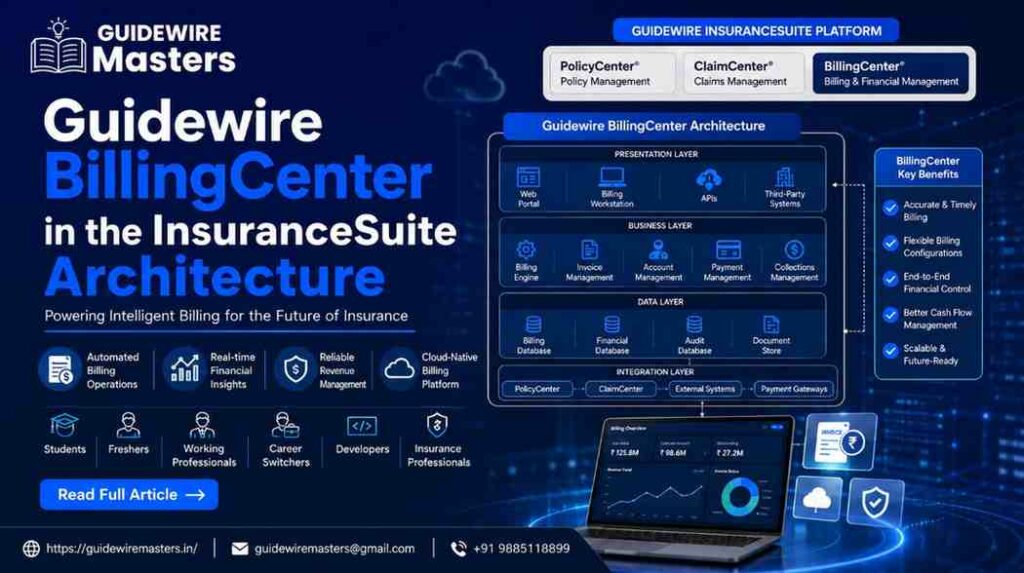
Guidewire BillingCenter in the InsuranceSuite Architecture
Guidewire InsuranceSuite consists of three primary core platforms:
System | Purpose |
PolicyCenter | Policy administration and underwriting |
ClaimCenter | Claims processing and loss management |
BillingCenter | Billing, payments, and financial management |
Among these systems, BillingCenter acts as the financial backbone of the insurance platform. While PolicyCenter manages policy creation and changes, BillingCenter ensures that premiums are invoiced correctly and payments are collected on time.
The integration between these systems is event-driven. When a policy is issued or modified in PolicyCenter, billing instructions are sent to BillingCenter. BillingCenter then generates invoices based on the configured payment plan.
For example:
- A policy is issued in PolicyCenter.
- Premium information is sent to BillingCenter.
- BillingCenter creates billing instructions.
- Invoices are generated according to the payment plan.
- Payments are collected and allocated to charges.
This integration ensures that policy data and financial data remain synchronized across the insurance platform.
From a technical perspective, the systems communicate using:
- Messaging queues
- Web services and APIs
- Event-driven integration
- Batch processing jobs
This architecture allows insurers to maintain scalability, reliability, and financial accuracy even when processing very large transaction volumes.
Overview of the Guidewire Billing Operations Syllabus
The Guidewire Billing Operations syllabus is designed to teach both business processes and system functionality related to insurance billing. Unlike generic billing training, this syllabus focuses on insurance-specific financial workflows.
A typical billing operations syllabus includes the following learning areas:
Learning Area | Key Topics Covered |
Billing fundamentals | Accounts, policies, invoices |
Billing lifecycle | Premium charges, invoice generation |
Payment processing | Payment allocation, reversals |
Payment plans | Installment billing structures |
Delinquency management | Dunning and collections |
Policy cancellation | Cancellation and reinstatement |
System integrations | PolicyCenter and financial systems |
The syllabus gradually moves from high-level billing concepts to deeper operational and technical understanding.
For example:
- Business analysts focus on billing workflows and requirements.
- Developers focus on billing rules, integrations, and customization.
- Testers focus on invoice validation, payment scenarios, and edge cases.
- Architects focus on billing architecture and system integration design.
This multi-role perspective makes the syllabus valuable across the entire insurance technology delivery team.
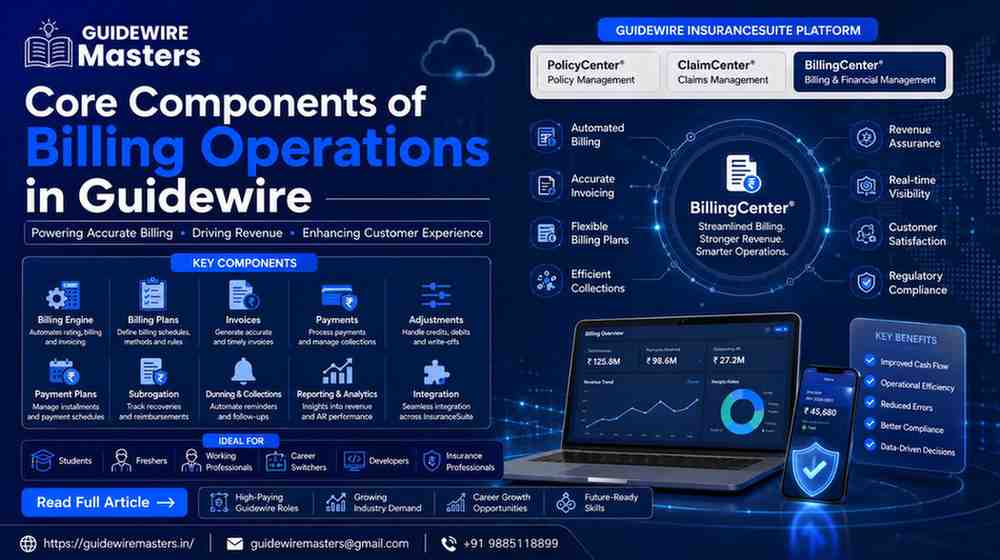
Core Components of Billing Operations in Guidewire
At the heart of BillingCenter are several key entities that represent real-world financial structures. Understanding these components is fundamental for anyone studying Guidewire Billing Operations.
1. Accounts
An account represents the financial relationship between the insurer and the customer. A single account may contain multiple policies and billing transactions.
For example, a business customer might have:
- Property insurance
- Liability insurance
- Commercial auto coverage
Instead of creating separate billing relationships, BillingCenter groups these policies under a single account, enabling consolidated billing and payment tracking.
2. Policies
Policies originate in PolicyCenter, but BillingCenter maintains a billing representation of the policy.
BillingCenter tracks:
- Policy premium
- Billing schedule
- Invoice history
- Outstanding balances
This ensures financial activities remain aligned with policy lifecycle events.
3. Charges
Charges represent financial obligations owed by the policyholder.
Examples include:
- Premium charges
- Installment fees
- Taxes
- Late payment fees
Charges are grouped into invoices and become payable by the customer.
4. Invoices
Invoices are generated periodically based on billing instructions and payment plans. They summarize all charges due within a billing cycle.
Invoices typically include:
- Premium amount
- Due date
- Outstanding balance
- Payment instructions
Invoice accuracy is critical because it directly impacts customer trust and regulatory compliance.
Payment Plans and Billing Flexibility
Insurance companies offer different payment structures to accommodate customer preferences. BillingCenter supports configurable payment plans that divide the premium into scheduled invoices.
Common payment plan types include:
Payment Plan | Description |
Full Pay | Entire premium paid upfront |
Monthly | Premium divided into 12 installments |
Quarterly | Four payments during policy term |
Down Payment Plan | Initial deposit followed by installments |
Agency Bill | Agency collects payment from insured |
Payment plans are defined using billing plan templates, which specify:
- Installment schedule
- Invoice generation timing
- Service charges
- Minimum payment thresholds
When a policy is issued, BillingCenter applies the appropriate payment plan and generates invoices accordingly.
This flexibility helps insurers balance customer affordability with predictable revenue streams.

The Billing Lifecycle in Guidewire
The billing lifecycle describes how financial transactions progress from policy issuance to final payment. Understanding this lifecycle is critical for professionals working on Guidewire billing implementations.
The lifecycle typically includes the following stages:
Policy Issuance
When a policy is issued in PolicyCenter, billing instructions are sent to BillingCenter.
Invoice Generation
BillingCenter generates invoices based on the payment plan schedule.
Payment Collection
Payments may arrive through various channels:
- Credit cards
- Bank transfers
- Online payment portals
- Agency remittances
- Checks
Payment Allocation
BillingCenter automatically allocates payments to outstanding charges.
Policy Changes
If coverage changes mid-term, BillingCenter recalculates premium balances and adjusts future invoices.
Policy Closure
The lifecycle ends when:
- All invoices are paid
- The policy expires
- The policy is cancelled
Each stage is recorded with a complete financial audit trail.
Delinquency and Collections Management
Not all policyholders pay on time. Insurance companies therefore rely on delinquency management processes to enforce payment compliance.
BillingCenter supports automated dunning workflows, which send payment reminders when invoices become overdue.
A typical delinquency process may include:
- Payment reminder notification
- Late fee application
- Cancellation warning notice
- Policy cancellation if payment is not received
These steps are configurable and vary based on company policy and regulatory requirements.
Automating this process helps insurers:
- Reduce manual work
- Improve collection rates
- Maintain consistent policy enforcement
Policy Cancellation and Reinstatement
When billing delinquencies remain unresolved, insurers may cancel the policy. BillingCenter manages the financial implications of cancellation.
During cancellation, the system calculates:
- Earned premium
- Unearned premium
- Refunds owed to the policyholder
- Outstanding balances
If the customer later pays the overdue balance, the policy may be reinstated, restoring coverage.
Handling cancellations correctly is crucial because incorrect calculations can lead to compliance violations or financial disputes.
Best Practices for Guidewire Billing Operations
Successful billing operations require both technical configuration and operational discipline.
Experienced Guidewire consultants often recommend the following best practices.
Maintain Clean Billing Data
Accurate billing data prevents downstream issues in invoicing and financial reporting.
Optimize Batch Processing
Batch jobs handle invoice generation and financial processing at scale. Proper scheduling ensures system performance remains stable.
Implement Strong Integration Monitoring
Because BillingCenter integrates with multiple systems, monitoring integration events helps detect billing discrepancies early.
Ensure Regulatory Compliance
Billing processes must align with regional insurance regulations, particularly regarding billing notices and cancellation timelines.
Following these practices ensures that BillingCenter remains reliable, scalable, and compliant.
Career Benefits of Learning Guidewire Billing Operations
Guidewire expertise continues to be in high demand across the global insurance technology market. Organizations implementing or upgrading Guidewire platforms require professionals who understand both the system and the insurance domain.
Professionals with strong billing operations knowledge can pursue roles such as:
- Guidewire BillingCenter Developer
- Billing Business Analyst
- Guidewire Solution Architect
- QA Automation Engineer
- Insurance Billing Consultant
These roles are critical in large digital transformation programs where insurers modernize their core systems.
Developing expertise in Guidewire Billing Operations positions professionals as valuable contributors in these initiatives.
Conclusion
Guidewire BillingCenter plays a central role in the financial operations of modern insurance companies. It manages premium billing, payment processing, delinquency workflows, and financial integrations across the insurance ecosystem.
The Guidewire Syllabus Billing Operations provides a structured learning path that helps professionals understand these complex processes. From accounts and payment plans to invoice generation and collections management, the syllabus covers every stage of the billing lifecycle.
For developers, architects, testers, and business analysts working in Guidewire projects, mastering billing operations offers a deeper understanding of how insurance platforms generate revenue and maintain financial accuracy.
In an industry where digital transformation continues to accelerate, professionals who understand Guidewire billing workflows and architecture will remain in strong demand.
FAQs
1. What is Guidewire Billing Operations syllabus?
Guidewire Billing Operations syllabus covers billing lifecycle management in Guidewire BillingCenter, including invoice processing, payment handling, delinquency management, workflows, integrations, and real-time insurance billing operations.
2. What topics are included in the Guidewire Billing Operations syllabus?
The syllabus includes BillingCenter fundamentals, account setup, policy billing, payment processing, Gosu programming, APIs, workflows, integrations, data management, cloud concepts, and real-time project implementation.
3. Is Guidewire Billing Operations suitable for beginners?
Yes, the Guidewire Billing Operations syllabus is designed for both freshers and experienced IT professionals who want to build careers in the insurance technology domain.
4. What skills will I learn in Guidewire Billing Operations training?
You will learn Guidewire BillingCenter configuration, billing workflows, invoice management, payment processing, Gosu scripting, integrations, API handling, cloud basics, and insurance billing operations.
5. Does the Guidewire Billing Operations syllabus include real-time projects?
Yes, most Guidewire Billing Operations training programs include real-time insurance billing projects, case studies, and hands-on exercises to improve practical knowledge.
6. What is the duration of Guidewire Billing Operations training?
The duration usually ranges from 2 to 4 months depending on the training mode, project sessions, and practical implementation coverage.
7. What are the prerequisites for learning Guidewire Billing Operations?
Basic knowledge of Java, databases, insurance concepts, and software development is helpful, but many training institutes also teach fundamentals for beginners.
8. Is Gosu programming included in the Guidewire Billing Operations syllabus?
Yes, Gosu programming is an important part of the syllabus because it is widely used for Guidewire customization, workflows, and business rule implementation.
9. What job roles can I apply for after completing Guidewire Billing Operations training?
After completing the course, learners can apply for Guidewire BillingCenter Developer, Billing Operations Analyst, Guidewire Consultant, Integration Developer, and Support Engineer roles.
10. Does Guidewire Billing Operations training provide placement support?
Many Guidewire training institutes provide placement assistance, resume preparation, mock interviews, certification guidance, and job referrals for students.

Mrs.Jyosna
GuidewireMasters | 25+ articles published
Guidewire experts passionate about helping learners build successful careers in the insurance IT industry. Through in-depth guides, real-time training, certification support, and industry-focused resources, Guidewire Masters simplifies Guidewire technologies and provides practical knowledge to help students and professionals grow their careers confidently.
Share