Guidewire ClaimCenter Integration
Guidewire ClaimCenter Integration is the process of connecting Guidewire ClaimCenter with internal and external systems — PolicyCenter, BillingCenter, payment gateways, banking, fraud, and CRM tools — using REST APIs, SOAP services, messaging, and events. It powers real-time, automated claims processing, so professionals who master ClaimCenter Integration are in high demand across the global P&C insurance industry.

- Sanjay
- July 22, 2026
- 6:16 am
Table of Contents
Introduction
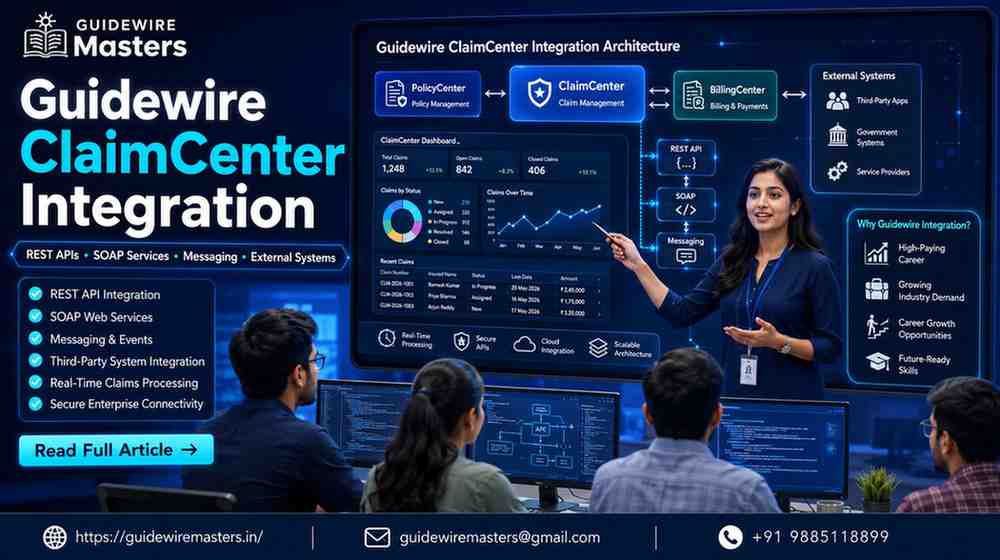
Guidewire ClaimCenter Integration is one of the most valuable skill sets in modern insurance technology. As Property & Casualty (P&C) insurers move claims onto digital, cloud-native platforms, the ability to make ClaimCenter talk cleanly to dozens of other systems has become mission-critical.
At its core, integration is what turns ClaimCenter from a standalone claims application into the nerve center of the whole claims ecosystem. When a customer files a claim, ClaimCenter needs policy data, billing details, contact records, payment rails, fraud checks, and supporting documents — all in real time. None of that lives inside ClaimCenter alone. Integration is the plumbing that connects it.
ClaimCenter communicates with external systems through several well-defined channels. Synchronous REST and SOAP APIs handle instant request-response calls. Asynchronous messaging and event streams carry high-volume traffic without blocking the core workflow. Batch jobs move bulk data on a schedule. A skilled integration developer knows which channel fits each use case, and why the wrong choice creates fragile systems that fail under load.
This is why Guidewire integration skills are in short supply and high demand. In India, consulting giants and insurers alike are hiring integration developers, technical leads, and architects at some of the strongest pay bands in the IT services sector. If you want a durable, well-paid career in insurance technology, ClaimCenter Integration is a smart specialization to build toward.
What is Guidewire ClaimCenter Integration?
Guidewire ClaimCenter Integration is the discipline of connecting ClaimCenter — Guidewire’s claims management application — with other software systems so that data and events flow reliably between them. The purpose is simple to state and hard to master: make the right information available to the right system at the right time.
Consider a real-world example. When an adjuster approves a settlement, ClaimCenter must trigger a payment through a banking API, notify BillingCenter so the financials reconcile, update the customer record in the CRM, and archive supporting documents in a document management system. Each of those steps is a separate integration point, and each one has to succeed reliably, in the right order, with a full audit trail.
In P&C insurance this matters enormously, because claims are where insurers spend most of their money and where they win or lose customer trust. Slow, error-prone, manual claims handling drives up loss adjustment expense and pushes customers to competitors. Clean integration enables straight-through processing, fewer manual errors, and dramatically faster settlements.
If you are new to the product itself, overview of Guidewire ClaimCenter is a useful starting point before diving into integration work.
Why ClaimCenter Integration is Important
Integration is what makes ClaimCenter useful in the real world. Here is why it sits at the heart of every modern claims platform.
- Real-time claims processing: Adjusters and customers get instant policy, coverage, and payment data instead of waiting on overnight batch cycles.
- Third-party system connectivity: Fraud engines, weather data providers, repair networks, medical providers, and banks all plug directly into the claim lifecycle.
- Improved customer experience: Automated status updates and faster payouts directly raise customer satisfaction and retention.
- Faster settlements: Straight-through processing removes manual re-keying, cutting cycle time from days to minutes for simple, low-value claims.
- Automation benefits: Event-driven rules can auto-assign adjusters, auto-set reserves, and auto-pay low-complexity claims without human intervention.
Without integration, ClaimCenter is an island. With it, ClaimCenter becomes the orchestration hub for the entire claims journey, from first notice of loss through to final settlement and closure.
Guidewire ClaimCenter Integration Architecture
A robust ClaimCenter integration architecture is organized in layers, each with a clear responsibility. Understanding these layers is the foundation of the entire skill set, because almost every design decision you make maps onto one of them.
- Application Layer: ClaimCenter itself — the entity model, business rules, and Gosu logic that define how claims behave.
- Integration Layer: The plugins, gateways, and API endpoints that expose ClaimCenter to the outside world and consume external services.
- Messaging Layer: Queues and event streams that carry asynchronous traffic reliably, even when downstream systems are slow, busy, or temporarily offline.
- External Systems: PolicyCenter, BillingCenter, ContactManager, banks, fraud engines, CRMs, ERPs, and data warehouses.
- Data Flow: The route a claim event travels — from FNOL capture, through validation and enrichment, to settlement, payment, and archival.
- Security Architecture: Authentication, authorization, encryption in transit and at rest, and audit logging that protect sensitive claims data end to end.
A practical example makes the layering concrete. A fraud check flows like this: ClaimCenter publishes a “new claim created” event from the application layer, the messaging layer routes that event to a broker, an integration gateway consumes it and calls the external fraud scoring API, and the returned risk score is written back to the claim. The core claim workflow never waits on the fraud vendor, so a slow third party cannot stall the adjuster’s screen.
Components of Guidewire ClaimCenter Integration
ClaimCenter ships with a rich toolkit for building integrations. Knowing which component to reach for is half the job.
- REST APIs: Modern, JSON-based endpoints for real-time request-response calls. This is the default choice for most new integrations.
- SOAP Web Services: XML and WSDL-based services, still very common in enterprise and legacy insurer landscapes where contracts are strictly defined.
- Messaging Queues: Reliable, ordered delivery of asynchronous events to external destinations, with retry and acknowledgement built in.
- Integration Gateway: A managed entry and exit point that centralizes routing, payload transformation, throttling, and security policy.
- Plugins: Custom Java or Gosu implementations of Guidewire plugin interfaces that hook directly into product behavior at defined extension points.
- Batch Integrations: Scheduled bulk jobs for large data loads, extracts, and reconciliations that do not need to run in real time.
- Event Listeners: Handlers that react to entity changes and business events inside ClaimCenter and trigger downstream activity.
External Systems Integrated with ClaimCenter
ClaimCenter rarely works alone. These are the integration targets you will encounter on almost every implementation.
- PolicyCenter: Pulls policy, coverage, limit, and insured details to validate that a claim is actually covered.
- BillingCenter: Coordinates deductibles, recoveries, subrogation amounts, and payment postings so financials stay reconciled.
- ContactManager: Provides a single source of truth for people and companies shared across the entire suite.
- Payment Systems and Banking APIs: Execute claim payouts, disbursements, and vendor payments securely and with full traceability.
- Document Management Systems: Store and retrieve claim documents, photographs, estimates, and adjuster reports.
- Fraud Detection Systems: Score claims for risk in real time and flag suspicious patterns for investigation.
- CRM and ERP: Synchronize customer interactions, service history, and enterprise financial records.
- Data Warehouses: Feed analytics, actuarial reserving, management reporting, and regulatory submissions.
Guidewire Integration Technologies
Integration developers work across a broad technology stack. The essentials are REST and SOAP APIs for service calls, JSON and XML as data formats, and WSDL for describing SOAP contracts. Beyond those basics, high-volume and decoupled communication depends on event streaming and message brokers.
Apache Kafka has become the de facto backbone for event-driven insurance platforms, comfortably handling millions of claim events per day with durable, replayable logs. Alongside Kafka, JMS and IBM MQ remain widespread in established enterprise estates, and frameworks such as Apache Camel provide declarative routing and transformation between systems.
Mastering when to use synchronous APIs versus asynchronous messaging is the single most important judgment call an integration developer makes. Synchronous is simpler to reason about but couples systems tightly. Asynchronous scales beautifully but demands careful thinking a

Guidewire ClaimCenter API Integration
APIs are the front door to ClaimCenter. Modern integrations lean on a clean REST API architecture: resource-based URLs, standard HTTP verbs, predictable status codes, and JSON payloads. Because claims data is highly sensitive personal and financial information, security is non-negotiable.
Authentication typically uses OAuth 2.0 to issue scoped access tokens, with JWT (JSON Web Tokens) carrying signed assertions about the caller’s identity and permissions. Layered on top, teams enforce API security through TLS encryption, rate limiting, IP allow-listing, and strict authorization checks on every request.
Good API practice also includes disciplined versioning, so that adding or changing a field never breaks an existing consumer. Consistent error handling matters just as much: callers need meaningful status codes and structured error bodies to react correctly rather than guessing. Comprehensive request and response logging closes the loop, giving support teams the trail they need when something goes wrong at 2 a.m.
Guidewire’s InsuranceSuite exposes standardized APIs that make these patterns easier to implement consistently across ClaimCenter, PolicyCenter, and BillingCenter, which reduces the amount of bespoke integration code a program has to maintain.
Event-Driven Integration in Guidewire ClaimCenter
Event-driven architecture is the modern default for scalable claims platforms. Instead of one system directly calling another and waiting for a reply, systems publish events — “claim opened”, “reserve changed”, “payment issued” — and any interested subscriber reacts independently.
In ClaimCenter, business events are published to a broker, very often Kafka. Downstream subscribers handling fraud scoring, analytics, customer notifications, and reporting consume those events asynchronously and at their own pace. This decoupling means a slow or offline subscriber never blocks the core claim workflow, and new consumers can be added later without touching the publisher.
Publish-subscribe patterns, message queues, and asynchronous processing together let a platform absorb sudden spikes in claim volume gracefully — which is exactly what insurers need during catastrophe events, when claim counts can jump tenfold in a single day.
Guidewire Integration Patterns
Experienced developers reach for proven patterns rather than reinventing solutions on every project. These are the patterns that recur across Guidewire implementations.
- Synchronous Integration: Real-time request-response, used when the caller genuinely needs an immediate answer, such as a coverage verification check.
- Asynchronous Integration: Fire-and-forget messaging for non-blocking, high-volume flows where an immediate reply is unnecessary.
- Batch Integration: Scheduled bulk transfers for reconciliations, extracts, and large data loads.
- Event-Based Integration: Reacting to published business events as they occur, rather than polling for changes.
- Publish-Subscribe: One event broadcast to many independent consumers, each with its own processing logic.
- Request-Response: The classic paired call-and-reply exchange over REST or SOAP.
- API Gateway Pattern: A single managed entry point handling routing, authentication, throttling, and observability for all inbound traffic.
Guidewire ClaimCenter Data Integration
Underneath every integration is a data model that must be understood and respected. ClaimCenter’s entity model defines claims, exposures, activities, contacts, and financial transactions, while typelists provide controlled vocabularies for statuses, loss causes, and categories.
Data integration work centers on careful data mapping between ClaimCenter’s schema and external formats, using metadata to drive transformations rather than hard-coding them. Developers manage database synchronization, understand the ORM layer that persists entities, and apply ETL concepts when moving data into warehouses for reporting and analytics.
Typelist alignment deserves particular attention. When an external system’s status codes do not map cleanly onto ClaimCenter typelists, teams are tempted to improvise. Those improvisations become the subtle, expensive defects that surface in year-end regulatory reporting. Getting the mapping right at design time, and documenting it, saves enormous rework later.
Guidewire Batch Integration
Not everything needs to happen in real time. Batch integration handles the heavy lifting of bulk data movement, and it remains essential even in modern event-driven platforms.
ClaimCenter batch processes run as scheduled jobs, feeding work queues that process records in controlled chunks rather than loading everything into memory at once. This chunking is what allows a batch to process millions of records without exhausting resources.
Well-designed batch integration emphasizes performance optimization through parallelism and sensible chunk sizing, robust retry mechanisms for transient failures such as a briefly unavailable endpoint, and clear error recovery so that a single malformed record does not abort an entire overnight run. Failed records should be quarantined and reported, not silently dropped.
Reconciliation batches — comparing ClaimCenter financial data against billing systems or the data warehouse — are a frequent and genuinely important use case, because they catch the integration failures that everything else missed.
Guidewire ClaimCenter Integration Roles and Responsibilities
Integration work spans several roles, each with a distinct focus and career track.
- Guidewire Integration Developer: Builds and maintains APIs, messaging flows, plugins, and event handlers. The hands-on core of integration delivery.
- Guidewire Configuration Developer: Configures product behavior in Gosu and PCF, and collaborates closely with integration on data and rules.
- Guidewire Technical Lead: Owns design decisions, code quality, review standards, and mentoring across the delivery team.
- Guidewire Architect: Defines the integration strategy, pattern catalogue, and technical standards for the entire program.
- Cloud Engineer: Manages Kubernetes, CI/CD pipelines, observability tooling, and cloud security for the platform.
On most programs these roles work as one team, and moving between them is a natural way to broaden your experience. For a fuller breakdown, see our page on Guidewire job roles and responsibilities.
Guidewire ClaimCenter Integration Career Opportunities in India
India is a global delivery hub for Guidewire implementations, which makes demand for integration talent especially strong here. Every major consulting firm runs a large Guidewire practice staffed substantially from Indian delivery centers, and insurers themselves are increasingly building in-house capability rather than outsourcing everything.
Roles range from junior integration developers on their first implementation through to senior architects setting standards for multi-year programs. Consulting companies drive most hiring, particularly for greenfield implementations and the wave of cloud migrations currently underway.
The trend is clear and durable. As more insurers modernize their claims platforms, the need for people who can connect ClaimCenter to everything around it keeps rising, and integration skills transfer readily between employers and geographies.
If you are planning your path, the most reliable first step is a structured Guidewire Training in Hyderabad program that combines product depth with genuine hands-on integration practice rather than slideware. To compare wider options, explore our guide to Guidewire careers in India.
Top Companies Hiring Guidewire Integration Professionals
The following firms actively recruit Guidewire ClaimCenter Integration professionals in India, largely because they run multi-year Guidewire delivery and cloud-migration programs for global insurers.
- Accenture, Capgemini, Deloitte, EY, and PwC: Large-scale transformation and implementation partners running end-to-end Guidewire programs.
- Cognizant, Infosys, TCS, Wipro, and LTIMindtree: Major IT services players with dedicated, long-established Guidewire practices.
These companies hire integration talent continuously because every new insurer engagement needs developers to wire ClaimCenter into policy, billing, payment, document, and data systems. That work only grows as cloud adoption accelerates and legacy estates are retired.
Skills Required for Guidewire ClaimCenter Integration
A strong integration developer blends Guidewire product knowledge with solid software engineering fundamentals and real insurance understanding.
- Guidewire and domain: ClaimCenter depth, Gosu programming, and genuine P&C insurance concepts.
- Programming: Java as the primary language, plus SQL and comfort with data structures and design patterns.
- Data and APIs: XML, JSON, REST, SOAP, WSDL, and web-services design principles.
- Messaging: Kafka, JMS, IBM MQ, and integration frameworks such as Apache Camel.
- Cloud and DevOps: Guidewire Cloud, Kubernetes, Docker, CI/CD pipelines, and DevOps working practices.
Guidewire ClaimCenter Integration Career Roadmap
Progression is predictable if you build skills in a sensible order rather than jumping straight to the fashionable tools.
Level | Skills to Master |
Beginner | Insurance basics, ClaimCenter navigation, Gosu fundamentals, XML and JSON |
Intermediate | REST and SOAP APIs, plugins, data mapping, SQL, basic messaging concepts |
Advanced | Kafka and JMS event-driven design, batch integration, OAuth and JWT security |
Expert | Guidewire Cloud, Kubernetes and Docker, CI/CD, full integration architecture |
ClaimCenter Integration vs Configuration Developer vs Integration Developer
These roles overlap but differ meaningfully in focus. This comparison clarifies where each one fits.
Aspect | Configuration Developer | Integration Developer |
Responsibilities | Configure product behavior, PCF screens, business rules | Connect ClaimCenter to external systems via APIs and messaging |
Skills | Gosu, PCF, data model, typelists | REST and SOAP, Kafka and JMS, Java, cloud, security |
Technologies | Guidewire Studio, Gosu, rules engine | APIs, Kafka, gateways, Docker and Kubernetes |
Salary | ₹5–25 LPA | ₹6–30+ LPA, often at a premium |
Career Growth | Configuration lead, then architect | Integration lead, then integration architect |
Why ClaimCenter Integration is One of the Best Careers in India
Few IT specializations combine demand, pay, and longevity as well as Guidewire integration does. Salaries sit near the top of the services market, and demand is genuinely global, so skills transfer readily to roles in the US, UK, Europe, and Australia.
Insurance digital transformation and large-scale cloud migration programs guarantee a steady pipeline of projects for years to come. Meanwhile, enterprise integration expertise — API design, event-driven thinking, distributed systems debugging — stays valuable long after any single tool or vendor fades from fashion.
The result is strong long-term career growth in an industry that is not going anywhere. Insurance is a regulated necessity, not a discretionary purchase, which makes it notably resilient through economic cycles.
Future Scope of Guidewire ClaimCenter Integration
The trajectory is firmly toward cloud and events. Expect continued growth in Guidewire Cloud adoption, API-first architecture as the default design stance, and AI-powered claims triage and fraud detection that depend entirely on real-time data pipelines.
Event-driven systems and microservices are becoming the standard design approach for new builds, and cloud-native applications will dominate greenfield work. Automated damage assessment, straight-through processing for simple claims, and predictive analytics all require exactly the integration foundations described in this guide.
As insurers pursue modernization, integration developers who understand both the insurance domain and modern distributed systems will remain central to every program. The tools will keep changing; the underlying need to connect systems reliably will not.
How to Become a Guidewire ClaimCenter Integration Developer
Follow this step-by-step roadmap to break in and grow steadily.
- Learn insurance fundamentals, especially how P&C claims actually work end to end.
- Master ClaimCenter navigation, screens, and the underlying data model.
- Learn Gosu, Guidewire’s native programming language.
- Build solid core Java skills, since most integration code is Java.
- Get genuinely comfortable with SQL and relational data.
- Learn XML and JSON data formats and their schema languages.
- Master REST API design, including versioning and error handling.
- Learn SOAP web services and WSDL contracts.
- Study Kafka and messaging systems, including idempotency and ordering.
- Learn Guidewire Cloud, Docker, and Kubernetes.
- Gain real project experience on an actual implementation.
- Grow into a technical lead role, owning design and mentoring.
- Advance to Guidewire Integration Architect.
A guided path shortens this considerably compared with self-study alone. Pairing Guidewire certifications with a structured course curriculum and real-time projects builds both the credentials and the hands-on proof that employers actually screen for. Official Guidewire certification training complements practical, project-based learning rather than replacing it.
Conclusion
Guidewire ClaimCenter Integration sits at the very center of modern insurance technology. As P&C insurers race to deliver faster, smarter, and more automated claims experiences, the developers who can connect ClaimCenter cleanly to the systems around it are the ones who make that transformation real. Integration expertise is no longer optional; it is the difference between a claims platform that genuinely works and one that merely exists.
If you want to build a durable, well-paid career in the global P&C insurance industry, now is the time to specialize. Start with a structured Guidewire Training in Hyderabad program, master the integration stack step by step, and back your learning with real project experience. The demand is here today, the salaries are strong, and the future is firmly cloud-native and event-driven. Learn Guidewire ClaimCenter Integration now and position yourself at the heart of insurance’s digital future. When you are ready to interview
How to Learn Guidewire Cloud Data Platform
You can build these skills systematically. Here is a practical, sequenced roadmap that mirrors how successful professionals get there.
- Learn insurance fundamentals so the data has meaning.
- Understand Guidewire InsuranceSuite — PolicyCenter, ClaimCenter and BillingCenter.
- Learn the Guidewire Cloud Platform and how it hosts these applications.
- Study data engineering concepts such as pipelines, ETL/ELT and modeling.
- Learn SQL to a confident, practical level.
- Learn REST APIs for integration work.
- Learn Kafka for real-time streaming.
- Learn cloud technologies on AWS and/or Azure.
- Understand Kubernetes and Docker for containerized deployment.
- Learn DevOps and CI/CD to ship pipelines reliably.
- Work on real-time projects to convert theory into demonstrable experience.
- Earn Guidewire certifications to validate your skills and stand out to employers.
Self-study can get you started, but most learners progress far faster with guided instruction. A structured Guidewire Training in Hyderabad program pairs the technical curriculum with insurance context and mentorship, compressing what could take years of trial and error into a focused path.
Conclusion
Insurance is becoming a data business, and the Guidewire Cloud Data Platform is quietly becoming the backbone of that transformation. By centralizing data in the cloud and making it available for real-time analytics, it lets insurers decide faster, serve customers better and prepare for an AI-driven future. For professionals, that shift represents one of the clearest, most rewarding opportunities in insurance technology today.
The window to build these skills is open now, while demand outstrips supply. If you are ready to move from curiosity to capability, structured guidance makes all the difference. Guidewire Masters offers hands-on Guidewire training in cloud and data technologies, live real-time projects, expert certification guidance and dedicated placement support — everything you need to turn Guidewire Cloud skills into a career. Explore our Guidewire Training in Hyderabad and take the first step toward becoming a Guidewire Cloud professional.
Frequently Asked Questions
1. What is Guidewire ClaimCenter Integration?
It is the process of connecting ClaimCenter with internal and external systems such as PolicyCenter, BillingCenter, payment gateways, and fraud engines, using REST APIs, SOAP services, messaging, and events to enable real-time, automated claims processing.
2. How does ClaimCenter Integration work?
ClaimCenter exposes and consumes APIs, publishes business events to message brokers, and runs scheduled batch jobs. Synchronous calls handle instant needs, while asynchronous events and queues handle high-volume, decoupled flows.
3. What APIs are used in Guidewire ClaimCenter?
Primarily REST APIs using JSON for modern integrations, and SOAP web services using XML and WSDL for enterprise and legacy connections. Both are typically secured with OAuth 2.0 and JWT.
4. What is Guidewire Cloud Integration?
It is integrating cloud-hosted ClaimCenter using cloud APIs on containerized, Kubernetes-orchestrated infrastructure, with CI/CD pipelines, DevOps practices, monitoring, and cloud security built in from the start.
5. Is Guidewire ClaimCenter Integration a good career?
Yes. It offers high salaries, strong global demand, and long-term growth, driven by insurance digital transformation and ongoing cloud migration across the P&C industry.
6.What skills are required?
Gosu, Java, SQL, XML, JSON, REST, SOAP, Kafka, JMS, integration frameworks, insurance domain knowledge, and cloud and DevOps tools such as Kubernetes, Docker, and CI/CD.
7. Which companies hire Guidewire Integration Developers?
Accenture, Cognizant, Capgemini, Infosys, TCS, Wipro, Deloitte, EY, PwC, and LTIMindtree, along with insurers building in-house Guidewire teams.
8. What is the salary of a Guidewire Integration Developer in India?
Freshers earn roughly ₹4–7 LPA, mid-level developers ₹9–16 LPA, senior developers ₹18–30 LPA, and architects ₹35–60+ LPA, depending on skills and certifications.
9. What is the difference between Configuration and Integration?
Configuration shapes ClaimCenter’s internal behavior through rules, screens, and Gosu, while integration connects ClaimCenter to external systems via APIs, messaging, and events.
10. How long does it take to learn Guidewire ClaimCenter Integration?
With focused, structured training and real projects, most learners reach job-ready integration skills in about four to six months. Mastery and architect-level depth build over years of hands-on experience.

Mrs.Jyosna
GuidewireMasters | 25+ articles published
Guidewire experts passionate about helping learners build successful careers in the insurance IT industry. Through in-depth guides, real-time training, certification support, and industry-focused resources, Guidewire Masters simplifies Guidewire technologies and provides practical knowledge to help students and professionals grow their careers confidently.
Share