How to Become a Guidewire Professional
A Guidewire Professional builds, configures, and integrates Guidewire’s insurance software that powers property and casualty (P&C) insurers worldwide. They are in high demand because Guidewire dominates the P&C core-systems market and most insurers are migrating to the cloud. Becoming one requires insurance domain knowledge, Gosu and Java programming, configuration, integrations, and cloud skills. Both freshers and experienced IT professionals can build a high-paying, future-proof career in this niche.

- Sanjay
- December 24, 2024
- 7:35 am
Table of Contents
Introduction
The insurance industry is rapidly modernizing, and Guidewire has become one of the most widely adopted platforms for core insurance operations. Many leading insurers use Guidewire applications such as PolicyCenter, ClaimCenter, and BillingCenter to manage policies, claims, and billing processes. Because of this adoption, the demand for Guidewire professionals including developers, architects, testers, business analysts, and consultants has grown significantly across global insurance markets.
At a high level, becoming a Guidewire professional requires three essential elements:
Strong insurance domain understanding
Technical expertise in Guidewire tools and technologies
Hands-on experience in real Guidewire projects
What is a Guidewire Professional?
A Guidewire Professional is an IT specialist who implements, configures, customizes, integrates, tests, or supports Guidewire’s insurance software for P&C insurance companies. In simple terms, they are the people who make Guidewire work the way each insurer needs it to.
Because Guidewire is a large platform with multiple applications, “Guidewire Professional” is really an umbrella term that covers several distinct roles.
Types of Guidewire Professionals
- Guidewire Developers who configure applications and write business logic in Gosu.
- Integration Developers who connect Guidewire to other systems using APIs and messaging.
- Business Analysts who translate insurance requirements into Guidewire configurations.
- QA Engineers who test the platform and automate test suites.
- Technical Leads and Architects who design the overall solution.
- Cloud Engineers who handle deployment, DevOps, and cloud migration.
Roles and Responsibilities
While responsibilities vary by role, a Guidewire Professional typically:
- Gathers and analyzes insurance business requirements.
- Configures PolicyCenter, ClaimCenter, or BillingCenter to match those requirements.
- Writes and maintains business rules and logic using Gosu.
- Builds integrations between Guidewire and external systems.
- Tests functionality and fixes defects.
- Supports production go-lives, upgrades, and cloud migrations.
Importance in Insurance Digital Transformation
Guidewire professionals sit at the heart of insurance modernization. When an insurer decides to retire a 20-year-old legacy system and move to a modern, cloud-native core, it is Guidewire professionals who make that transition happen. They are not just coders; they are the people enabling insurers to compete in a digital-first world. That strategic importance is a big reason the role pays well and stays in demand.
Why Choose a Career in Guidewire?
If you are weighing your options, here is why a Guidewire career path stands out from a crowded IT job market.
Growing demand. Hundreds of insurers worldwide run Guidewire, and every one of them needs talent to implement, upgrade, and maintain it. The supply of skilled professionals has not caught up with this demand.
Global opportunities. Guidewire is used across North America, the UK, Europe, Australia, and Asia. Skills you build in India are directly transferable to projects and roles worldwide.
High salaries. Because the skill set is niche and the talent pool is limited, Guidewire professionals earn noticeably more than generalist developers at the same experience level.
Insurance technology market growth. The P&C insurance applications market is projected to grow from around $13.3 billion in 2024 to roughly $17.9 billion by 2029. A rising market means more projects and more jobs.
Cloud migration projects. Guidewire’s cloud transition is in full swing, with insurers upgrading at an accelerated rate. Every migration project creates demand for trained professionals.
Long-term career stability. Insurance is one of the oldest and most resilient industries in the world, and Guidewire is deeply embedded in how it runs. That makes Guidewire skills unusually future-proof compared to trend-driven technologies.
Understanding the Guidewire Ecosystem
To understand how to become a Guidewire Professional, you first need to understand the platform itself. Guidewire is not a single product; it is a suite of applications that work together to run the full insurance lifecycle.
Guidewire InsuranceSuite
InsuranceSuite is the flagship bundle that combines Guidewire’s three core applications: PolicyCenter, ClaimCenter, and BillingCenter. Together they cover the complete journey of an insurance policy from quote to claim to payment. More than 700 insurers worldwide run InsuranceSuite, making it the core skill set most employers look for.
Guidewire PolicyCenter
PolicyCenter is the policy administration system. It manages everything related to creating and maintaining policies: quoting, underwriting, issuance, renewals, endorsements, and cancellations. This is where insurers design and sell their products. PolicyCenter is the most widely deployed Guidewire application, and India is one of its top global markets.
Guidewire ClaimCenter
ClaimCenter is the claims management system. When a policyholder files a claim, ClaimCenter handles the entire process: first notice of loss, claim assignment, investigation, reserving, and settlement. Strong claims handling is critical to an insurer’s profitability, so ClaimCenter expertise is highly valued.
Guidewire BillingCenter
BillingCenter is the billing and payments engine. It manages invoicing, payment plans, commissions, collections, and disbursements. It ensures money flows correctly between policyholders, agents, and the insurer.
ContactManager
ContactManager is a shared system that stores and manages contact information for everyone involved in the insurance process: policyholders, claimants, agents, vendors, and adjusters. It acts as a single source of truth for contacts across PolicyCenter, ClaimCenter, and BillingCenter, so the same person is recognized consistently across all three applications.
Guidewire Cloud Platform
The Guidewire Cloud Platform delivers InsuranceSuite as a cloud-native service. Instead of installing and maintaining software on their own servers, insurers run Guidewire in the cloud with regular updates, better scalability, and lower infrastructure overhead. The cloud platform is now the primary direction for Guidewire, which is why cloud skills are increasingly essential for new professionals.
How They Work Together
Here is the simple version of how the ecosystem flows: A customer buys a policy in PolicyCenter. Their billing schedule and payments are handled in BillingCenter. If something goes wrong and they file a claim, it is processed in the ClaimCenter. Throughout all of this, ContactManager keeps everyone’s details consistent, and the Cloud Platform runs the whole thing. Integrations tie these applications to each other and to outside systems like payment gateways, document services, and rating engines. To go deeper into the data model and configuration, this Guidewire documentation guide is a useful reference
Skills Required to Become a Guidewire Professional
Becoming a Guidewire Professional means combining three layers of skills: technical, functional (insurance), and soft skills. You do not need to master all of them on day one, but you will build them progressively.
Technical Skills
- Gosu Programming — Guidewire’s own object-oriented language, similar to Java. This is the core programming skill for any Guidewire developer.
- Java — Guidewire is built on Java, and a strong Java foundation makes learning Gosu and the platform much easier.
- SQL — for querying and understanding the underlying insurance data model.
- XML — used heavily in Guidewire configuration files and data exchange.
- REST APIs — modern web-service integrations between Guidewire and other systems.
- SOAP Web Services — older but still common integration style in many insurance environments.
- JSON — the lightweight data format used in REST integrations and cloud services.
- Guidewire Configuration — adapting screens, fields, rules, and workflows to an insurer’s needs without breaking the core product.
- Integrations — connecting Guidewire to external systems such as rating, document generation, and payment platforms.
- Cloud Technologies — Docker, Kubernetes, CI/CD pipelines, and DevOps practices used in cloud deployments.
Functional Skills
- Insurance Fundamentals — understanding how P&C insurance products, premiums, and policies work.
Policy Administration
— the lifecycle of a policy from quote to renewal.
- Claims Management — how losses are reported, investigated, and settled.
- Billing Processes — invoicing, payment plans, and collections.
- Underwriting Concepts — how insurers assess and price risk.
Functional knowledge is what separates a good Guidewire developer from a great one. Employers love professionals who understand both the technology and the insurance business behind it.
Soft Skills
- Problem Solving — Guidewire projects involve complex requirements and edge cases.
- Communication — you will work with business teams, testers, and clients.
- Client Interaction — many roles are consulting roles with direct client contact.
- Analytical Thinking — translating fuzzy business needs into clean technical solutions.
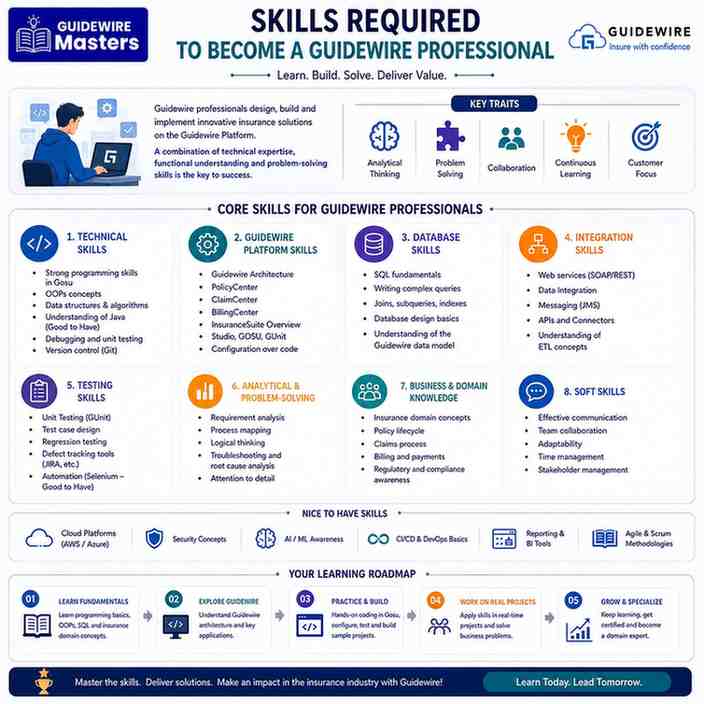
Step-by-Step Guide on How to Become a Guidewire Professional
Here is a practical, ordered roadmap that takes you from complete beginner to job-ready. This is the core of how to become a Guidewire Professional.
Step 1: Learn Insurance Fundamentals
Start with the business. Understand what P&C insurance is, the difference between policies, premiums, claims, and billing, and how underwriting works. In India, the sector is regulated by the IRDAI, so understanding the regulatory backdrop helps too. This context makes everything else click.
Step 2: Understand Guidewire Basics
Get familiar with the Guidewire platform at a high level: what InsuranceSuite is, how PolicyCenter, ClaimCenter, and BillingCenter relate, and how the data model is structured.
Step 3: Learn Guidewire PolicyCenter
Since PolicyCenter is the most in-demand application, learn its screens, product model, and policy lifecycle. Practice configuring product definitions, underwriting rules, and workflows.
Step 4: Learn Guidewire ClaimCenter
Move on to claims. Understand the first notice of loss, claim setup, reserves, and settlement processes, and how to configure claim workflows.
Step 5: Learn Guidewire BillingCenter
Round out your core knowledge with billing: invoicing, payment plans, delinquency handling, and disbursements.
Step 6: Master Gosu Programming
Gosu is the heart of Guidewire development. Learn its syntax, object-oriented concepts, enhancements, and how to write business rules and validation logic. A Java background makes this faster.
Step 7: Learn Integrations and APIs
Study how Guidewire connects to outside systems using REST APIs, SOAP web services, messaging, and plugins. Integration skills are some of the most valued in the market.
Step 8: Gain Hands-On Project Experience
Theory alone will not get you hired. Work on real-time Guidewire projects that mirror enterprise implementations: build a product in PolicyCenter, configure a claim workflow, or build a sample integration. Practical experience is what employers actually test for.
Step 9: Learn Guidewire Cloud Concepts
Because the platform is now cloud-first, learn the Guidewire Cloud Platform, along with Docker, Kubernetes, CI/CD, and DevOps basics. Cloud skills increasingly determine who gets hired.
Step 10: Earn Guidewire Certifications
Certifications validate your skills to employers. Aim for the Guidewire Certified Associate credential and then specialist or cloud certifications in your chosen application.
Step 11: Apply for Guidewire Jobs
With skills, projects, and certifications in hand, build a strong resume, highlight your hands-on work, and apply to the many companies hiring Guidewire talent in India and abroad.
Guidewire Career Paths
A Guidewire career path offers clear, well-defined progression. Here is a typical roadmap from entry level to expert.
Career Level | Role | Skills Required |
Beginner | Guidewire Trainee | Insurance and Guidewire fundamentals |
Junior | Guidewire Developer | Configuration + Gosu |
Intermediate | Senior Developer | Integrations and advanced configuration |
Advanced | Technical Lead | Solution architecture and team leadership |
Expert | Guidewire Architect | Cloud and enterprise design |
Each level builds on the last, and the jump in both responsibility and salary is significant once you cross into senior and architect roles.
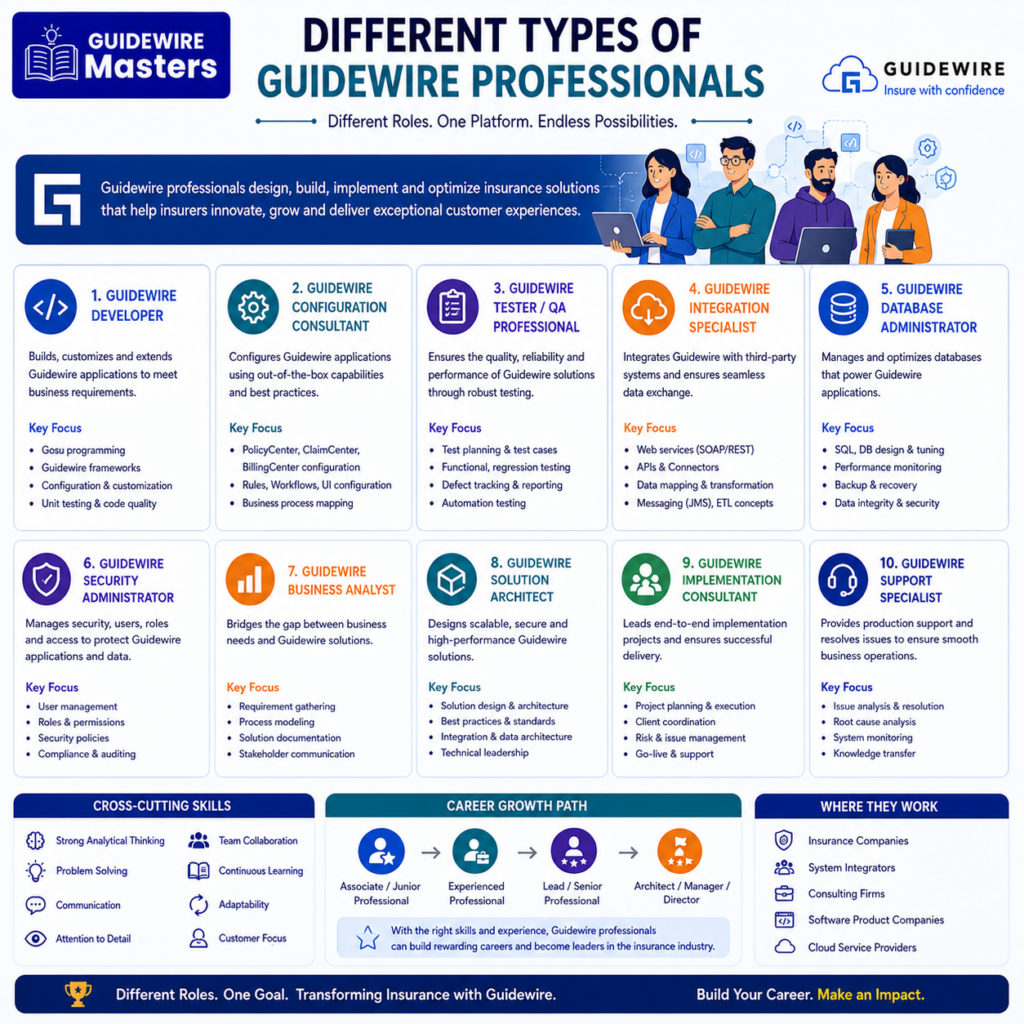
Different Types of Guidewire Professionals
The Guidewire ecosystem supports a wide variety of specializations. Here are the most common ones.
- Guidewire Developer — builds and configures applications and writes Gosu logic.
- Guidewire Configuration Developer — focuses specifically on configuring screens, rules, products, and workflows within the core applications.
- Guidewire Integration Developer — specializes in connecting Guidewire to other systems via APIs, messaging, and plugins.
- Guidewire Business Analyst — bridges business and technical teams by translating insurance requirements into clear specifications.
- Guidewire QA Engineer — tests applications, writes automated test suites, and ensures quality before release.
- Guidewire Technical Lead — guides the development team, makes design decisions, and owns technical delivery.
- Guidewire Architect — designs the overall solution, including data models, integrations, and cloud architecture.
- Guidewire Cloud Engineer — handles deployment, DevOps, CI/CD, and cloud migration on the Guidewire Cloud Platform.
- Guidewire Consultant — advises insurers on best practices and leads implementations, often with direct client interaction.
You do not have to pick one forever. Many professionals start as developers and branch into integration, architecture, or cloud roles as they gain experience.

Guidewire Developer vs Guidewire Integration Developer vs Guidewire Architect
These three roles are often confused. Here is a clear comparison.
Aspect | Guidewire Developer | Integration Developer | Guidewire Architect |
Responsibilities | Configures applications, writes Gosu logic and business rules | Builds and maintains connections between Guidewire and external systems | Designs the overall solution, data model, and integration strategy |
Skills | Gosu, configuration, core application knowledge | REST, SOAP, JSON, XML, messaging, plugins | Enterprise architecture, cloud design, deep platform expertise |
Tools | Guidewire Studio, Gosu, configuration tools | API tools, messaging systems, integration frameworks | Architecture and modeling tools, cloud and DevOps platforms |
Salary (India) | Mid range | Higher than core developer due to niche demand | Highest in the ecosystem |
Career Growth | Foundation role; grows into senior developer | Grows into integration lead or architect | Senior-most technical track; can lead to enterprise architect |
In short: developers build inside Guidewire, integration developers connect it to the outside world, and architects design how everything fits together.
Guidewire Certifications for Career Growth
Certifications are a powerful way to prove your skills and stand out, especially when you are new.
Guidewire Certified Associate. This foundational credential validates your core knowledge of a Guidewire application. It is the most common starting certification and is widely recognized by employers.
Guidewire Specialist Certifications. These go deeper into specific applications like PolicyCenter, ClaimCenter, or BillingCenter, and into specializations such as configuration or integration.
Cloud Certifications. As the platform moves to the cloud, certifications focused on the Guidewire Cloud Platform are becoming increasingly important and differentiate you in a competitive market.
Benefits of Certification
- Validates your skills to recruiters who may not know you.
- Improves employability and helps you clear screening rounds.
- Often leads to higher starting offers.
- Demonstrates commitment to the Guidewire career path.
For freshers especially, a certification plus a few hands-on projects can be the difference between getting shortlisted and getting ignored.
Guidewire Cloud Careers and Future Opportunities
The single biggest shift in the Guidewire world is the move to the cloud, and it is reshaping which skills matter most.
The Guidewire Cloud Platform delivers InsuranceSuite as a managed cloud service, and insurers are migrating to it at an accelerating rate. This shift has made several technologies essential for modern Guidewire professionals:
- Kubernetes— orchestrates containerized applications at scale in the cloud.
- Docker — packages applications into portable containers for consistent deployment.
- CI/CD — continuous integration and continuous delivery pipelines that automate building, testing, and releasing software.
- DevOps — the culture and practices that combine development and operations for faster, more reliable releases.
- Microservices — an architecture style where applications are built as small, independent, loosely coupled services.
- Cloud Migration Projects — the large initiatives where insurers move from on-premise Guidewire to the cloud.
Why are cloud skills becoming mandatory? Because the platform’s future is cloud-native, and almost every new and upgrade project now involves cloud deployment. A Guidewire professional who understands both the core applications and the cloud delivery model is far more valuable than one who knows only configuration. If you are starting today, building cloud skills early gives you a real edge. Insurers also increasingly extend the platform through the Guidewire Marketplace, where ready-made apps and integrations speed up cloud deployment.
Guidewire Jobs in India
India is one of the most important hubs for Guidewire delivery in the world, which is great news for anyone starting this career path.
Current demand is strong and steady. Major IT services firms run large Guidewire practices from India to serve insurers across North America, the UK, Europe, and Australia.
Hiring trends favor candidates who combine technical skills (Gosu, configuration, integrations) with insurance domain knowledge and, increasingly, cloud expertise.
Remote opportunities have expanded significantly, allowing Indian professionals to work on global projects without relocating.
Global projects are the norm rather than the exception. Even based in India, you will likely work on implementations for international insurers.
Future hiring outlook is positive. With Guidewire’s cloud transition driving a wave of migration and upgrade projects, demand for trained professionals is expected to remain high for years.
Top Companies Hiring Guidewire Professionals
A wide range of leading companies hire Guidewire talent in India. They hire because they run large Guidewire implementation and support practices for insurance clients, and they constantly need developers, integration specialists, analysts, testers, and architects.
- Accenture — runs one of the largest global Guidewire practices.
- Cognizant — a major Guidewire implementation partner for insurers.
- Capgemini — delivers large-scale Guidewire transformation projects.
- Infosys — supports insurance clients with Guidewire modernization.
- Wipro — provides Guidewire implementation and managed services.
- TCS — runs extensive insurance technology delivery including Guidewire.
- Deloitte — offers Guidewire consulting and implementation services.
- EY — advises and implements for insurance clients on Guidewire.
- PwC — supports insurance transformation programs involving Guidewire.
- LTIMindtree — a recognized Guidewire delivery partner.
- HCLTech — provides Guidewire engineering and support services.
- Tech Mahindra — delivers Guidewire projects for global insurers.
These firms hire at every level, from freshers entering through training programs to experienced architects leading enterprise transformations.
Guidewire Professional Salary in India
One of the biggest attractions of this career is the strong pay, driven by limited talent supply and high demand. The table below shows typical ranges in India. Actual figures vary by company, city, certifications, and specialization, with product companies and niche integration or architecture roles paying at the higher end.
Experience Level | Average Salary (Per Year) |
Fresher (0–2 Years) | ₹4–7 LPA |
Junior (2–4 Years) | ₹8–12 LPA |
Mid-Level (4–6 Years) | ₹12–18 LPA |
Senior (6–10 Years) | ₹18–28 LPA |
Architect (10+ Years) | ₹28–45 LPA and above |
For a city-wise and role-by-role view, see this detailed breakdown of Guidewire salaries in India.
A clear pattern stands out: salaries jump sharply after about five years, once you have real implementation experience with production go-lives, integrations, and migrations. Certifications and cloud skills push you toward the upper end of every band.
Guidewire Training and Learning Resources
The fastest way to break into this field is structured, practical training combined with real project work. Structured Guidewire Training in Hyderabad that pairs instructor-led learning with real-time projects and certification prep is one of the most reliable ways to become job-ready. Here are the learning options that matter.
Online Training offers flexibility to learn at your own pace, which suits working professionals.
Instructor-Led Training provides structure, guidance, and the ability to ask questions in real time, which is especially helpful for beginners.
Real-Time Projects are essential. Working on realistic scenarios builds the hands-on skills employers actually test for.
Practice Environments let you experiment with configuration, Gosu, and integrations safely, reinforcing what you learn.
Certification Preparation helps you target the specific knowledge needed to pass Guidewire exams.
Community Learning through forums, study groups, and peer discussion keeps you motivated and helps solve problems faster.
The single biggest accelerator is practical project experience. Reading about PolicyCenter is one thing; configuring a product, building a workflow, and fixing a broken integration is what turns knowledge into job-ready skill, and it is what gets you hired and promoted faster.
Challenges Faced by New Guidewire Professionals
It is worth being honest about the hurdles, because knowing them helps you overcome them.
Learning curve. Guidewire is a large platform with many moving parts. Solution: learn in stages following the roadmap above, one application at a time.
Insurance domain understanding. Many newcomers know coding but not insurance. Solution: invest early in insurance fundamentals so configurations actually make business sense.
Integrations. Connecting Guidewire to other systems can be complex. Solution: start with simple REST integrations and build up gradually.
Cloud concepts. Docker, Kubernetes, and CI/CD can feel intimidating. Solution: learn cloud basics in parallel rather than treating them as an afterthought.
Certification preparation. Exams require focused study. Solution: use structured certification prep and practice in real environments rather than memorizing.
The common thread in every solution is the same: hands-on practice beats passive reading every time.
Why Guidewire is One of the Best IT Careers in India
Stepping back, here is why Guidewire deserves a place at the top of your shortlist.
- High salary potential thanks to niche, in-demand skills.
- Niche technology that fewer people know, which protects your value.
- Global opportunities across North America, Europe, the UK, and Australia.
- Limited talent pool, meaning demand consistently outpaces supply.
- Strong demand from insurance companies that depend on Guidewire to run their core operations.
- Future-proof technology rooted in an industry that is not going anywhere.
Few IT specializations combine high pay, strong demand, and long-term stability the way Guidewire does.
Future Scope of Guidewire Careers
The outlook for Guidewire careers is bright, and several trends are shaping the next decade.
- Guidewire Cloud adoption continues to accelerate, creating a steady stream of migration and upgrade projects.
- AI integration is becoming a core differentiator, with machine-learning tools embedded in claims and pricing workflows.
- Analytics is growing as insurers use data to price risk and improve decisions.
- API-first architecture is making integrations central to every implementation.
- Event-driven architecture lets insurance systems react to events in real time, improving responsiveness.
- Microservices are enabling more flexible, scalable Guidewire deployments.
- Digital transformation in insurance is far from finished, ensuring continued investment for years to come.
Professionals who keep building cloud, integration, and AI-adjacent skills will be the most sought after as these trends mature.
Key Guidewire Terms and Technologies Explained
A quick reference to the key terms and technologies every Guidewire professional should know:
- Guidewire PolicyCenter — the policy administration system for quoting, underwriting, and managing policies.
- Guidewire ClaimCenter — the claims management system for handling losses from first notice to settlement.
- Guidewire BillingCenter — the billing engine for invoicing, payment plans, and collections.
- ContactManager — the shared system that keeps contact data consistent across all applications.
- Guidewire Cloud Platform — the cloud-native delivery of InsuranceSuite as a managed service.
- Gosu — Guidewire’s own Java-like programming language used for business logic and rules.
- REST APIs — modern, lightweight web services for connecting systems.
- SOAP APIs — an older, XML-based web-service standard still common in insurance.
- JSON — a lightweight data format used in REST and cloud integrations.
- XML — a structured data format used widely in Guidewire configuration and exchange.
- Kafka— a distributed event-streaming platform used for real-time data and event-driven integrations.
- Docker — packages applications into portable containers.
- Kubernetes — orchestrates and scales containerized applications in the cloud.
- CI/CD — automated pipelines for building, testing, and releasing software continuously.
- DevOps — practices that unite development and operations for faster, more reliable delivery.
- Microservices — an architecture of small, independent, loosely coupled services.
- Event-Driven Architecture — a design where systems react to events in real time.
Conclusion
Learning how to become a Guidewire Professional is one of the most rewarding career moves you can make in today’s insurance technology landscape. The demand is real, the salaries are strong, the opportunities are global, and the technology is future-proof. Whether you are a fresher looking for a high-growth entry point or an experienced IT professional wanting to specialize in a niche, Guidewire offers a clear path to a stable, well-paid, and respected career.
The roadmap is straightforward: build your insurance fundamentals, master the core Guidewire applications and Gosu, develop integration and cloud skills, gain real hands-on project experience, and earn industry-recognized certifications. Each step makes you more valuable and moves you closer to the role you want.
The best time to start is now, while demand still far outpaces the supply of trained professionals. Begin your Guidewire Training in Hyderabad, work on real-time projects to turn knowledge into practical skill, earn your certifications, and step confidently into a thriving career in the insurance technology industry. Your future as a Guidewire Professional starts with the first step.
Frequently Asked Questions (FAQ)
- How to become a Guidewire Professional?
A.Start by learning insurance fundamentals, then study the Guidewire platform (PolicyCenter, ClaimCenter, BillingCenter), master Gosu programming, learn integrations and cloud concepts, gain hands-on project experience, earn certifications, and apply for Guidewire jobs.
- What skills are required for Guidewire jobs?
A.You need technical skills (Gosu, Java, SQL, XML, REST and SOAP APIs, configuration, integrations, cloud), functional insurance knowledge (policy, claims, billing, underwriting), and soft skills like problem solving and communication.
- Is Guidewire a good career in India?
A.Yes. Guidewire is a niche, high-demand skill with limited talent supply, strong salaries, global project exposure, and long-term stability, making it one of the best IT career paths in India.
- What is the salary of a Guidewire Professional?
A.In India, freshers typically earn ₹4–7 LPA, mid-level professionals ₹12–18 LPA, seniors ₹18–28 LPA, and architects ₹28–45 LPA and above, depending on skills, certifications, and company.
- Which companies hire Guidewire professionals?
A.Top employers include Accenture, Cognizant, Capgemini, Infosys, Wipro, TCS, Deloitte, EY, PwC, LTIMindtree, HCLTech, and Tech Mahindra, among many insurers and consulting firms.
- How long does it take to learn Guidewire?
A.With focused, structured training and hands-on practice, most learners become job-ready in roughly three to six months, though mastering integrations and cloud skills continues on the job.
- Is Guidewire difficult to learn?
A.It has a learning curve because it is a large platform, but with a step-by-step approach, insurance domain study, and practical projects, it is very learnable, especially with a programming background.
- What is Guidewire Cloud?
A.Guidewire Cloud is the cloud-native delivery of Guidewire’s InsuranceSuite, offering insurers a managed, scalable, regularly updated platform instead of running software on their own servers.
- Do I need Java to learn Guidewire?
A.Java is not strictly mandatory, but it helps a lot. Guidewire is built on Java and its Gosu language is Java-like, so a Java foundation makes learning faster and easier.
- What certifications are available for Guidewire professionals?
A.Guidewire offers the Certified Associate credential, specialist certifications for applications like PolicyCenter, ClaimCenter, and BillingCenter, and cloud-focused certifications that are increasingly valued.

Mrs.Jyosna
GuidewireMasters | 25+ articles published
Guidewire experts passionate about helping learners build successful careers in the insurance IT industry. Through in-depth guides, real-time training, certification support, and industry-focused resources, Guidewire Masters simplifies Guidewire technologies and provides practical knowledge to help students and professionals grow their careers confidently.
Share