Guidewire Cloud vs On-Premise
Guidewire Cloud is InsuranceSuite delivered as Guidewire SaaS, run by Guidewire on AWS, updated on a fixed release cadence and paid for by subscription. Guidewire On-Premise — now officially called self-managed — is the same applications on infrastructure the insurer owns and upgrades itself. Cloud leads on release speed and resilience; self-managed leads on infrastructure control. For careers in 2026, cloud is where the work is.

- Sanjay
- July 31, 2026
- 9:19 am
Table of Contents
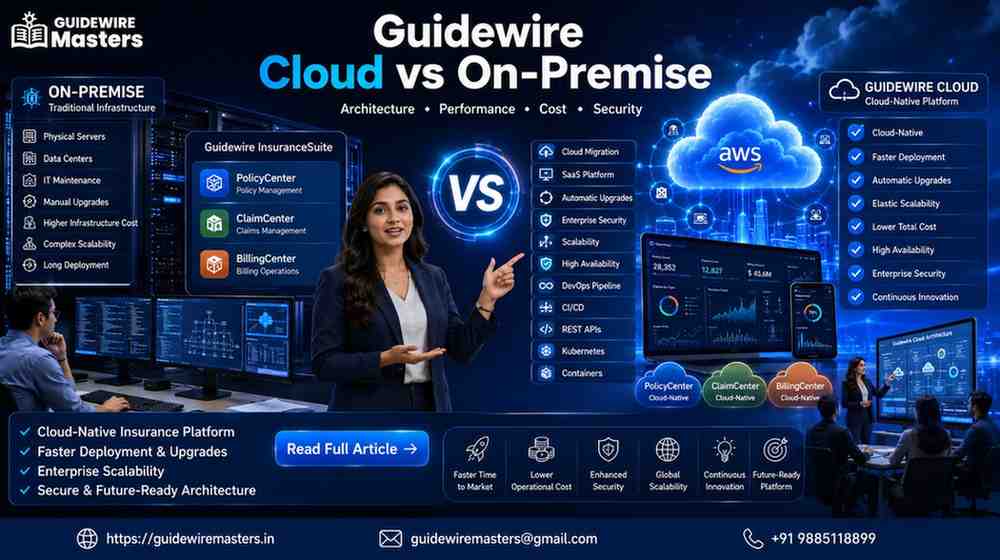
Guidewire Cloud vs On-Premise question stopped being theoretical some time ago. It now shows up in board papers, five-year IT budgets, RFP scoring sheets and — increasingly — in job descriptions. Insurers who spent a decade building deeply customised self-managed InsuranceSuite estates are deciding whether to keep maintaining them or move to the Guidewire Cloud Platform. Engineers who learned Gosu and PolicyCenter configuration are deciding which skills to invest in next.
The reason the debate has sharpened is simple: Guidewire itself has reorganised its entire business around the cloud, and the numbers are public. In fiscal year 2025, the company reported annual recurring revenue of $1,041 million, up 19% year on year, with cloud ARR growing 36% and reaching roughly three-quarters of total ARR. By the third quarter of fiscal 2026 — the quarter ending 30 April 2026 — ARR had reached $1,147 million, again up 19%, with subscription and support revenue growing 35% and eleven new cloud wins closed in a single quarter. Meanwhile, legacy on-premise licence revenue has been in decline for several years.
That is the industry context. But context is not a decision. This guide compares the two deployment models on architecture, cost, security, integration, migration and career impact — and it separates what is verifiable from what is opinion, because a lot of what circulates online about Guidewire deployment is neither.
What Is Guidewire Cloud?
Guidewire Cloud is the delivery of Guidewire InsuranceSuite — PolicyCenter, ClaimCenter, BillingCenter and ContactManager — as a software-as-a-service offering that Guidewire operates on behalf of the insurer. The underlying platform is the Guidewire Cloud Platform, usually shortened to GWCP.
Three things define it, and it is worth being precise about each because they are frequently described loosely:
- It is built on Amazon Web Services. Guidewire’s own engineering team describes GWCP as a standardised cloud infrastructure and services layer built on top of AWS and optimised specifically for InsuranceSuite. This matters for the common misconception addressed below.
- It uses containers and Kubernetes underneath. Guidewire built an internal platform-as-a-service layer, referred to in its engineering writing as ATMOS, which uses AWS, Kubernetes and Docker to automate the deployment, management and scaling of containerised core applications and cloud services.
- It is hybrid-tenancy, not pure multi-tenant. Each insurer gets its own single-tenant InsuranceSuite instance, running alongside genuinely multi-tenant cloud-native services. That design is deliberate: insurers keep configuration freedom while Guidewire still gets the operational economics of shared services.
A correction worth making: a lot of Guidewire content — including training material and job adverts — lists “AWS and Azure” as the Guidewire Cloud infrastructure. That is not accurate. GWCP runs on AWS. Microsoft technology does appear in the platform, but as a service integration rather than the hosting layer: the Niseko release (August 2025) added native support for Microsoft Azure Maps for geocoding and catastrophe heat maps, ahead of Bing Maps Enterprise retiring in June 2028. Knowing the difference between “the platform runs on AWS” and “one mapping service uses Azure Maps” is exactly the sort of detail that separates a credible candidate from a rehearsed one in interviews.
This is what the market means by Guidewire SaaS: the insurer subscribes to an operated service rather than licensing software to run itself. The subscription model changes the rhythm of the relationship. Instead of buying a perpetual licence and upgrading every few years, the insurer subscribes and receives releases on Guidewire’s schedule. Recent Guidewire cloud releases have arrived roughly three times a year: Mammoth in April 2025, Niseko in August 2025, Olos in December 2025, and Palisades in April 2026, which introduced embedded AI assistants for PolicyCenter, ClaimCenter and InsuranceNow along with cloud-native PricingCenter integration. If you want depth on the platform itself, our complete Guidewire Cloud guide covers components and architecture in detail.
What Is Guidewire On-Premise (Self-Managed)?
Guidewire On-Premise refers to InsuranceSuite installed and operated on infrastructure the insurer controls — traditionally its own data centre, though many “on-premise” estates have actually been running in the customer’s own AWS or Azure account for years. Guidewire’s official term for this is self-managed, and the distinction is not cosmetic. “On-premise” describes where the hardware sits; “self-managed” describes who carries the operational responsibility, which is the part that actually drives cost and risk.
This model has not been discontinued. Guidewire’s developer documentation still states that InsuranceSuite is available as a cloud service via Guidewire Cloud or as a self-managed application, and its regulatory filings continue to describe InsuranceSuite as deployable on-premise or in the cloud. Large insurers with heavily customised v9 and v10 estates are still running production workloads this way.
In a self-managed deployment the insurer owns:
- Infrastructure — application servers, web servers, load balancers, storage and the Oracle or SQL Server databases behind each application. In older estates it is common to find a separate database per application: one for PolicyCenter, one for BillingCenter, one for ClaimCenter, one for ContactManager. How those entities relate is foundational under either deployment model — our guide to the Guidewire data model covers it in depth.
- Upgrades — every version jump is a project, with regression testing, customisation re-merges and a go-live window.
- Availability and disaster recovery — failover design, backup schedules, DR testing and the standby capacity that sits idle most of the year.
- Security operations — patching, identity integration, penetration testing, certificate management and audit evidence.
The strategic pressure on this model is version drift. Because Guidewire ships roughly three cloud releases a year, an insurer that stays on a fixed self-managed version falls several releases behind for every year it waits, and the eventual catch-up gets harder and more expensive. Guidewire’s own partner programme reflects this: there is a “Technical Upgrades” specialisation, which the company notes was formerly called the Self-Managed Upgrades specialisation.
Guidewire Cloud vs On-Premise Full Comparison
| Dimension | Guidewire Cloud | Guidewire On-Premise (Self-Managed) |
|---|---|---|
| Deployment | SaaS on the Guidewire Cloud Platform, provisioned and operated by Guidewire | Installed by the insurer or its systems integrator on infrastructure the insurer controls |
| Infrastructure | AWS, abstracted behind GWCP; containerised workloads orchestrated by Kubernetes | Customer-owned data centre or customer-owned cloud account; VM or bare-metal application, web and database tiers |
| Maintenance | Guidewire handles patching, scaling and platform operations | Insurer’s IT and infrastructure teams, often with SI support |
| Upgrades | Regular releases (roughly three a year) delivered as updates, with automated update tooling and preview environments | Discrete upgrade projects, typically every few years, with full regression cycles |
| Release cadence | Named cloud releases — Mammoth, Niseko, Olos, Palisades — with certification tracks aligned to each | Version-based, e.g. InsuranceSuite 9 or 10; new capability arrives only when the insurer upgrades |
| Security | Shared responsibility: Guidewire secures the platform, the insurer secures its configuration, data handling and access | End-to-end responsibility sits with the insurer’s security function |
| Scalability | Elastic; capacity scales with workload rather than with procurement cycles | Fixed to provisioned capacity; scaling means buying and installing more |
| Availability | Multi-availability-zone design with blue/green deployment to reduce planned downtime | Depends entirely on the insurer’s own HA and DR architecture and investment |
| Disaster recovery | Built into the platform, including automated database backup and restore APIs | Designed, funded, staffed and tested by the insurer |
| Cost shape | Operating expenditure: subscription plus usage-based platform consumption | Capital expenditure plus ongoing licence, support, hardware refresh and staffing |
| Customisation | Extensive configuration, but within cloud standards; heavy platform-level customisation is constrained by design | Very few technical limits; the trade-off is upgrade cost later |
| DevOps and CI/CD | Managed CI/CD pipeline with quality gates, build promotion APIs, and self-service deployment tooling | Insurer-built pipelines using its own tooling, typically Jenkins, GitLab or similar |
| Monitoring | Built-in observability including application performance monitoring and real user monitoring via Datadog, plus log streaming to external tools | Whatever the insurer builds and licenses independently |
| Compliance | Platform-level certifications and controls provided by Guidewire; software bill of materials and supply-chain visibility included in recent releases | Insurer proves every control itself, which suits organisations with strict data-residency mandates |
| Best suited to | Insurers prioritising speed to market, predictable operations and access to new AI and analytics capability | Insurers with binding data-residency or sovereignty constraints, or very deep existing customisation and a long amortisation horizon |
How the Two Architectures Actually Differ
The comparison table gives the shape. The architecture explains why the differences are structural rather than cosmetic.
Guidewire Cloud architecture
GWCP is best understood as three layers. At the bottom is AWS infrastructure. In the middle is Guidewire’s own platform layer, which packages InsuranceSuite applications as containers and uses Kubernetes to schedule, scale and update them. On top sit the core applications alongside multi-tenant cloud services — Integration Gateway, Autopilot Workflow Service, Advanced Product Designer, Guidewire Data Platform, the Jutro Digital Platform and, since the Olos and Palisades releases, PricingCenter and the ProNavigator AI assistants.
Several operational capabilities follow directly from that design. Blue/green deployment lets Guidewire promote new code with minimal planned downtime. Multi-availability-zone deployment provides resilience without the insurer building a second data centre. Elastic scaling absorbs quote surges and catastrophe-event claim spikes. Application performance monitoring and real user monitoring, delivered through Datadog, give teams distributed traces they can correlate with specific transactions. Recent releases have added self-service outbound network connection management, SCIM-based user deprovisioning and thread dumps for diagnosing stalled nodes.
Guidewire on-premise architecture
A self-managed estate looks like a conventional enterprise Java deployment. Load balancers front a tier of application servers running each xCenter. Web servers handle static content and routing. Each application typically has its own relational database. Batch processing runs on dedicated nodes. If you are mapping this against real project work, our walkthrough of Guidewire PolicyCenter implementation covers how these tiers are sized and sequenced. Integration happens through plugins, messaging destinations and web services rather than through externalised cloud microservices. Disaster recovery means a second site, replication and a tested failover runbook.
None of this is bad engineering. It is well-understood, and for organisations with mature infrastructure practice it is entirely workable. The problem is opportunity cost: every hour spent keeping the platform running is an hour not spent on product, pricing or customer experience — and the capability gap against the cloud releases widens each year.
Integration in Cloud vs On-Premise
Integration is where the two models diverge most sharply for developers, and it is the area where a self-managed background transfers least directly.
In a self-managed estate, integration is largely code that lives inside the application: Gosu plugins, messaging destinations, batch file exchanges, SOAP web services and increasingly REST endpoints, with an enterprise service bus or middleware layer handling routing and transformation.
In Guidewire Cloud the integration surface is externalised and API-first. Guidewire componentised the InsuranceSuite core behind a layer of RESTful Cloud APIs, then added services around it:
- InsuranceSuite Cloud APIs — versioned REST endpoints, with JSON payloads, covering policy, billing and claims operations. Successive releases have steadily expanded coverage; the Olos release, for example, added Billing APIs supporting real-time payment plan comparison and policy-change billing.
- Integration Gateway — a cloud microservice that externalises integration logic so connector apps bridging Guidewire APIs and third-party APIs can be built and deployed independently of the core. We break the wider service layer down in our overview of Guidewire Cloud services.
- App Events — an event-driven pattern that publishes business events to downstream systems without custom code, which is how most modern Guidewire event-driven architecture is delivered.
- Cloud Data Access — streams InsuranceSuite data changes into the insurer’s own AWS S3 buckets for analytics and downstream integration.
Kafka does feature in the Guidewire ecosystem — the Guidewire Data Platform is built on an AWS big-data stack that includes Kafka, EMR, Spark, Flink and Kubernetes — but insurers generally consume its output rather than operate the broker. If you are preparing for integration interviews, the honest framing is this: Kafka concepts and event-driven design matter; claiming you administer Kafka clusters inside GWCP does not reflect how the platform is delivered.
Security, Compliance and Performance Compared
Security in Guidewire Cloud follows a shared-responsibility model, and candidates who can articulate the split tend to interview well. Guidewire secures the platform: infrastructure hardening, network isolation, encryption, patching, supply-chain integrity and the certifications insurers audit against. Recent platform work has added a software bill of materials with provenance generation, SCIM Connect for automated user deprovisioning between an insurer’s identity provider and GWCP, and role-based user access management.
The insurer remains responsible for what it configures: role design, data masking in non-production environments, who can approve deployments, and how personally identifiable information is handled inside its own reports and datasets. The Olos release added PII role-based access controls in Data Studio specifically for that reason.
In a self-managed deployment, the insurer owns every layer of that stack. For a large carrier with a mature security function and specific sovereignty obligations, that control has genuine value. For a mid-size insurer, it usually means carrying costs that a specialist platform provider absorbs more efficiently.
On performance, the meaningful difference is elasticity rather than raw speed. A well-tuned self-managed PolicyCenter can be very fast. What it cannot easily do is absorb a tenfold quote spike from an aggregator campaign, or a catastrophe-driven claims surge, without pre-provisioned headroom sitting idle for the rest of the year. Cloud shifts that from a capacity-planning problem to a scaling behaviour — which is why Guidewire has moved capabilities such as high-volume quoting onto PolicyCenter’s cloud-native job engine.

Cost Comparison What Actually Changes
Cost is where most published Guidewire comparisons become unreliable, because vendor-independent five-year total-cost-of-ownership figures for Guidewire deployments are not public. Guidewire does not publish list pricing, and any article quoting precise rupee or dollar totals for a “typical” implementation is inventing them. What can be described accurately is the structure of the cost, and that is what actually drives the business case.
| Cost component | Guidewire Cloud | On-Premise (Self-Managed) |
|---|---|---|
| Initial outlay | Lower capital cost; spend concentrated in implementation and data migration services | Higher upfront: perpetual or term licences plus hardware and environment build |
| Infrastructure | Included in subscription, with usage-based charges for additional platform resources | Purchased, hosted, refreshed and depreciated by the insurer |
| Licensing model | Subscription, contracted over multi-year terms | Licence plus annual maintenance and support |
| Maintenance and operations | Absorbed by Guidewire at the platform layer | Internal staffing plus vendor support contracts |
| Upgrades | Included; delivered as regular updates rather than funded projects | Discrete capital projects, historically the single largest recurring line item |
| Hardware refresh | Not applicable | Recurring three-to-five-year cycle including DR capacity |
| Specialist IT staff | Reduced infrastructure and DBA need; increased need for cloud, API and DevOps skills | Sustained requirement for infrastructure, DBA, middleware and release engineering |
| Cost predictability | Largely predictable, with consumption-linked variability | Predictable in steady state, punctuated by large upgrade and refresh spikes |
One directional signal is public. Guidewire’s subscription and support gross margin reached 74% in the third quarter of fiscal 2026, up from 71% a year earlier — evidence that operating the platform at scale is getting cheaper per customer. That efficiency is precisely what a single insurer cannot replicate by running its own estate.
Advantages and Trade-offs of Each Model
Where Guidewire Cloud is stronger
- Faster access to new capability. AI assistants, PricingCenter, Claims Intel and Autopilot workflow templates arrive with the release rather than with the next upgrade project.
- Upgrades become updates. Automated update tooling and preview environments turn a multi-month programme into a routine operation.
- Resilience by default. Multi-AZ architecture and blue/green deployment come with the platform.
- Operational focus shifts to the business. Engineering effort moves from keeping servers healthy to shipping products.
- Analytics and AI readiness. Cloud Data Access, Data Studio and the Guidewire Data Platform are cloud-native services; replicating them on-premise is a large independent build.
Where Cloud creates friction
- Standardisation constrains deep customisation. Cloud standards exist to make automated updates safe; estates built on heavy platform-level customisation must be reworked.
- Subscription is a permanent operating cost rather than a depreciating asset, which changes how CFOs model it.
- Less direct infrastructure control, which some regulated environments and internal security policies resist.
- Migration is real work. It is not a lift and shift, and the effort scales with how much customisation has accumulated.
Where self-managed still holds up
- Complete infrastructure and data-residency control, which matters where regulation or internal policy is explicit about where data physically sits.
- Very deep customisation where a carrier’s differentiation genuinely lives in bespoke platform behaviour.
- Established integrations with legacy estates that would be expensive to re-platform simultaneously.
Where self-managed costs the insurer
- Version drift — falling several releases behind for every year of delay, compounding the eventual upgrade cost.
- Hardware and DR spend that scales with peak rather than average demand.
- Dependency on scarce specialist skills as the market’s centre of gravity moves to cloud.
- Slower innovation cycles, because new capability requires an upgrade before it can be evaluated.
Guidewire Cloud Migration How Insurers Actually Move
Guidewire Cloud migration is a re-platforming programme, not a hosting change. GWCP is architected as an upgrade path from self-managed InsuranceSuite rather than a separate product, which preserves prior investment, but the work is substantial.
A representative migration follows five phases:
- Assessment. Inventory the current version, every customisation, every integration and the data model. This phase determines the size of everything that follows. Customisations that duplicate capability now available as standard cloud services are candidates for removal rather than migration.
- Planning and design. Decide the target release, sequence the applications, and choose between a big-bang cutover and a phased approach by line of business or application. Many insurers migrate ClaimCenter first and PolicyCenter later, which makes fluency in the Guidewire claims management process unusually valuable on early-phase migration teams.
- Data migration. Move policy, billing and claims history, then reconcile. Legacy estates commonly have separate databases per application, which have to be mapped into the cloud data model and validated line by line.
- Testing. Functional, integration, performance and user acceptance testing, using data-masking tooling to populate non-production environments safely.
- Deployment and stabilisation. Cutover through the managed CI/CD pipeline, then run a hypercare period before adopting the automated update cadence.
A documented example is worth knowing, because it is verifiable rather than anecdotal. As reported by Guidewire, Definity migrated InsuranceSuite to Guidewire Cloud and achieved ten times faster deployment, 75% less downtime, broker quote response times 34% faster and a 4% increase in quotes. Migrations of this kind commonly start from older self-managed estates running InsuranceSuite version 8 or 9, where each application sits on its own Oracle or SQL Server database and every version jump has been a funded project.
The most common migration mistakes are consistent across programmes: treating migration as an infrastructure task rather than an application programme; carrying every legacy customisation across instead of retiring what the platform now does natively; underestimating data reconciliation; and starting without enough cloud-certified people on the team. Guidewire’s partner programme recognises this last point explicitly through Migration Acceleration and regional Cloud Ready specialisations.
Which Deployment Model Should an Insurer Choose?
The honest answer depends on four variables: regulatory constraints on data residency, the depth of existing customisation, the maturity of the in-house infrastructure function, and how much of the strategy depends on speed to market.
- Small insurers and MGAs. Cloud, in almost every case. Running a self-managed InsuranceSuite estate requires an infrastructure, DBA and release-engineering capability that is disproportionate at this scale. For very small operations, Guidewire InsuranceNow — a cloud-based all-in-one system aimed at insurers with limited IT resources — may fit better than InsuranceSuite.
- Mid-size insurers. Cloud is usually the stronger case, but sequencing matters. Migrating one application first, proving the operating model, then bringing the rest across reduces programme risk considerably.
- Large and enterprise insurers. The decision is genuinely nuanced. The direction of travel is clearly toward cloud — Guidewire’s Q3 FY2026 results included eleven cloud wins, and the quarter before that closed fifteen InsuranceSuite Cloud deals plus two InsuranceNow deals, spanning new customers, migrations and expansions. But carriers with binding sovereignty requirements, or with a decade of differentiating customisation, will reasonably run a hybrid estate for a transitional period.
What This Means for Your Career
For engineers, the strategic question is simpler than it is for insurers, because the market has already answered it.
Guidewire is now predominantly a cloud company by revenue, and its implementation ecosystem has followed. The systems integrators that staff most Guidewire work in India are organised around Guidewire’s PartnerConnect tiers. As listed by Guidewire, Capgemini, EY and PwC hold Global Strategic status; Accenture, Cognizant and Deloitte are Global Premier; the Advantage tier includes TCS, Tech Mahindra/Tenzing, Hexaware, GFT, Sollers, Zensar and alchemy (part of NTT DATA); and the Select tier includes IBM, Infosys, LTIMindtree, Wipro, ValueMomentum, CGI, Endava, Softtek and Sopra Steria, among others. Several of these hold specific Guidewire Cloud, Cloud Ready or Migration Acceleration specialisations — which is a useful signal when you are choosing where to apply.
The roles that have grown fastest are those that sit at the boundary between insurance domain knowledge and cloud engineering: cloud integration developers working with Cloud APIs, Integration Gateway and App Events; DevOps engineers who understand the managed CI/CD pipeline and quality gates; migration consultants who can assess and rationalise legacy customisation; and technical architects who can design within cloud standards rather than around them.
A note on cost of entry that is often missed: Guidewire removed the fees for all of its e-learning education courses for PartnerConnect partners, announced in October 2025. If you join a partner organisation, formal Guidewire e-learning is more accessible than it was. Note that Guidewire certification remains gated through partners and employers rather than open to individual public enrolment — our guide to Guidewire certifications explains how the designation structure and eligibility actually work.
This is also why self-study alone tends to stall. InsuranceSuite is not publicly downloadable, so hands-on environment access — not tutorials — is the real bottleneck for most people entering the field. Structured Guidewire training in Hyderabador online instruction exists mainly to solve that access problem and to compress the domain learning that would otherwise take a first project to acquire.
Guidewire Cloud Salary in India: What the Data Shows
Salary content in this space is unusually unreliable, so here is what public aggregators actually report, with sources and dates attached. No aggregator currently publishes a separate salary band for “Guidewire Cloud” as distinct from Guidewire generally, and any article that presents one is estimating.
| Source and date | What it reports | Sample |
|---|---|---|
| Glassdoor India, “Guidewire Developer”, July 2026 | Average ₹7.96 lakh per year; typical range ₹4.43 lakh (25th percentile) to ₹14.98 lakh (75th percentile); 90th percentile ₹20.96 lakh | 53 self-reported salaries |
| Glassdoor Bangalore, “Guidewire Developer”, May 2026 | Average ₹10.00 lakh per year; 90th percentile ₹21.70 lakh | 12 self-reported salaries |
| 6figr India, professionals listing Guidewire as a skill, 2026 | Average ₹20.4 lakh; median ₹18.0 lakh; top 10% above ₹30.4 lakh | 43 profiles |
Why the gap between roughly ₹8 lakh and roughly ₹20 lakh? Because the datasets are measuring different populations. “Guidewire Developer” as a job title skews toward earlier-career roles at service organisations. “Professionals with Guidewire as a skill” captures senior consultants and architects whose titles do not contain the word Guidewire at all. Both are true; neither alone describes the market.
What can be said with confidence is directional: compensation rises steeply with insurance domain depth and integration or architecture responsibility, and cloud-specific capability is the current differentiator because demand for it is being created by migration programmes that are still in progress. For a fuller breakdown by role and experience, see our analysis of Guidewire salaries in India.
How to Learn Guidewire Cloud in 2026
The sequence below reflects how cloud project teams are actually staffed. Skipping the insurance fundamentals is the most common and most costly mistake — Guidewire work is domain engineering, and candidates who cannot explain an endorsement, a reserve or an agency-bill statement struggle regardless of technical skill.
| Level | What to build | Why it matters |
|---|---|---|
| Foundation | P&C insurance fundamentals: policy lifecycle, underwriting, endorsements, claims handling, billing and commissions. Core Java and SQL. | Every configuration decision is a business decision first. Without domain fluency you cannot interpret requirements. |
| Core | InsuranceSuite configuration: PolicyCenter, ClaimCenter, BillingCenter, ContactManager. Gosu, the data model, PCF, rules and workflow. Start with policy administration and management. | This is still the backbone. Cloud changes how it is deployed, not what the applications do. |
| Integration | InsuranceSuite Cloud APIs, REST and JSON, Integration Gateway, App Events, event-driven patterns, Cloud Data Access. Legacy SOAP and messaging for context. | Integration is the highest-demand specialisation on cloud programmes and the least transferable from self-managed experience. |
| Cloud and DevOps | Containers and Kubernetes concepts, AWS fundamentals, CI/CD principles, quality gates, observability and monitoring. Advanced Product Designer. | You do not administer GWCP, but you work inside it daily. Understanding the platform’s mechanics is what separates a configurator from an engineer. |
| Advanced | Migration assessment, customisation rationalisation, performance tuning, release-aligned certification, and the newer services — PricingCenter, Autopilot, Jutro, Data Studio. | Migration and modernisation work is where senior roles and premium rates currently sit. |
Practical advice on certification: Guidewire’s certifications are aligned to named releases, so a Palisades or Olos credential signals current knowledge in a way that an older release credential does not. Maintaining certification through new-features courses is part of the job, not an optional extra. If you are planning a structured path, our Guidewire course curriculum maps these stages to specific modules, and the configuration versus customisation guide covers a distinction that becomes critical once you are working to cloud standards.
Conclusion
The Guidewire Cloud vs On-Premise comparison is no longer a debate between two equally weighted options. It is a question of timing and constraint. Guidewire Cloud is where the platform’s investment, its release cadence and its new AI and analytics capability now live, and the company’s own financial trajectory makes that unambiguous. Self-managed InsuranceSuite remains a supported, legitimate choice — but it is increasingly a choice made for specific reasons, on a defined horizon, rather than a default.
For insurers, the practical work is assessment: understand what your customisation actually costs you, what your regulatory constraints genuinely require rather than what they are assumed to require, and how much of your strategy depends on shipping faster than you currently can. For engineers, the path is clearer still — build real insurance domain depth, master InsuranceSuite configuration, then specialise in the cloud integration and DevOps skills that migration programmes are actively short of.
Frequently Asked Questions
1.What is Guidewire Cloud?
Guidewire Cloud is InsuranceSuite delivered as software-as-a-service on the Guidewire Cloud Platform, which Guidewire builds on AWS using containers orchestrated by Kubernetes. Guidewire operates the platform, delivers regular named releases, and charges by subscription.
2.What is Guidewire On-Premise?
Guidewire On-Premise, officially called self-managed, is InsuranceSuite installed on infrastructure the insurer controls. The insurer is responsible for servers, databases, upgrades, disaster recovery and security operations.
3.What is the main difference between Guidewire Cloud and On-Premise?
Responsibility. In the cloud model Guidewire operates the platform and ships updates on a fixed cadence; in the self-managed model the insurer owns infrastructure, upgrades and availability. That single difference drives most of the downstream differences in cost shape, release speed and required skills.
4.Is Guidewire Cloud better than On-Premise?
For most insurers, yes — particularly on release speed, resilience and operational overhead. It is not universally better. Organisations with binding data-residency requirements or very deep platform-level customisation have legitimate reasons to remain self-managed, at least during a transition.
5.Why are insurance companies migrating to Guidewire Cloud?
Three recurring reasons: faster access to new capability including AI and analytics services; the elimination of multi-year upgrade projects in favour of automated updates; and avoiding the version drift that accumulates when a self-managed estate falls several releases behind each year.
6.Is Guidewire Cloud a good career choice?
The demand signal is strong. Guidewire’s cloud ARR has been growing far faster than total ARR, migration programmes are still running across the industry, and specialist partners are staffing them. As with any specialisation, the return depends on combining it with genuine insurance domain knowledge.
7.Which companies implement Guidewire Cloud?
Guidewire’s published consulting partner tiers list Capgemini, EY and PwC as Global Strategic; Accenture, Cognizant and Deloitte as Global Premier; TCS, Tech Mahindra/Tenzing, Hexaware, GFT, Sollers, Zensar and alchemy (NTT DATA) at Advantage level; and IBM, Infosys, LTIMindtree, Wipro, ValueMomentum and others at Select level.
8.What skills are required for Guidewire Cloud roles?
InsuranceSuite configuration and Gosu remain the base. On top of that: REST APIs and JSON, Integration Gateway and App Events, event-driven integration patterns, container and Kubernetes concepts, AWS fundamentals, CI/CD practice, SQL, and P&C insurance domain knowledge.
9.What does Guidewire Cloud migration involve?
Assessment of the existing estate, target-release and sequencing decisions, data migration and reconciliation, layered testing, then cutover and stabilisation. It is a re-platforming programme rather than a lift and shift, because cloud standards constrain the customisation patterns many legacy estates rely on.
10.Should I learn Guidewire Cloud or On-Premise?
Learn InsuranceSuite fundamentals first — they apply to both — then specialise in cloud. Self-managed knowledge is still useful, particularly for migration work, but new projects and new hiring are overwhelmingly cloud-oriented.

Mrs.Jyosna
GuidewireMasters | 25+ articles published
Guidewire experts passionate about helping learners build successful careers in the insurance IT industry. Through in-depth guides, real-time training, certification support, and industry-focused resources, Guidewire Masters simplifies Guidewire technologies and provides practical knowledge to help students and professionals grow their careers confidently.
Share